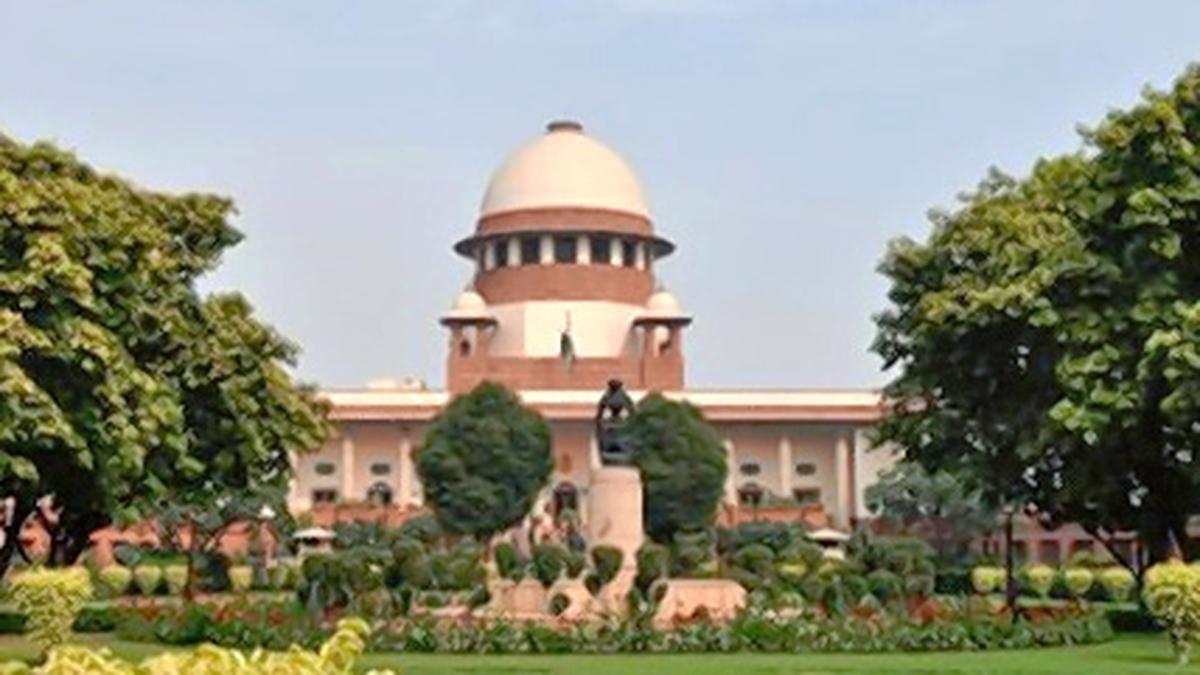
The Supreme Court judgement on creamy layer exclusion for OBC quota | Explained Premium
The Hindu
The Hindu explainer on the Supreme Court's recent judgment clarifies creamy layer criteria for OBC candidates, impacting reservation eligibility for many.
The story so far:
The Supreme Court of India this week delivered a judgement that has held that parental income alone cannot be the sole determinant of whether an OBC candidate falls under the “creamy layer” category. The judgement came on March 11 in a case that was meant to clear decades-long confusion about how to apply the crucial income/wealth test prescribed in regulations, specifically for OBC candidates whose parents are officials of Central or State PSUs or in private employment, where the equivalence of their posts had not yet been established with government posts.
Following the 1992 Supreme Court judgement in the Indra Sawhney case, which paved the way for the implementation of reservations for the Other Backwards Classes (OBC), the concept of a creamy layer among OBCs was introduced. The idea was to exclude certain categories of OBC candidates whose families had accumulated certain social and economic privileges over the years, known as the creamy layer.
In order to define the exclusion criteria and clarify which categories of OBC candidates would fall under the creamy layer, the Department of Personnel and Training had prepared a guiding charter, in the form of an Office Memorandum issued in September, 1993.
This OM prescribed specific categories of OBC candidates who would not be entitled to the OBC quota. This included children of people holding Constitutional positions like the Offices of President, Vice-President, judges of High Courts and the Supreme Court; children of Class I and Class II officers directly recruited into either the Central or State government; and children of officers in the Armed Forces or Paramilitary Forces above a particular rank.
Apart from these categories of OBC candidates being excluded as the creamy layer, the DoPT had prescribed a crucial income/wealth test for people who were in the salaried professional class or engaged in trade industry, people holding plantations, vacant land and/or buildings in urban areas, and people whose parents were holding posts in Central or State PSUs where the equivalence of these posts with government service posts has not yet been established.


Adithya Prakash’s Kannada mid-length thriller ‘Watch Out Krishna’ mixes sharp humor with subtle yet relatable social commentary

Four people died and several were injured when a bus overturned on NH-44 in Nizamabad district, prompting an investigation.

A short story by Lesley D. Biswas on family dynamics

The Hindu explainer on the Supreme Court's recent judgment clarifies creamy layer criteria for OBC candidates, impacting reservation eligibility for many.

Oil prices remain above $100 as Khamenei threatens the Strait of Hormuz, causing global stock markets to decline.

Hyderabad proposes 29 new bridges on the Musi river, aiming for a total of 46 by 2050 under the master plan.

Explore how electrifying industrial heat can drive India's thermal independence amidst geopolitical challenges and energy supply crises.

An India-made app uses AI to transform impaired speech into clear communication, enhancing accessibility for individuals with speech disorders.

India seeks to establish itself as a global education hub amidst shifting international dynamics and increasing foreign campus presence.

CII-Rajasthan's annual session emphasizes youth entrepreneurship to drive economic growth and achieve a $4.30 trillion economy by 2047.

Bengaluru Metro faces cost overruns and delays, raising concerns about efficiency and commuter accessibility amidst ongoing traffic congestion.

Actor Sonam Kapoor on her post-motherhood style, jewellery as personal embrace, and bringing up boys who value women

BJP leaders meet PM Modi ahead of Kolkata rally, discussing candidates and strategies for upcoming West Bengal Assembly polls.