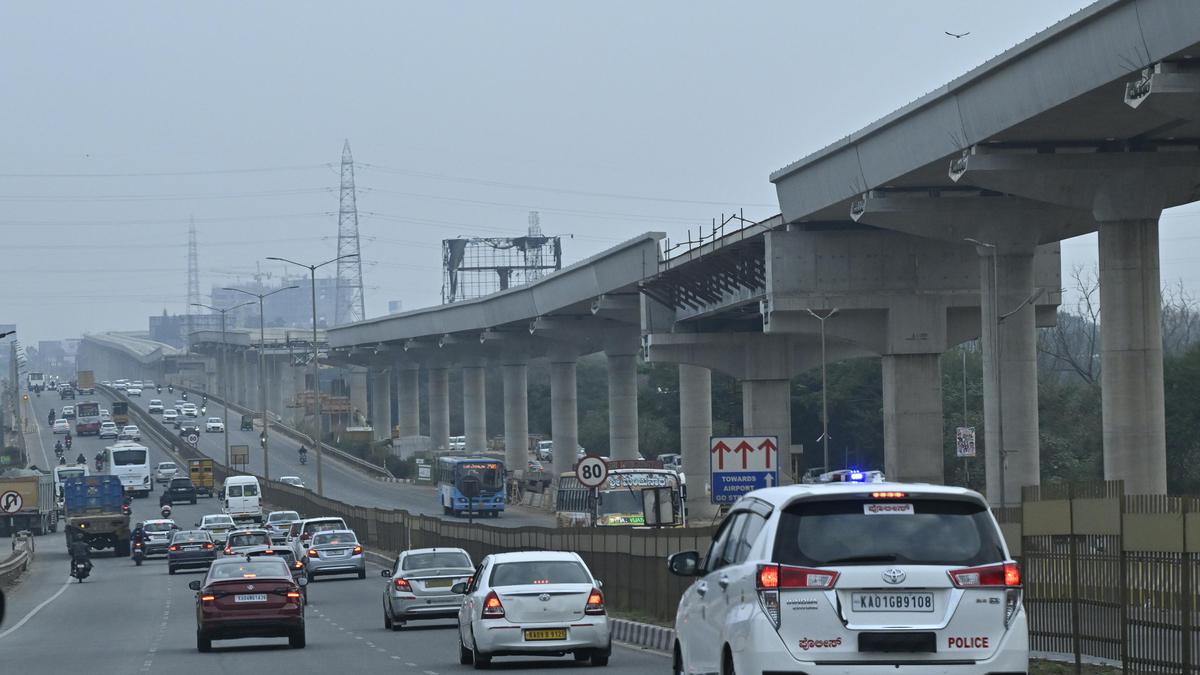
Cost escalation and delays haunt Bengaluru Metro project
The Hindu
Bengaluru Metro faces cost overruns and delays, raising concerns about efficiency and commuter accessibility amidst ongoing traffic congestion.
“Every day my journey to work feels like a puzzle with too many pieces,” says Hastha Shetty, a resident of Hulimavu in south Bengaluru. “I take an auto from my home to Jayadeva station, board the Yellow Line, change to the Green Line at R.V. Road, change again at Majestic to the Purple Line, get down at Cubbon Park, and then take another auto to reach my office on Lavelle Road. It takes me nearly one hour and 50 minutes. If I book a cab from home, I can reach in about 50 minutes. I keep wondering, what exactly is the purpose of the metro if it cannot make daily commute easier?”
For Shetty, who has been working in a private firm in Bengaluru’s central business district for the past four years, the metro was supposed to be the solution to the city’s notorious traffic congestion. Instead, her commute has become an example of the challenges many residents face while navigating the city’s expanding but still incomplete metro network.
“I have been waiting for the Pink Line for almost five years. When it becomes operational, I can travel directly towards M.G. Road from Bannerghatta Road without all these changes. But the project keeps getting delayed. The metro has not yet expanded across the city in a way that truly serves commuters. Then how has it already become the most expensive metro system in the country?” she questions.
Workers inside the under construction Namma metro underground M. G. Road metro station tunnel on the Pink Line. Metro construction in a dense city like Bengaluru involves complex engineering challenges, especially during underground tunnelling and land acquisition, says an official. | Photo Credit: K. MURALI KUMAR
Her questions reflect a wider debate around the Namma Metro which has become both one of India’s largest and costliest urban rail projects, even as concerns persist over ridership, connectivity and planning priorities.
Today, Bengaluru has India’s second-largest metro network, with around 96 km of operational track and 83 stations. As much as ₹67,460 crore has already been spent on building this infrastructure across multiple phases.


Akhilesh Yadav meets Swami Avimukteshwaranand, pledges to combat fake saints and criticizes the BJP over the LPG crisis.

Leclerc hopes the Year of the Horse brings Ferrari luck at the Chinese Grand Prix after last year's disqualification.

Explore the gentle narrative of Allen Levi's Theo of Golden, a tale of connection, reflection, and spiritual themes.

Vilathikulam All Women Police Station Inspector V.P. Praveena was suspended on charges of failing to take timely action in registering a “missing case” filed by parents of a 17-year-old class XII girl, who was later found murdered in a forest area, near a village at Kulathur in Thoothukudi district

Maharashtra forms teams to combat LPG cylinder hoarding amid shortages affecting businesses and residents in multiple districts.

Kochi Corporation considers replacing KSINC for ro-ro services amid rising criticism and financial losses from councillors across party lines.

Tekion partners with Mind and Matter to educate 10,000 students on mental health in Karnataka and Tamil Nadu through inclusive programs.

Chennai's groundwater table remains shallow, with levels between 2 to 9.6 feet, encouraging the use of open wells.

Bihar firms surrendering sand mining leases face a ban on participating in future tenders due to significant revenue losses.

Bengaluru Home Minister G. Parameshwara announces Dy. SP seniority revision and upcoming promotions following a committee report.

Madurai court alters custodial death case to murder, invoking SC/ST Act amid ongoing protests for justice.

Explore India's ambition to become a global education hub and the challenges it faces in internationalising higher education.

Fuel outlets in Puducherry see long queues as fears of supply disruption rise, despite assurances of normal supply from officials.