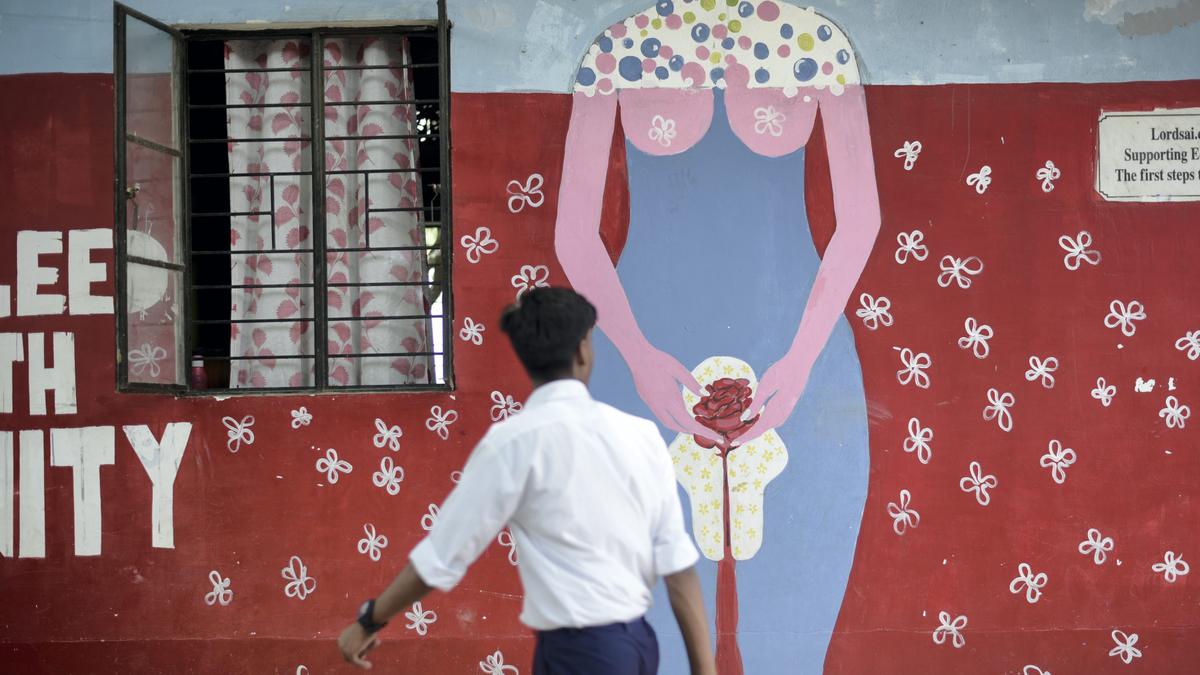
The politics of periods: why India cannot afford to ignore menstrual health Premium
The Hindu
Transforming menstrual health in India requires systemic policy change, robust infrastructure, and political will for dignity, equity, and empowerment.
Imagine Priya, a bright 13-year-old in a village nestled miles from the nearest town. Her first period arrives not with understanding or support, but with hushed warnings and a palpable sense of shame, passed down through generations. Given a rough, inadequate piece of cloth, she’s quietly instructed to avoid the kitchen, refrain from touching the shared water pot, and crucially, stay home from school during those five days each month. The school’s basic toilet lacks water, privacy, and disposal facilities, making managing her period there an unthinkable ordeal. Fearful of leaks, whispers, and breaking unspoken rules, Priya isolates herself, her education disrupted, her potential dimmed with each recurring cycle.
Priya’s story, sadly, is not unique. It echoes the lived experience of countless girls and women across India, particularly in rural areas. As Menstrual Hygiene Day observed on May 28 prompts reflection, it is crucial to acknowledge that while awareness around menstruation is growing in India, it remains largely absent from the mainstream political agenda and public discourse. Menstrual health is often relegated as a “women’s issue,” shrouded in a pervasive culture of silence and coloured by patriarchal notions that limit knowledge and open conversation. This silence translates into a chronic health and social challenge, where many lack adequate information, access to necessary products, and face stigma, impacting their well-being and participation in society. While efforts to distribute sanitary pads are visible and sometimes feature in government schemes, we must recognise that true access demands a fundamental shift beyond products towards systemic policy change and robust infrastructure.
Focusing solely on period product distribution dangerously simplifies this complex reality. While commendable progress has been made, with National Family Health Survey-5 data indicating that around 78% of individuals who menstruate in India may use commercial period products, this statistic masks a deeper infrastructural gap. The figure plummets dramatically when we consider those who have access to both products and essential water, sanitation and hygiene (WASH) facilities – clean, private toilets with water and soap. Shockingly, only about 27.7% benefit from this comprehensive access. This stark difference highlights a critical point: distributing pads achieves little genuine progress towards dignified menstrual health if individuals lack the basic infrastructure needed to manage their periods hygienically and privately, particularly in schools and public spaces. This lack of essential WASH facilities remains a persistent barrier, often highlighted during crises that disrupt normal life.
The current political landscape shows some commendable, albeit limited, steps. Various Central and State government schemes, such as those under the National Health Mission or State-specific initiatives like ‘Asmita Yojana‘ in Maharashtra or ‘Swechcha‘ in Andhra Pradesh, aim to provide subsidised or free sanitary napkins, primarily targeting adolescent girls in schools. While valuable, these initiatives often face limitations. Their focus frequently excludes women outside the school system, those in the workforce, or other vulnerable groups. Additionally, distribution can be hampered by external factors like school closures, and the focus often remains narrowly on disposable pads, without adequately expanding knowledge on diverse, sustainable options like menstrual cups (despite pioneering efforts in States like Kerala and Karnataka) or addressing the crucial need for safe disposal and the environmental impact of sanitary pads. This lack of strong, consistent political backing, often stemming from the underrepresentation of women and their allies in decision-making spaces, means menstrual health remains a relatively neglected public health concern, susceptible to policy oversights like initial exclusion from essential items lists during emergencies or debates around taxation.
Therefore, building a truly stigma-free, inclusive menstrual health infrastructure demands its integration into the core of our national policy framework. This means legislating for mandatory, comprehensive, and scientifically accurate menstrual health education within school curricula for all students, treating it not just as biology but as essential for equity and empowerment. It requires prioritising and funding national standards for MHM-friendly WASH facilities in all public institutions – viewing this as critical infrastructure essential for public health, education continuity, and enabling of full economic participation. Health policy must be reformed to train healthcare providers for sensitive care, integrate MHM screening and treatment into primary healthcare, ensure insurance coverage, and use inclusive language for all who menstruate. Fair fiscal policies, such as eliminating discriminatory taxes on essential menstrual products and exploring targeted subsidies, are needed to ensure affordability is not a barrier to dignity. Policy levers should encourage supportive workplace environments with adequate facilities and understanding for menstrual health needs, recognising its impact on labour force participation.
Crucially, these comprehensive interventions must be framed not as an expenditure, but as a strategic political and economic investment. Ensuring economic viability requires moving beyond siloed projects. Funding for MHM should be integrated into existing budgets for Health, Education, WASH, Gender Equality, and Rural/Urban Development, leveraging existing political and administrative structures. Smart fiscal tools like tax reform and targeted subsidies offer cost-effective ways to improve access. Supporting local social enterprises producing affordable, sustainable menstrual products can boost local economies, create jobs, and reduce import dependency, aligning with national development goals. Most importantly, policymakers must recognise and champion the significant return on investment: improved educational attainment, increased workforce participation, better public health outcomes, and accelerated gender equality far outweigh the costs. The economic and social cost of inaction – perpetuated by silence and policy neglect – actively undermines India’s broader development objectives.
This Menstrual Hygiene Day, the call must be for decisive political action. We need political leaders and parties to champion menstrual health not as a marginal issue, but as fundamental to human rights, public health, and national progress. It requires integrating MHM robustly into national development plans, legislative agendas, and resource allocation. While the efforts of NGOs and local champions are vital, sustainable change at scale hinges on political will. It is time to break the silence in our policy chambers and build an India where everyone can manage their menstruation with dignity, safety, and informed choice – unlocking the full potential of half our population.


TGSRTC plans to cut CO2 emissions by 1,200 tons daily through the adoption of electric buses, enhancing sustainable public transport.

Parliamentary panel urges a review of EPF pensions, highlighting ₹1,000 is insufficient amid rising living costs.

ECI reshuffles 19 senior police officers in West Bengal ahead of upcoming Assembly elections, ensuring transparent and fair polls.

Rajasthan’s employment offices report no government job placements in five years, with over 22 lakh registered job seekers.

In a post shared in his X account, the actor also wrote about his emotional attachment to the State

NIA charges six in Puducherry BJP leader Senthil Kumaran's murder case for attempting to sabotage trial by threatening witnesses.

Bollywood star Hrithik Roshan’s HRX Films has teamed up with Prime Video for ‘Mess’ after the thriller series ‘Storm’. The latest series is directed by Rajesh A Krishnan

Bengaluru NGO PfA Wildlife Hospital replenishes water sources in Turahalli forest to protect urban wildlife from dehydration and human-animal conflict.

Bengaluru NGO PfA Wildlife Hospital replenishes water sources in Turahalli forest to protect urban wildlife from dehydration and human-animal conflict.

Andhra Pradesh Upa Lokayukta orders ₹50.24 lakh payment of EPF and ESI dues to KGBV outsourcing staff in Srikakulam.

Former Puducherry Congress MLA V. Vizeaveny joins BJP

Bajaj Electricals acquires Morphy Richards brand rights in India and South Asia, enhancing innovation and market strategy.

CPI(M) insists on contesting more seats in the 2026 Tamil Nadu Assembly elections amid ongoing seat-sharing negotiations with DMK.