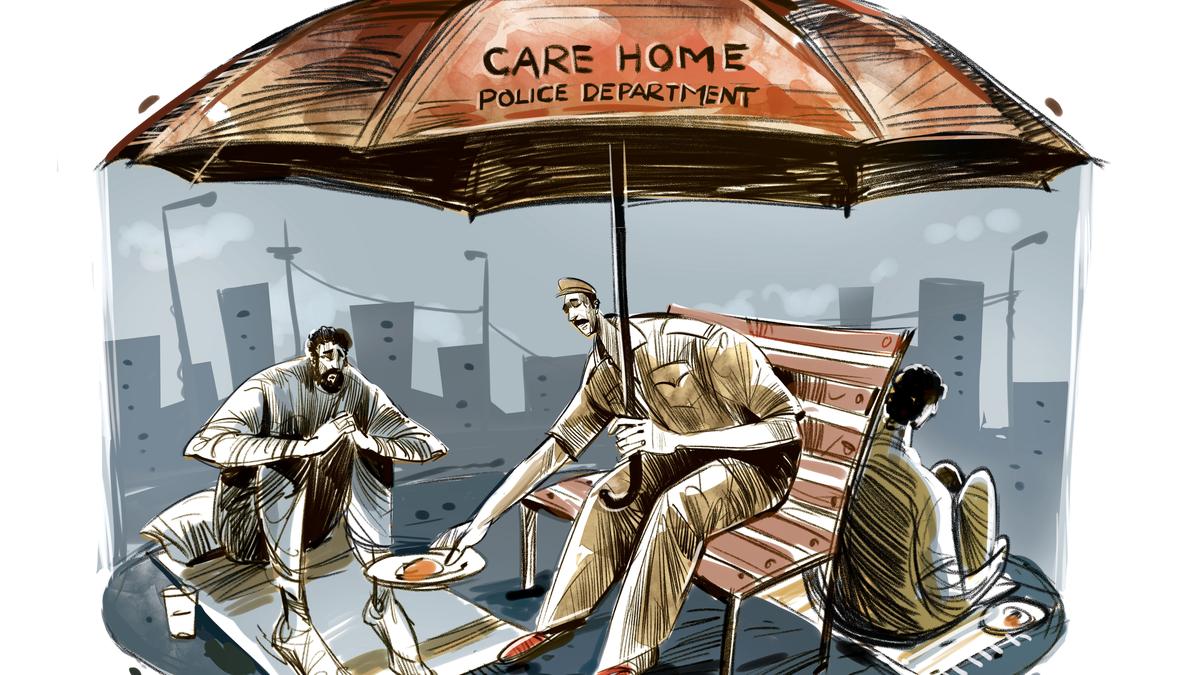
The first care home for beggars in Madras was established under police management Premium
The Hindu
Madras School of Social Work conducts survey on beggars, leading to establishment of special homes for rehabilitation.
In November 1953, the Madras School of Social Work, which was started only the previous year, conducted a survey of beggars in the State capital. As many as 400 volunteers were drawn from colleges, schools, and social service institutions in Madras to conduct the survey. The study revealed that there were nearly 7,500 beggars, of whom nearly 2,000 were juveniles. A large majority of them were able-bodied. These beggars were found in large numbers near railway stations, bus stops, hotels, markets, parks, temples, schools, hospitals, pavements, and choultries.
Citing this report, Inspector-General of Police J. Devasagayam had observed, “Any person interested in criminology will deplore the fact that there are nearly 2,000 children in the streets subjected to the degradation of begging. There is not the slightest doubt that large numbers of these young persons will become delinquents in the criminal sense.”
Back then, some of these children were dealt with by the police under the Children’s Act and committed to the rescue home maintained by the Government of Madras and to an orphanage at Royapuram maintained by the Corporation of Madras. A few others were rescued by the Young Men’s Christian Association (YMCA) and looked after in the Boy’s Town.
The adult beggars were dealt with under a 1901 provision of the City Police Act, which contemplated the provision of a work house for able-bodied beggars and a special home for diseased and infirm beggars. A Madras Corporation institution at Krishnampet was notified by the government as a special home, with a capacity to accommodate around 400 persons. The work house at Royapuram had a capacity of 200 persons.
In February 1954, C. Rajagopalachari, Chief Minister of Madras (as Tamil Nadu was called then), inaugurated the ‘Daya Sadan’, a special home for beggars, at a Goshala on Konnur High Road, Madras City, a private institution, managed by a committee recognised by the government. On March 14, 1954, Rajagopalachari inaugurated a care home and camp at Melpakkam.
The care home and camp was “a unique institution in that this is the first time that a Government Work House and Special Home has been set up under Police management,” the Inspector-General of Madras said on the occasion. This camp had started functioning from the beginning of March that year, with 83 beggars.
“A staff of 1 Deputy Superintendent of Police, 1 Sub-Inspector, 2 Head Constables and 12 Constables has been sanctioned, apart from the other usual menial staff... The strength of the beggars today is 229 men, 84 women and 20 children. The inmates are eligible for one set of 2 shirts and 2 dothies for each male, one set of 2 sarees and 2 blouses for each female and one mat, one pillow, one blanket, one aluminium plate and one tumbler for each. The inmates are given 2 square meals and kanji costing not more than 14 annas per head per day,” according to the speech of Devasagayam, published in the April 1954 edition of The Madras Police Journal. The inmates of the camp were given medical care too, with the Medical Officer of the Government Dispensary at Poonamalee visiting them daily.


Bengaluru's M. Chinnaswamy Stadium conducts readiness drill ahead of IPL 2026, ensuring upgrades and technical preparations are complete.

First-level randomisation of EVMs completed in Nagapattinam for upcoming elections, ensuring transparency and security.

A district-level committee in Krishnagiri has been formed to assess and verify seizure claims of goods and cash.

Minister Anam Ramanarayana Reddy pledges government support for local fishermen and farmers facing challenges in Andhra Pradesh.

MP M. Sribharat urges collective efforts to revive Visakhapatnam Steel Plant, highlighting key reforms for crucial recovery and growth.

141 candidates have filed nominations for Kozhikode's Assembly elections, with scrutiny on March 24 and campaigning intensifying.

BJP's Vijayendra accuses Congress of using money to influence Bagalkot bypolls, urging voters to reject their tactics.

First randomization of electronic voting machines completed in Tirunelveli and Tenkasi districts for upcoming Assembly elections.

RPF seizes 10.12 kg of unclaimed cannabis worth ₹5.06 lakh from a train in Mangaluru.

Kolar's groundwater levels rise to 50-100 ft due to the K.C. Valley project, ensuring clean water and improved health outcomes.

Three smugglers arrested in Sangareddy with 574 kg of ganja valued at ₹2.87 crore during a police operation.

Mysuru MP urges a 'flex-free Mysuru' by discouraging birthday banners, promoting responsible celebrations to preserve the city's heritage.

Farmers of Kalakudi demand payment for paddy bags procured at DPC