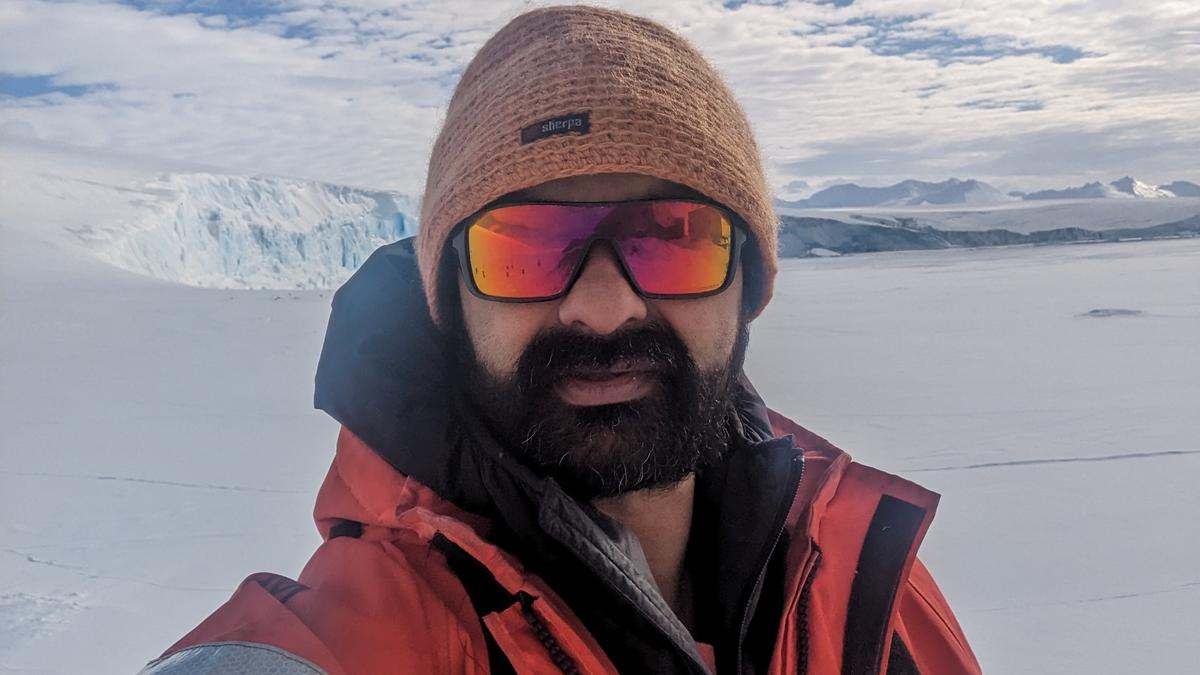
Studying sea ice amid penguins and the Southern Lights
The Hindu
Vishnu Nandan braved extreme weather and polar darkness in the Antarctic as part of a 25-member team of the British Antarctic Survey. He installed a U.S.-made instrument to measure the thickness of sea ice, which is prone to error when measured using satellite radars. This year recorded the worst sea ice ever and the lowest since 1986. Life in the poles can be rewarding but also stressful due to isolation and the cold. Vishnu is humbled and lucky to be able to do this as his profession, and is addicted to the darkness, silence, and isolation.
It is unlike any workspace in the world. Each day starts off with frigid, brutally record-low temperatures. In the Antarctic, everything depends on the weather.
“If the weather is good, we head out. Else, we stay in,” says polar researcher Vishnu Nandan, as he settles down reluctantly to the temperate climate of his hometown Thiruvananthapuram in Kerala, after a 40-hour flight from Antarctica. “It is not warm enough here,” he says. “Or maybe by now I have been so used to the cold that this isn’t warm enough,” he adds quickly, as an afterthought.
Vishnu has just returned from an eight-month odyssey in the Antarctic. He was one of the two scientists who were part of a 25-member team of the British Antarctic Survey, braving the extreme weather and the polar darkness at the Rothera Research Station on Adelaide Island, West Antarctica as part of a scientific survey. The research is part of a U.K.-based project called DEFIANT (Drivers and Effects of Fluctuations in sea Ice in the ANTarctic), which set up a ground-based radar system to take measurements of sea ice.
A research scientist at the University of Calgary and the University of Manitoba in Canada, Vishnu’s expertise lies in sea ice (frozen seawater that floats on the ocean surface). His work involves measuring the thickness of sea ice using the ground-based radar-based system and correcting the errors in the measurements of the same obtained from radar satellites. As part of the research, Vishnu, along with scientist Robbie Mallett, installed a U.S.-made instrument owned by the University of Manitoba on the sea ice to take the measurements.
“The thickness of the sea ice measured using satellite radars is prone to error. We cannot determine how thick the sea ice really is through this method because sea ice keeps drifting and it is not easy to keep track of its movement using satellites. Also, snow forms a layer over the ice. With the presence of snow, we could overestimate the thickness when measurements are taken using satellite radars. This is very crucial, because, we might be under the impression that the sea ice is thicker than it really is. This could impact the policies we come up with to tackle climate change,” says Vishnu.
The Antarctic can be challenging to conduct field measurements of sea ice, says Vishnu, explaining that the snow is very thick and deep. It floods the ice into the ocean and becomes slushy. “It is more salty, and is not homogeneous when compared to that in the Arctic. So there are combined errors from different sources,” he says. Of the eight months they spent in the Antarctic, he says the team could take readings on only 22 days. The rest of the days, there was no sea ice in the area where their ground-based radar system was mounted.
This year recorded the worst sea ice ever and the lowest since 1986, he says. The researchers found that the sea ice area is almost one million square kilometres less than the previous lowest which was in 1986, a real climate concern. “The maximum thickness of sea ice measured by us was 44 cm, which is low. It can ideally go up to 1.5 metres or more,” he says.


CERN's Large Hadron Collider discovers the Xi-cc-plus particle, enhancing understanding of quantum mechanics and baryon behavior.

Vibha Batra’s latest book, Spotless (Hachette India) is a novel in verse for young adults

In its first edition, the Madras Art Salon spotlights the works of journalist and artist Narayan Lakshman at The Botanical Club, a social space in the British Deputy High Commission, Chennai

Cholesterol enhances melanoma cell invasion by making nuclei squishier, revealing a potential treatment target in cancer progression.

The designers reinterpret the Swedish artist’s symbolic forms and colour energy through contemporary resortwear silhouettes

Discover the inspiring legacy of Bibha Chowdhuri, a pioneering woman in physics and a trailblazer in STEM history.

Discover the inspiring legacy of Bibha Chowdhuri, a pioneering woman in physics and a trailblazer in STEM history.

Ashdeen’s Spring 2026 collection features saris inspired by the designer’s Parsi gara archive

Red ochre burials, ritual markings and myths across cultures show that red repeatedly marks liminal thresholds such as puberty, sacrifice and death; anthropologists argue that the colour functions as a technology of collective ritual and value, binding communities through shared symbolic acts

India approves 23 institutions for quantum labs under the National Quantum Mission, aiming to advance quantum technology and research.

India approves 23 institutions for quantum labs under the National Quantum Mission, aiming to advance quantum technology and research.

The Gaza conflict exacerbates environmental damage, emitting millions of tonnes of CO2 and threatening climate stability in West Asia.

Chefs and cookery experts share smart kitchen hacks, hybrid cooking methods and appliance tips to help households reduce LPG use without compromising on food