Storms brewing in East, South China seas | Explained Premium
The Hindu
Expert analysis on escalating maritime tensions in East and South China Seas, highlighting regional responses and U.S. alliances.
The story so far:
In the last few years, maritime East Asia has become an arena for intensified power politics. The East China Sea borders China, Taiwan, Japan, and South Korea. China asserts that the Senkaku/ Diaoyu islands, located in the East China Sea and under Japanese control, belong to Beijing. There have been multiple crises over these islands in the past. The South China Sea lies between China, Taiwan and five Southeast Asian countries — Vietnam, Malaysia, Brunei, the Philippines, and Indonesia — and has emerged as one of the most important flashpoints in the Indo-Pacific. China has been aggressively pushing its claims in the South China Sea.
China views the East and South China Seas through the prism of sovereignty, territorial integrity, and national security. China’s Defence White paper, issued in 2019, declares, “South China Sea islands and Diaoyu Islands are inalienable parts of the Chinese territory.” In responding to the criticism regarding China’s activities, it asserts that “China exercises its national sovereignty to build infrastructure and deploy necessary defensive capabilities on the islands and reefs in the South China Sea, and to conduct patrols in the waters of Diaoyu Islands in the East China Sea.” What China perceives as its defensive actions are considered offensive and provocative by the regional countries surrounding the East and South China Seas.
The key maritime trade routes in East Asia pass through these two seas. Taiwan Strait is a critical maritime choke point. The region is home to undersea cables that are important for the global digital economy. As per the U.S. Energy Information Administration, in 2023, 10 billion barrels of petroleum and petroleum products and 6.7 trillion cubic feet of liquefied natural gas passed through the South China Sea. It is also home to vast reserves of untapped oil and natural gas.
China has been aggressively pushing its territorial claims in both seas in two ways: by building defence-related infrastructure such as ports, military installations, airstrips, and artificial islands and by pushing back against the claims of regional countries. In the East China Sea, China vehemently contested Japanese claims and, both countries found themselves embroiled in multiple crises, the most notable being the arrest of a Chinese captain of a fishing boat in 2010 and Japan’s nationalisation of the Senkaku islands in 2012. These crises saw both countries taking maximalist positions. China had imposed a ban on the export of rare earth minerals to Japan. In the last few years, there has been a slight easing of tensions over the issue regarding the Senkaku/Diaoyu islands. As per the Japan Coast Guard data, 2023 saw the highest level of activity by the Chinese Coast Guard in the contiguous zone of the Senkakus. Owing to China’s assertive foreign policy, its relationship with South Korea, Taiwan and Japan has deteriorated rapidly.
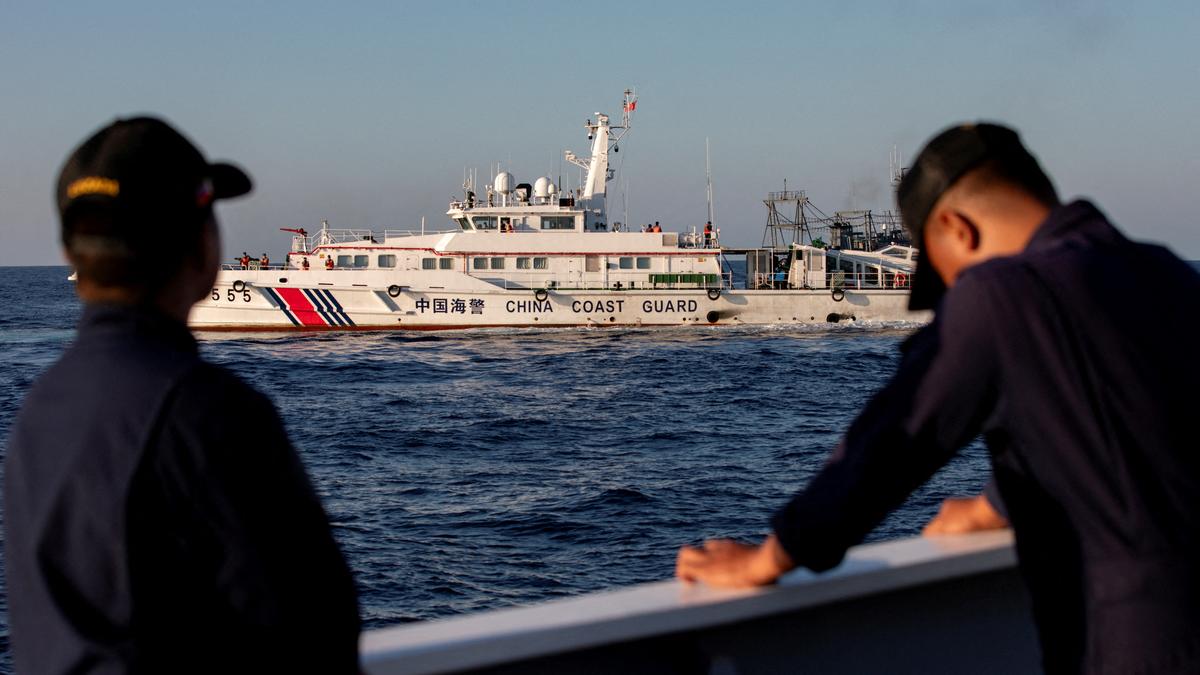
Meanwhile, the South China Sea has become a major theatre of Chinese belligerence. The power asymmetry between China and the South China Sea claimant countries is large and is growing continuously. China’s navy is also the largest naval force in the world by numbers. Therefore, the South China Sea is seeing the ever-growing projection of Chinese power. For asserting its claims, China has deployed a Coast Guard and maritime militia. The tactics include dangerous and aggressive manoeuvres at sea, harassing resupply missions, ramming vessels, collisions, and using water cannons and military-grade lasers, etc. These tactics are known as ‘grey zone’ operations, which fall short of war but are designed to alter the status quo.
China has been actively pushing its claims in the Exclusive Economic Zone (EEZ) of the Philippines. Since 2022, tensions between China and the Philippines have been rising due to a significant increase in the frequency of such incidents. In June-July 2024, multiple incidents of clashes occurred. The Second Thomas Shoal and Sabina Shoal have been the focus of China’s recent assertiveness. The Philippines’ resupply missions to the grounded ship, BRP Sierra Madre, have been repeatedly disrupted by China and have become a point of contention. China aims to drive a wedge between the U.S. and its treaty partners in East Asia. Chinese Coast Guard ships are considerably heavier and larger in terms of tonnage compared with Coast Guard vessels of other countries. For example, the Chinese vessel CCG 5901 (541 feet long and displaces 12,000 tons) is three times larger than the main ships of the U.S. Coast Guard. Hence, China’s frequent ramming of the Philippines’ vessels is dangerous and risky. There is a chance of miscalculation.


Denmark's recent election results leave Prime Minister Mette Frederiksen's future uncertain amid a fragmented parliamentary landscape.

An explosion at Valero's Port Arthur refinery caused a temporary shutdown but resulted in no reported injuries.

Anduril and Palantir Technologies are working together to develop software for U.S. President Donald Trump’s Golden Dome antimissile shield initiative, a source familiar with the matter said

A federal judge weighing the merits of the Pentagon’s designation of rising Silicon Valley star Anthropic as a security threat repeatedly questioned the government’s reasons for vilifying the company

When the conflict in West Asia, which began with the U.S. and Israel’s attack on Iran on February 28, escalated into a regional war, analysts said that the war would last as long as Iran had missiles or until the Gulf nations ran out of interceptors. However, with “emergency” military sales, piling monetary costs and a strained supply chain, is the U.S. becoming too constrained in its effort to keep the war going — both militarily and monetarily?

U.S.-Israel war on Iran LIVE: Follow The Hindu for updates on the West Asia conflict on March 25, 2026

Jair Bolsonaro to serve his sentence at home due to health issues, monitored by police, with a review in 90 days.

A New Mexico jury finds Meta liable for harming children's mental health, marking a significant shift in accountability for tech companies.

Modi and Dissanayake discuss energy cooperation, West Asia conflict, and global supply chain disruptions in a recent phone call.

Russia launches a massive drone and missile attack on Ukraine, signaling the potential beginning of a spring offensive.

U.S. official Elbridge Colby emphasizes India's vital role in the Indo-Pacific, highlighting mutual benefits despite existing differences.

Philippine President Marcos declares national energy emergency amid Middle East conflict, ensuring fuel and essential goods supply stability.

Mohammad Baqer Zolqadr appointed as Iran's new security chief, succeeding Ali Larijani after his assassination.