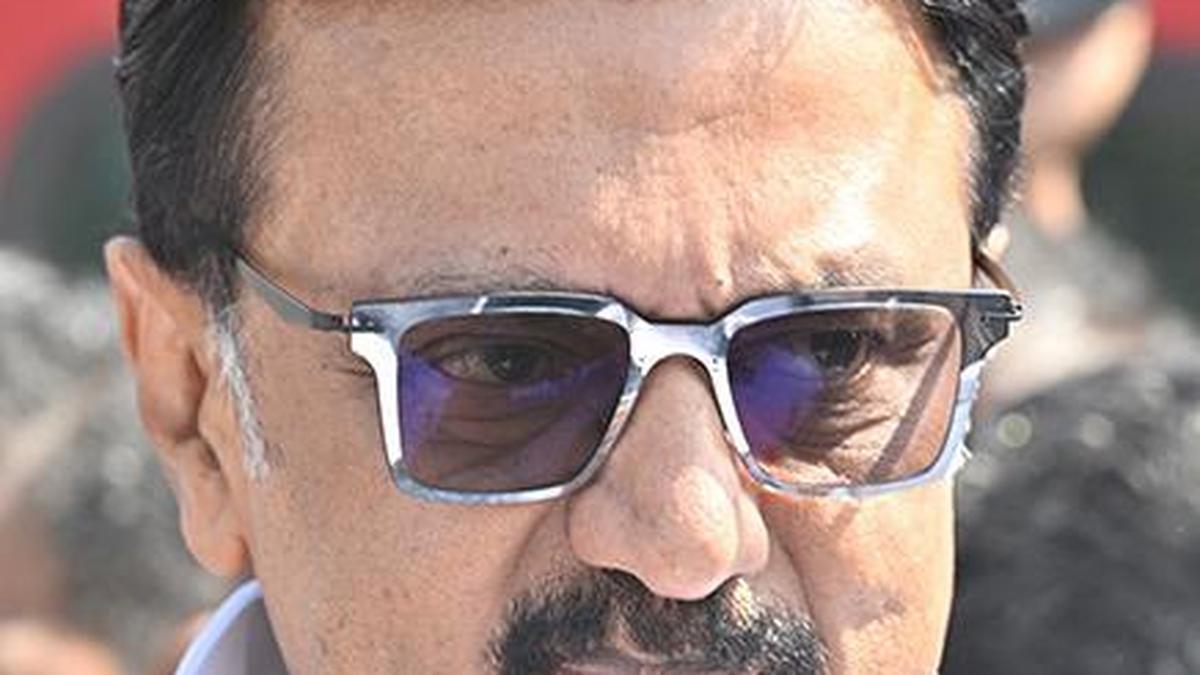
Stalin writes to Modi on registered Sri Lankan Tamils living in India
The Hindu
M.K. Stalin urges Modi to address citizenship applications for Sri Lankan Tamils in India, highlighting humanitarian and legal concerns.
Tamil Nadu Chief Minister M.K. Stalin on Sunday wrote to Prime Minister Narendra Modi placing four requests before the Union government for the welfare of Sri Lankan Tamils living in the State. Mr. Stalin requested the Union government for rescinding earlier administrative instructions that barred the consideration of citizenship applications from Sri Lankan Tamils.
Mr. Stalin, in his letter, sought to flag the matter, which he termed was of “profound humanitarian, constitutional, and national importance concerning Sri Lankan Tamils”, who have sought refuge in India, predominantly in Tamil Nadu, for over four decades. He requested for issuing an executive clarification waiving passport and visa requirements, where appropriate, for the purpose of citizenship or long-term visa applications, based on verified identity documentation issued by the Tamil Nadu government.
The CM requested for delegating appropriate powers to designated district-level authorities for streamlined processing and also requested the Union government for formally clarifying the legal status of registered Sri Lankan Tamil nationals sheltered in India up to January 9, 2015. “These individuals have lived in India with dignity, discipline, and deep cultural affinity for more than four decades. Their presence has been supported and regulated in coordination with the Union government. The continued characterisation of their status as irregular does not reflect the humanitarian context of their entry nor the State-sanctioned nature of their stay.”
Since 1983, successive governments of Tamil Nadu, with the support and concurrence of the Union government, have extended shelter, subsistence support, education, and healthcare to Sri Lankan Tamils, who fled ethnic conflict in Sri Lanka, he said. As of February 15, approximately 89,000 individuals continued to reside in Tamil Nadu — a significant proportion of whom have lived in India for more than 30 years, and nearly 40% of whom were born on Indian soil, Mr. Stalin pointed out.
“While the State has fulfilled its humanitarian responsibilities with commitment and compassion, these individuals remain in a state of prolonged legal uncertainty. Despite their decades-long residence and integration into the social fabric, many continue to lack access to durable legal solutions such as citizenship or long-term visa status,” Mr. Stalin said. The Tamil Nadu government had constituted an advisory committee that undertook detailed study of the status of these Sri Lankan Tamils and had presented recommendations.
One of the recommendations was that the demographic assessment undertaken by the committee indicated that “several categories of Sri Lankan Tamils are eligible for regularisation under existing legal frameworks — including those born in India prior to June 30, 1987, individuals born to one Indian parent, spouses of Indian citizens, persons of Indian origin with lineage documentation, and those otherwise eligible for long-term visas.” Mr. Stalin underlined: “I wish to state that the 2003 amendment to the Citizenship Act, which introduced the category of “illegal migrant,” has had the unintended consequence of retrospectively affecting those who entered India under extraordinary humanitarian circumstances and with the tacit approval of the Union government.”


Deputy Chief Minister Mallu Bhatti Vikramarka offers special prayers at the Sri Mrityunjaya Swamy temple in Madhira, Khammam, on Maha Shivaratri for the prosperity of the State.

ENC chief inaugurates MILAN Village in Visakhapatnam, a cultural hub for the upcoming International Fleet Review and Exercise MILAN 2026.

The Indo-US trade agreement sparks debate over benefits for some farmers versus concerns for domestic producers amid global integration.

Udhayanidhi Stalin frames upcoming elections as a battle for Tamil identity and social justice against Delhi's imposition.

Priyank Kharge accuses RSS of money laundering, questioning its income sources and unregistered status in a recent statement.

SKF Elixer India Pvt. Ltd., Moodbidri, has chosen B.K. Deva Rao, winner of Plant Genome Saviour Farmers’ Reward for 2020-21 and conservator of over 300 varieties of rice/paddy, from Mittabagilu village, Belthangady taluk in Dakshina Kannada, for the first Raithapeetha Award. The award carries ₹1 lakh in prize money. It will be presented to him at a function to be held at Gaudhama farm in Muniyal, Karkala taluk in Udupi district on February 20, 2026, according to G. Ramakrishna Achar, chairman of the company.

Udhayanidhi Stalin inaugurates a new ₹20 crore bus stand in Pattukkottai, enhancing local transport and infrastructure.

M.K. Stalin urges Modi to address citizenship applications for Sri Lankan Tamils in India, highlighting humanitarian and legal concerns.

Kanthapuram calls for the reunification of Samastha, with IUML supporting and a centenary celebration planned for 2027.

The 12 residential quarters for police constables had have been built at a cost of ₹ 3.64 crore by the Karnataka State Police Housing and Infrastructure Development Corporation.

Numaish 2026's final day attracted 22.5 lakh visitors, showcasing vibrant crowds, food stalls and a cherished annual tradition.

Actor Bhavana receives the 'Sake of Honour' award from the Rotary Club at a district conference in Kozhikode.

West Bengal Chief Secretary must comply with Election Commission's directives by February 17, including payment to BLOs and FIRs.