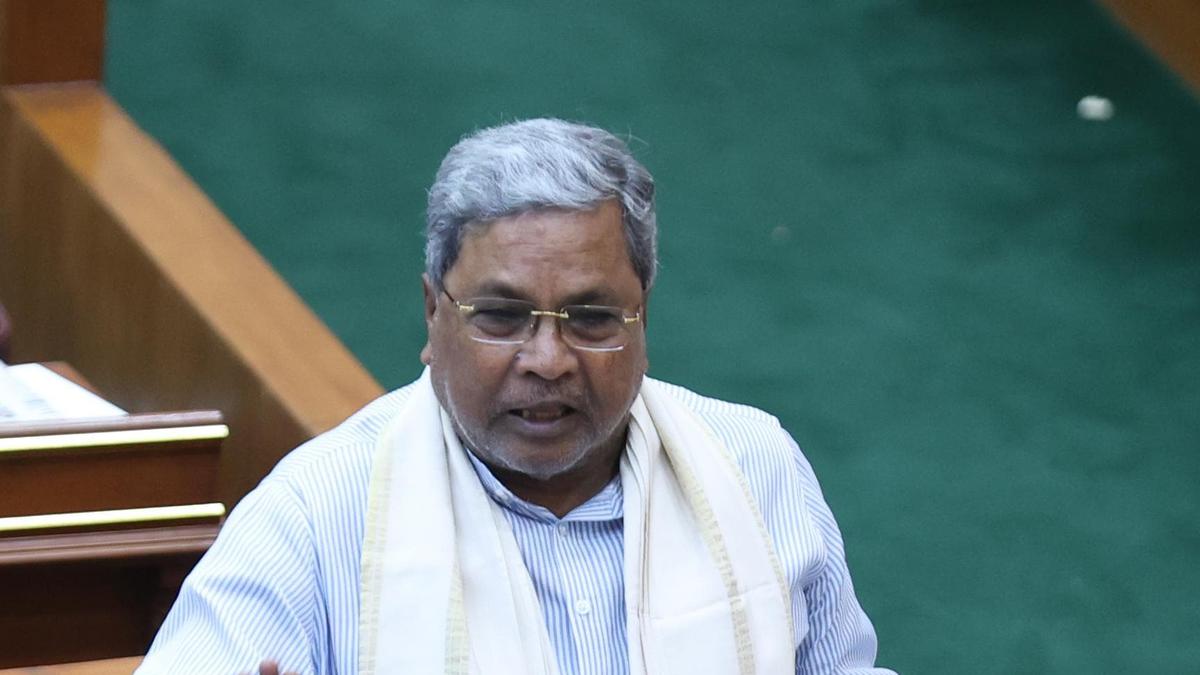
Siddaramaiah says government is committed to addressing regional imbalance
The Hindu
Chief Minister Siddaramaiah addresses regional imbalance in north Karnataka through irrigation projects and special status initiatives for development.
Chief Minister Siddaramaiah has said his government is committed to addressing the regional imbalance in the State by spending funds for programmes, including pending irrigation projects that benefit the north Karnataka region.
In his reply to the debate on the development of north Karnataka in the Legislative Assembly on Thursday, Mr. Siddarmaaiah said 14 districts of the north Karnataka region did not progress on the expected lines even after spending over ₹17,850 crore, besides the regular funds, for the backward taluks of the region, as per the recommendations of the D.M. Nanjundappa committee report on regional imbalance.
The Nanjunadappa committee submitted its report in 2002 when there were 175 taluks in the State. Of the total 39 most backward taluks he had listed, 21 were in Kalaburagi and Belagavi divisions. Among the 40 more backward taluks, 23 were in north Karnataka and of the total 35 backward taluks, 16 were in the north Karnataka region, the Chief Minister said.
The committee had recommended a special project to improve backward areas. As per the recommendations, the government spent ₹31,000 crore over eight years and of that, ₹17,500 crore was spent on 14 districts of the north Karnataka region. “However, the region did not show progress on the expected lines,” he said.
Mr. Siddaramaiah said he had constituted a high-powered committee under the chairmanship of Govinda Rao, an economist, who was member of the 14th Finance Commission, to study the regional imbalance.
Irrigation
The Chief Minister said his government would give attention to completing the pending irrigation projects, including increasing the height of Almatti dam to 524.256 m. The project would irrigate 5.94 lakh hectares (14.85 lakh acres) of land in the region. The project would require 75,563 acres of land. So far, only 2,543 acres has been acquired.


NCC cadets participated in a community development walkathon and awareness skit, organised by Ramaiah University and sponsored by 40 Karnataka Battalion.

Join a free webinar on March 20 exploring patient-centric, tech-enabled TB care ahead of World Tuberculosis Day.

Gold worth ₹2.5 crore seized in Nilgiris due to lack of documentation during transport to private jewellery stores.

Explore the inspiring journey of Geetha Kannan, a national-level Paralympic swimmer and junior cooperative auditor, overcoming challenges with resilience.

BJP's Dilip Ghosh claims Mamata Banerjee is trapped in Bhabanipur, facing tough election challenges from Suvendu Adhikari.

DMK MP R. Girirajan petitions Madras High Court for ED to investigate AIADMK leaders for money laundering linked to corruption cases.

V.D. Satheesan urges the Election Commission to remove LDF government hoardings, citing violations of the Model Code of Conduct.

Featuring Sanjay Dutt and Nora, the Kannada original version of the song, titled ‘Sarse Ninna Seraga Sarse’, was slammed for its “oscene” lyrics by fans and people from film fraternity on social media

Supreme Court questions West Bengal's claim that ED lacks rights to challenge obstruction during I-PAC raids by Chief Minister.

Madras High Court bans unauthorized Dhurandhar merchandise sales on major platforms and orders ISPs to block pirated content.

Ex-AAP councillor Tahir Hussain seeks one-month interim bail on medical grounds to undergo surgery related to a hernia.

BJP leader Dilip Ghosh aims to secure over 1 lakh votes, promising a victory margin greater than in 2016 elections.

IUML faces internal dissent as leaders criticize candidate selections, claiming deserving voices are overlooked in Kerala Assembly polls.