Shades of bus stop management on two arterial roads in Chennai
The Hindu
At the relocated Perungudi bus stop, a temporary shelter seems to have achieved a status of permanence, even putting in the shade two regular, relocated shelters
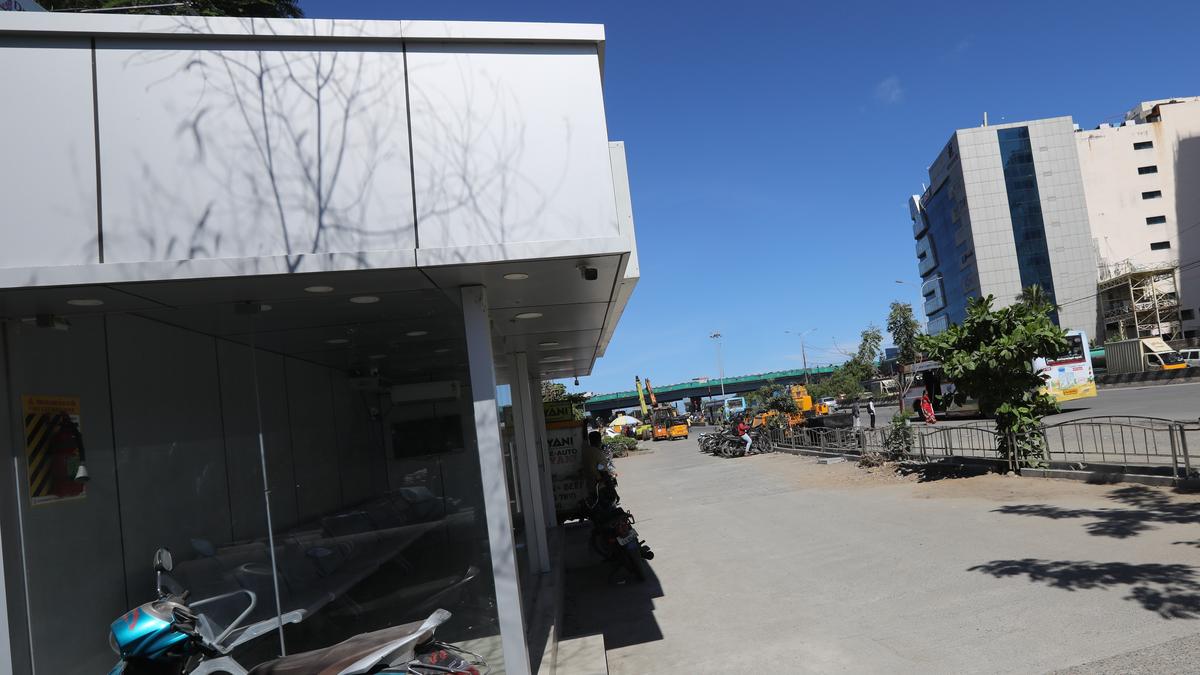
The AC shelter at the Pallikaranai bus stop is as squeaky-clean as an aisle readied for a royal wedding. On the service lane of 200-feet Thoraipakkam-Pallavaram Radial Road, the bus shelter has an impeccable maintenance record, thanks to Dr. Kamakshi Memorial Hospital, which also has the credit of installing the shelter in the first place.
From the shelter, one can watch others board a bus, but not head out of it in time to board that bus oneself. The distance between the shelter and where buses stop is significant. It takes an Usain Bolt to bask in the cool of the shelter and dart to the door of a bus. In truth, even more athleticism is needed — throw in the hurdling ability of an Aries Merritt for good measure. The commuter would have to jump over a metal barricade at the edge of the service lane to reach the halting point on time. Getting to the current opening in the metal barricade would cause valuable seconds to be lost. An opening has to be created in the metal barricade right opposite the shelter.
If the Vels bus stop on 200-feet Radial Road in Pallavaram were personified, it would come across as a personality with a severe case of cognitive dissonance. Its shelter is tethered in one place and a majority of its commuters in another. A classy-looking shelter has been installed by Vels University, but a majority of the commuters instead prefer the roof of the police check-point apparatus and a couple of trees nearby to this shelter. These commuters ignore the shelter as it does not seem to afford a clear view of the oncoming buses, a shock of greenery obstructing the view. Can these trees — only in their adolescence — be transplanted at spots nearby, and the view from the shelter improved. The images were taken on August 13, 2024.
At the Perungudi bus stop, adjoining the compound wall of Brigade Residences at World Trade Center, a bus shelter illustrates the power of habit.
This shelter clearly had been raised in short order. The materials for its making were probably carted into a mini-truck and rushed to the spot. That is hardly a far-fetched idea, coconut thatching and casuarina poles being the materials in question. The economy and speed of construction had to do with one factor: it was going to be a temporary shelter. A little distance away, the original bus stop operated, but had to be discontinued on account of Metro Rail work. While the regular bus stop was relocated, the bus shelters were not.
Commuters continued without a shelter, until this modest, but neatly put-together shelter was raised as a stand-in.
As it has turned out, it was going to be anything but a stand-in. Though the two old shelters were subsequently relocated right next to this one, commuters still prefer this thatched shelter, says a commuter.


Anuradha Jonnalagadda took over as in-charge Vice-Chancellor of the University of Hyderabad, focusing on continuity during the transition.

Telangana government awaits committee report on TGSRTC staff absorption, with decisions to be made at an appropriate time.

Telangana's revised pay scale implementation for employees will take timer. The tenure of Pay Revision Commission extended. Govt likely to take decision on reccomendation based on its report.

Vizianagaram's SP A.R. Damodar highlights 20 accident-prone areas and urges drivers to prioritize safety with helmets and seat belts.

Kerala HC stays disqualification of SNDP Yogam leaders, reversing a single judge's order regarding financial and regulatory compliance issues.

Karnataka announces daily supply of 10,000 LPG cylinders to hotels, easing the commercial shortage for the hospitality industry.

Malayalam superstar Mohanlal will be reuniting with filmmaker Priyadarshan, it was announced recently. It will mark the 100th film of Priyadarshan and is backed by Mohanlal’s longtime collaborator, Antony Perumbavoor

Gautham Vasudev Menon loses Madras High Court appeal, ordered to pay ₹4.25 crore to R.S. Infotainment with interest.

AIADMK faces its toughest challenge in 53 years as it prepares for the crucial 2026 T.N. Assembly elections.

Lakmé Fashion Week x FDCI 2026 in Mumbai: What worked and what didn’t

Telangana CM announces underpass beneath Begumpet Airport runway to alleviate traffic congestion in Hyderabad.

Congress leader Ramesh Chennithala claims an alliance between Pinarayi Vijayan, Modi, and Shah aims to undermine UDF in Kerala elections.

CCB arrests Bengaluru couple for running a fake government job scam, cheating over 100 victims out of crores.