Primary Country (Mandatory)

Other Country (Optional)

Set News Language for United States

Primary Language (Mandatory)
Other Language[s] (Optional)
No other language available

Set News Language for World

Primary Language (Mandatory)
Other Language(s) (Optional)

Set News Source for United States

Primary Source (Mandatory)
Other Source[s] (Optional)

Set News Source for World

Primary Source (Mandatory)
Other Source(s) (Optional)
  • Countries
    • India
    • United States
    • Qatar
    • Germany
    • China
    • Canada
    • Singapore
    • World
  • Categories
    • National
    • International
    • Business
    • Entertainment
    • Sports
    • Special
    • All Categories
  • Available Languages for United States
    • English
  • All Languages
    • English
    • Hindi
    • Arabic
    • German
    • Chinese
    • French
  • Sources
    • India
      • AajTak
      • NDTV India
      • The Hindu
      • India Today
      • Zee News
      • NDTV
      • BBC
      • The Wire
      • News18
      • News 24
      • The Quint
      • ABP News
      • Zee News
      • News 24
    • United States
      • CNN
      • Fox News
      • Al Jazeera
      • CBSN
      • NY Post
      • Voice of America
      • The New York Times
      • HuffPost
      • ABC News
      • Newsy
      • USA TODAY
      • NBC News
      • CNBC
    • Qatar
      • Al Jazeera
      • Al Arab
      • The Peninsula
      • Gulf Times
      • Al Sharq
      • Qatar Tribune
      • Al Raya
      • Lusail
    • Germany
      • DW
      • ZDF
      • ProSieben
      • RTL
      • n-tv
      • Die Welt
      • Süddeutsche Zeitung
      • Frankfurter Rundschau
    • China
      • China Daily
      • BBC
      • The New York Times
      • Voice of America
      • Beijing Daily
      • The Epoch Times
      • Ta Kung Pao
      • Xinmin Evening News
    • Canada
      • CBC
      • Radio-Canada
      • CTV
      • TVA Nouvelles
      • Le Journal de Montréal
      • Global News
      • BNN Bloomberg
      • Métro
    • Singapore
      • CNA
      • The Straits Times
      • Lianhe Zaobao
How do astronauts return from space and survive re-entry?

How do astronauts return from space and survive re-entry?

The Hindu
Monday, March 02, 2026 12:43:42 AM UTC

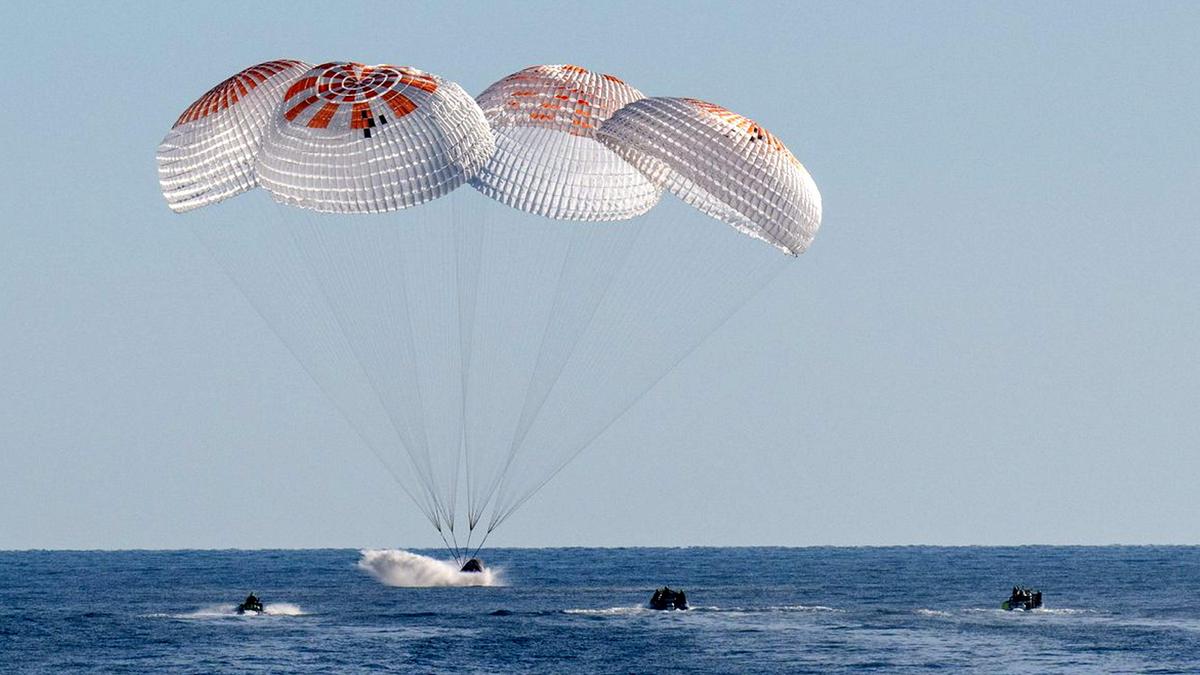
A launch vehicle’s ascent battles gravity to gain orbital velocity, while re-entry is a controlled struggle against the atmosphere to systematically shed that immense kinetic energy through aerobraking, thermal protection and precise guidance within the re-entry corridor. Operating as a semi-ballistic body, the crew module performs a deorbit burn, manages communication blackout, and deploys a three-stage parachute system to ensure a safe splashdown.

The ascent of a launch vehicle is a battle against gravity to gain the immense velocity required to stay in orbit — while re-entry is a struggle against the atmosphere to shed that same energy in a systematic way.

Initially, aerospace scientists believed that surviving atmospheric re-entry would be impossible because the massive kinetic energy of an orbiting space capsule would be converted into intense heat energy upon re-entry. The resulting temperatures would be so extreme that they would melt any known structural material. The breakthrough came with the blunt body theory, which proved that if the space capsule’s forebody is rounded with a large radius, it can deflect most of the re-entry heat into the surrounding air rather than being directed into the capsule.

More than 98% energy of a re-entering capsule is dissipated through the atmosphere and converted into heat. The capsule is shielded from this intense thermal environment by its heatshield, which has a robust thermal protection system: it dissipates the heat through either ablation — where the material sacrificially chars and erodes to carry heat away — or thermal insulation, which uses low-conductivity materials to prevent the heat from reaching the capsule’s primary structure.

To return to earth, a space capsule must break its orbit by reducing its velocity. It does this by performing a deorbit burn: turning 180 degrees and firing its engines in the opposite direction of its travel. Since forward speed is what maintains the orbit, losing that speed allows gravity to overcome the capsule’s centrifugal force. The capsule then drops out of its stable circular path and enters a shallow, downward elliptical curve, leading it into the upper atmosphere for re-entry.

The re-entry corridor is a precise atmospheric window that a spacecraft must hit to return safely, balanced between two extremes. If the entry angle is too shallow (the overshoot boundary), the capsule will act like a stone skipping across a pond, bouncing off the atmosphere back into space. Conversely, if the angle is too steep (the undershoot boundary), the capsule will hit the dense air too hard, generating lethal deceleration forces and frictional heat that exceed what the crew and capsule can survive.

A ballistic body behaves like a falling stone: it cannot steer by itself and is slowed only by the air resistance (drag). In contrast, a semi-ballistic body flies at a specific angle, known as the angle of attack. This is achieved by intentionally offsetting its centre of gravity laterally, causing the body to fly at an angle relative to the oncoming air.

Read full story on The Hindu
Share this story on:-
More Related News
Science Snapshots: March 1, 2026 Premium

Discover groundbreaking research on Mars lightning, innovative smart materials, and a universal ageing marker in just one minute.

How do astronauts return from space and survive re-entry?

A launch vehicle’s ascent battles gravity to gain orbital velocity, while re-entry is a controlled struggle against the atmosphere to systematically shed that immense kinetic energy through aerobraking, thermal protection and precise guidance within the re-entry corridor. Operating as a semi-ballistic body, the crew module performs a deorbit burn, manages communication blackout, and deploys a three-stage parachute system to ensure a safe splashdown.

Nissan Gravite: A value-driven seven-seater

The Nissan Gravite is a budget-friendly seven-seater MPV designed for practical family use in India. Sharing its platform with the Renault Triber, it offers flexible 2-to-7 seating, a removable third row, generous boot space, and a fuel-efficient 1.0-litre petrol engine delivering around 19 km/l. With features such as a floating touchscreen, wireless connectivity, digital instrument cluster, and six airbags as standard, the Gravite blends affordability, safety and everyday usability in a compact footprint tailored to urban and small-family needs.

Meet the teenage cyclists from Tamil Nadu racing at the Track Asia Cup

Discover the dedication of Tamil Nadu's teenage cyclists competing at the Track Asia Cup, balancing sport and academics.

Why are scientists studying gypsum in the Salar de Pajonales? Premium

Explore how Salar de Pajonales in Chile serves as a vital Mars analogue for studying microbial life and ancient fossils.

NASA announces overhaul of Artemis lunar programme amid technical delays

NASA revamps its Artemis lunar program to address delays and ensure a Moon landing by 2028.

© 2008 - 2026 Webjosh  |  News Archive  |  Privacy Policy  |  Contact Us