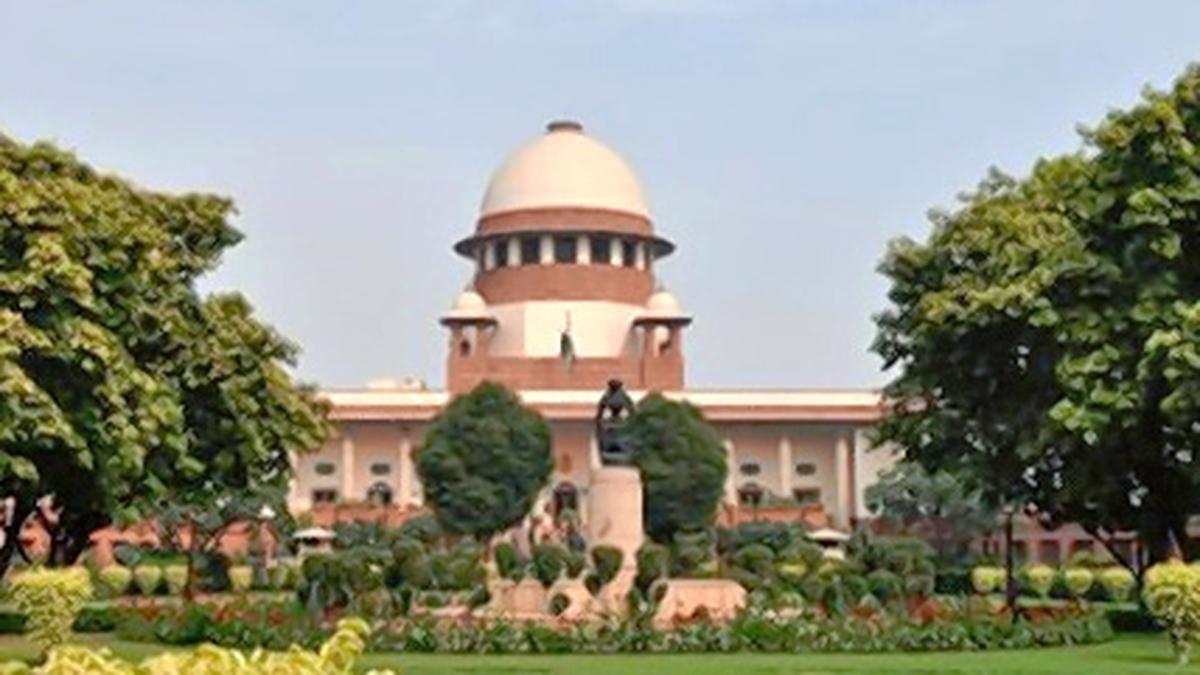
SC urges balance while government says IT Rules not meant to curb satire, humour or criticism
The Hindu
Supreme Court seeks balance between free speech and curbing fake content as government defends IT Rules amid legal scrutiny.
The Supreme Court on Tuesday (March 10, 2026) sought balance between protecting the nation against fake online content and safeguarding the right to free speech while the Centre defended that its Information Technology Rules was not meant to curb humour, satire or criticism of the government.
“There is no intention under the statute (Information Technology Act) or the Rules to curb any humour, statute, expression of view, critical expression of view and criticism,” Solicitor General Tushar Mehta, for the Union government, addressed a Bench headed by Chief Justice of India Surya Kant.
In fact, the government had notified the formation of a Fact Checking Unit (FCU) under the Press Information Bureau through a notification issued in March 2024 via the Information Technology (Intermediary Guidelines and Digital Media Ethics Code) Rules as amended in April 2023. The FCU was supposed to act as a “deterrent” against the creation and dissemination of fake news or misinformation regarding the “business” of the Centre.
The Amendment Rules and the establishment of the FCU had come under the judicial scrutiny of the Bombay High Court through petitions filed by the Editors Guild of India and stand-up comedian Kunal Kamra.
The High Court had eventually, in September 2024, struck down the FCU notification and concluded the amended IT Rules of 2023 “unconstitutional” and violative of Article 14 (right to equality), 19 (freedom of speech and expression) and 19(1)(g) (freedom and right to profession) of the Constitution. It had concluded that the expression “fake, false and misleading” in the Rules was “vague and hence wrong” in the absence of any definition. The High Court had said the government cannot assume the role of the “sole arbiter of truth”.
The Centre appealed in the Supreme Court against the High Court decision, saying it had no subversive intention to crush free speech.


Hyderabad faces an LPG shortage impacting PGs and hostels, raising concerns over meal preparation for residents.

A faunal survey in Kerala's Vazhachal adds 26 new species to the wildlife checklist, showcasing the region's rich biodiversity.

Shivamogga hoteliers face commercial gas cylinder shortages, prompting concerns about potential shutdowns and urgent discussions on supply issues.

Coimbatore district hotels have cut down menus and restricted service hours to manage LPG cylinder availability issue because of the Iran US Israel war

Investigate the alleged U.S.-Israeli strike on an Iranian school, resulting in significant casualties amidst ongoing Middle East tensions.

Iran's Revolutionary Guard asserts it will decide the war's end, amid escalating regional tensions and U.S. responses.

Shorts News:Watch: Would like to assure Karnataka priority is to ensure gas supply: Tejasvi Surya

Former T.N. Minister Senthilbalaji to testify before CBI on March 17 regarding the deadly Karur stampede investigation.

Kerala High Court dismisses challenges against government’s bulk messaging to officials, ruling it not a political campaign.

Experts emphasize the health impact of overbite and underbite, urging early screening for effective treatment and prevention.

Kerala Speaker declares allegations against Minister K.B. Ganesh Kumar "a closed chapter," urging separation of family issues from politics.

Despite an LPG shortage, Hyderabad's iconic haleem remains unaffected as it's primarily cooked in traditional wood-fired ovens.

Hyderabad police seize over 5,000 litres of adulterated cooking oil and 5,000 kg of wheat flour in raids