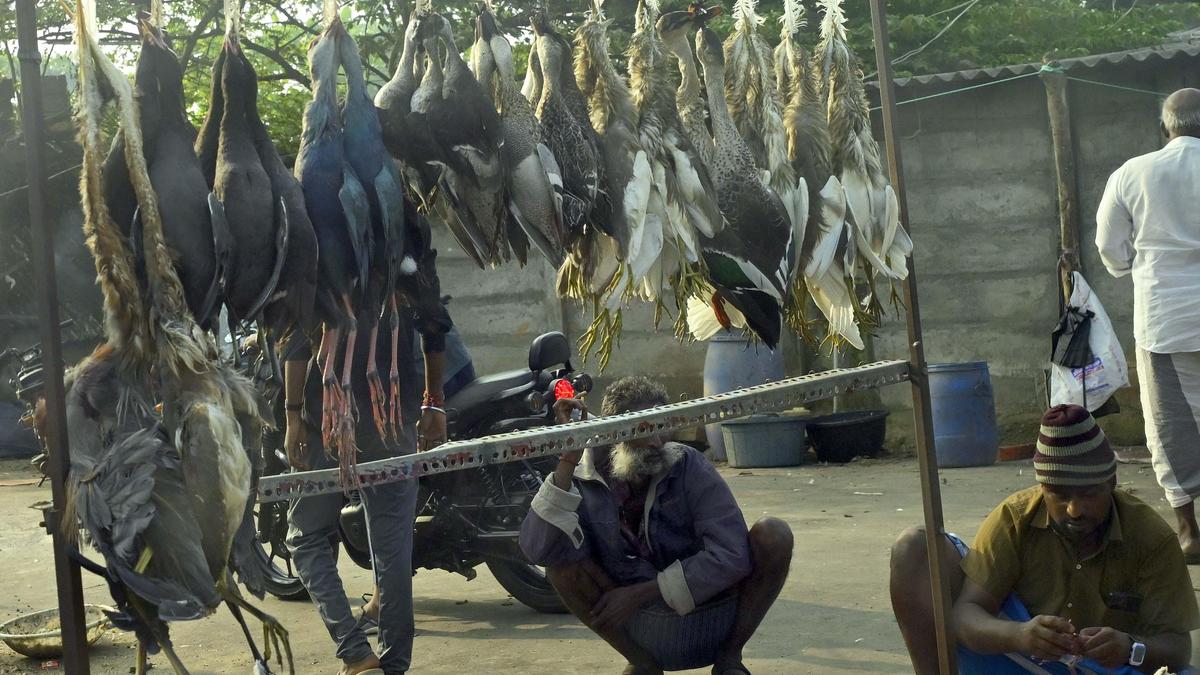
Rising bushmeat demand in local cuisine alarms conservationists in Puducherry
The Hindu
Rising bushmeat demand in Puducherry alarms conservationists amid escalating poaching, health risks, and dwindling wildlife populations.
The rising popularity of bushmeat (meat of wild animals or birds) in regional cuisine has set off alarm bells among conservationists, who fear that poor vigilance against organised poaching at bird sanctuaries and waterbodies may have turned what was, not too long ago, a rare delicacy into regular fare.
Conservationists contend that while the sale of meat of water birds and live parakeets during weekends is not uncommon in Puducherry, the trade in bushmeat has now flourished unabated on all days of the week, thanks to poor vigilance by the Forest authorities.
Odiampet village near Villianur has emerged as the epicentre of this organised poaching, with water birds and small mammals hunted by poachers from forest fringes near the Oussudu Bird Sanctuary and far-off places in neighbouring Tamil Nadu being brought here for sale to prospective customers.
The birds often killed include munias, Eurasian moorhens, grey-headed swamphens, garganeys, whistling ducks, open-billed storks, Indian spot-billed ducks, Indian pond herons, egrets and weaver birds, along with mammals such as the palm civet, black-naped hare, porcupine, and jungle cat.
Of these, the garganey is a migratory bird listed under the Agreement on the Conservation of African-Eurasian Migratory Waterbirds (AEWA). The cotton pygmy goose is the world’s smallest waterfowl.
On the roadside of the Odiampet-Thirukanchi Road, vendors offer motorists a pair of live parakeets for an average price of ₹500 to ₹1,000, while meat of jungle cat and black-naped hare is priced at ₹800 per kg.


Jeevan Reddy leads a rally for maize farmers in Jagtial amid speculation of leaving Congress for BRS.

BJP and AINRC likely to maintain 2021 seat-sharing formula for Puducherry's 2026 Assembly elections, confirms party president.

BJP reveals 144 candidates for Bengal Assembly polls, featuring Suvendu Adhikari contesting against Mamata Banerjee in Bhabanipur.

Anna University partners with Ramco Systems to create an advanced ERP lab for enhanced industrial engineering education.

NDA announces candidates for 12 Kozhikode seats in Kerala Assembly polls 2026 as UDF and LDF ramp up campaigning.

As India formulates its next steps in the Israel-U.S.-Iran war, it is necessary to consider not only what it will mean for the whole region but also its own ties with each neighbour

CITU criticizes the Centre's privatization efforts for VSP, alleging employee removal over production increase and financial mismanagement.

Visakhapatnam Customs House's short film "Right Turn" wins Honourable Jury Mention at the 10th Indian World Film Festival.

Economist Arvind Subramanian advises CM Revanth Reddy on strengthening Telangana's finances during a meeting in Hyderabad.

Supreme Court emphasizes stakeholder consultation for legal education reforms, hesitant to change five-year law course duration.

Authorities in Andhra Pradesh are set to tranquillise a roaming tiger near Annavaram temple for safety and conservation.

MEA criticizes USCIRF for bias, urging focus on vandalism of Hindu temples in the U.S. over selective criticism of India.

Bengaluru's Urban Development aims to beautify underutilized flyover spaces, enhancing city aesthetics and improving green cover initiatives.