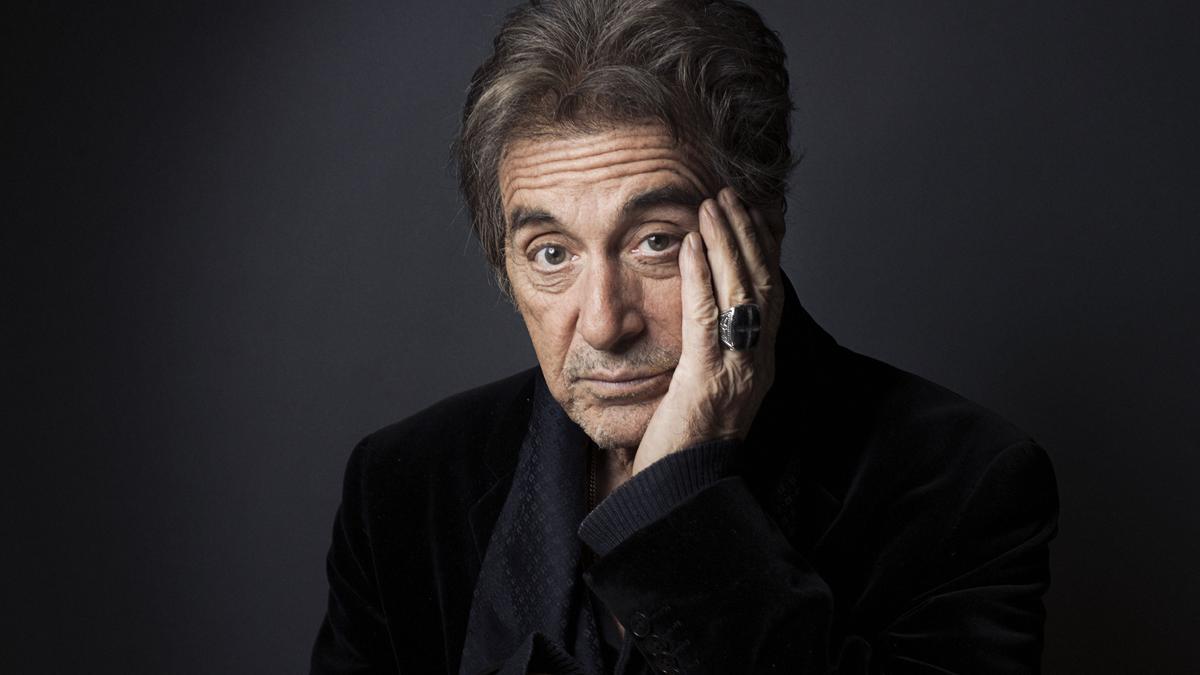
Review of Al Pacino’s Sonny Boy: And justice for Al
The Hindu
Review of Al Pacino’s Sonny Boy
Al Pacino’s autobiography, Sonny Boy, is not a well-crafted book. The legendary actor, now 84, is aware that he’s been in more bad movies than good ones, and while describing an artless biography he once read, starts talking about his own: “Let me tell you, it read like this: He does this. Then he does that. Then he goes here. Then he goes there. Like the book I’m writing now... It’s like saying, Hamlet comes home. Then he sees his father. Then he goes to his mother.”
Mercifully, Pacino’s life is improbable enough to vault over short sentences and inconsistent syntax. The clunkiness only makes the voice more authentic, as if readers are sharing a beer with Pacino while he’s saying “Actors, man. There’s nothing like actors,” or labelling himself “as dumb as a donut.” Most of the book feels raw and untethered — like some of Pacino’s early masterpieces — and I came away from Sonny Boy feeling like I had been on a bender with the great performer.
Greatness, of course, takes its time. Pacino started out on infinitely small stages — “as I was smoking, in character, a woman from the audience reached in and gave me an ashtray” — and climbed to Broadway, where Jackie Kennedy came backstage to applaud his Richard III. “When you’re coming back from the stage after performing one of the greatest plays of all time,” he writes, “you’re liable to do anything.” In that post-performance delirium, the actor, still slumped in his chair, put out his hand for Kennedy to kiss.
That Michael Corleone lingers inside Pacino may not be a surprise, but his mother’s father actually came from the Sicilian town of Corleone. While the underworld “was there for my grandfather and easy to access,” the man instead became an exemplary plasterer, known for his craftsmanship. Pacino describes an afternoon where his granddad, hearing that Al had tattled on a classmate, said “So you’re a rat, huh?” so matter of factly that the actor never ratted on anybody again. “Although right now as I write this, I’m ratting on myself.”
There is, indeed, a surprising lack of bluster. Pacino presents his life as a series of fortunate accidents, sidestepping the credit. He is sheepish, for instance, about his only Oscar-winning role in Scent of a Woman — “I did go overboard sometimes... I would get too out of control. I could do it better now” — and describes the Oscar as something that shifts perception, but only just: “People know that you’ve accomplished something special, and they treat you that way, for about a week.” The book is often, charmingly, about his naïveté: “What I lack in intelligence, I make up for in energy.”
He shared a flat with Martin Sheen where a young Joan Baez would play guitar cross-legged, acted with his idol Marlon Brando, and fell in love with Diane Keaton — “We go together like two straws and a Coke,” he writes, sweetly. He calls Francis Ford Coppola “a miracle”, gushes over David Mamet’s dialogue, and was awestruck by Dustin Hoffman: “You would pick up on other students discussing him with a strange reverence, like he was a ghost or a wanted criminal.” The most mentions are saved for Chekhov, though, and Pacino seems fundamentally shaped by the pocket-sized books he carried everywhere in his youth.
“I’m a man who has more Golden Raspberry nominations than Oscars.” His is a dramatically uneven filmography, featuring masterpieces — The Godfather, Dog Day Afternoon, Glengarry Glen Ross, Heat, Scarface, And Justice For All — alongside unbearable clunkers like S1m0ne and Gigli. Has any other iconic actor done that many awful films? Pacino, unfortunately, kept going broke. “I’ll never learn, and that’s my problem,” he writes. “Or my gift.”


Anuradha Jonnalagadda took over as in-charge Vice-Chancellor of the University of Hyderabad, focusing on continuity during the transition.

Telangana government awaits committee report on TGSRTC staff absorption, with decisions to be made at an appropriate time.

Telangana's revised pay scale implementation for employees will take timer. The tenure of Pay Revision Commission extended. Govt likely to take decision on reccomendation based on its report.

Vizianagaram's SP A.R. Damodar highlights 20 accident-prone areas and urges drivers to prioritize safety with helmets and seat belts.

Kerala HC stays disqualification of SNDP Yogam leaders, reversing a single judge's order regarding financial and regulatory compliance issues.

Karnataka announces daily supply of 10,000 LPG cylinders to hotels, easing the commercial shortage for the hospitality industry.

Malayalam superstar Mohanlal will be reuniting with filmmaker Priyadarshan, it was announced recently. It will mark the 100th film of Priyadarshan and is backed by Mohanlal’s longtime collaborator, Antony Perumbavoor

Gautham Vasudev Menon loses Madras High Court appeal, ordered to pay ₹4.25 crore to R.S. Infotainment with interest.

AIADMK faces its toughest challenge in 53 years as it prepares for the crucial 2026 T.N. Assembly elections.

Lakmé Fashion Week x FDCI 2026 in Mumbai: What worked and what didn’t

Telangana CM announces underpass beneath Begumpet Airport runway to alleviate traffic congestion in Hyderabad.

Congress leader Ramesh Chennithala claims an alliance between Pinarayi Vijayan, Modi, and Shah aims to undermine UDF in Kerala elections.

CCB arrests Bengaluru couple for running a fake government job scam, cheating over 100 victims out of crores.