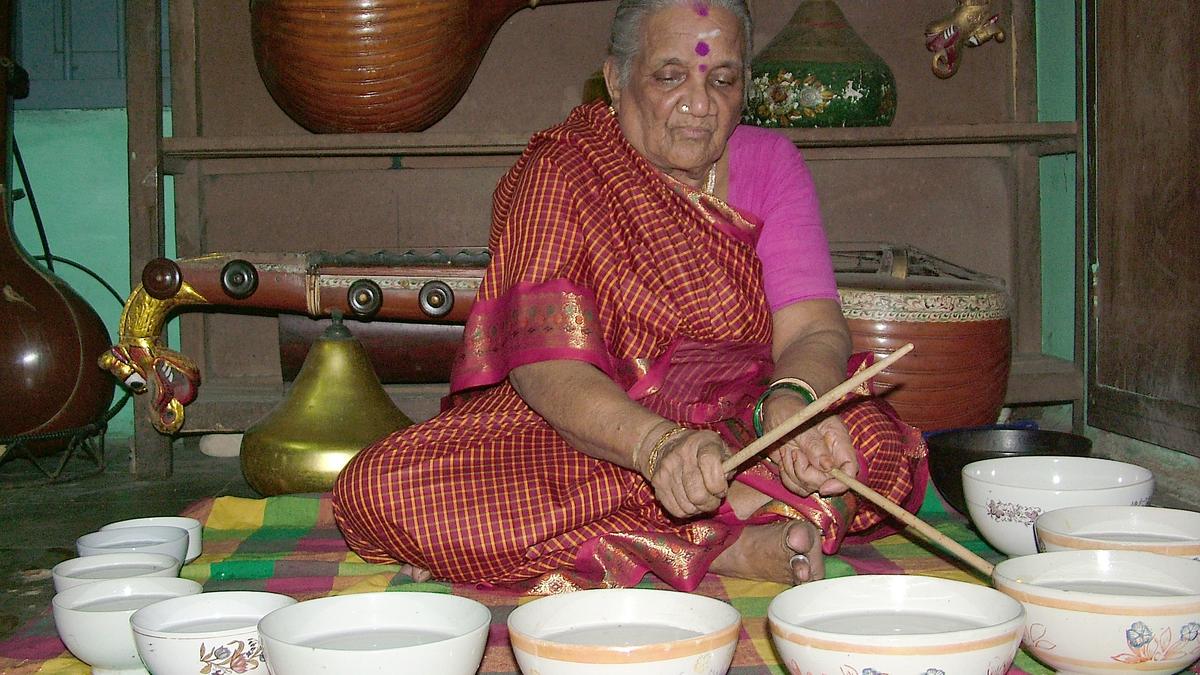
Remembering Seetha Doraiswamy, who broke the glass ceiling with the jalatharangam
The Hindu
Meet Seetha Doraiswamy, who passionately pursued the jalatharangam
In the mid-1930s, a 10-year-old and her elder sister attended a summer music school conducted by musicologist and composer Professor Sambamurthi. The younger sibling Seetha, who was training in Carnatic music from Bhagavathars Seetharama Sharma and Kodaganallur Subiah in Tirunelveli, was fascinated by the jalatharangam, where musical sounds are created by striking varied sizes of water-filled porcelain cups.
Seetha expressed a desire to learn the instrument from exponent Ramaniah Chettiar. He taught it to only a select few, and as a test, asked her to change the raga from Mayamalavagowla to Sankarabharnam. Seetha passed the test, changing the rishabam and daivatham by adjusting the water levels.
The talented child, daughter of illustrious engineer Ganapathy Iyer and Meenakshi, a descendant of Sanskrit scholar Appaya Dikshitar, went on to become Seetha Doraiswamy, a pioneering woman jalatharangam artiste.
Impressed by her dedication, Sambamurthy gifted his porcelain cup set to Seetha. She also learnt the harmonium on her own, and underwent veena training from vidwan Suryanarayana Sastri. Meenakshi was a disciplinarian, and insisted Seetha practise before school. This laid a strong foundation, and Seetha and her elder sister started participating in vocal concerts even when young.
Seetha was married to N. Doraiswamy Iyer at a very young age, and in an era when society restricted women’s movements to within the home, he enrolled his 14-year-old wife in the Teacher’s College of Music, run by The Music Academy. She studied under distinguished maestros during Valadi Krishna Iyer’s tenure as principal, and made history by becoming the first female student to receive a gold medal during graduation for standing first in her course in 1941, and in a college competition.
Seetha taught the veena, vocal music, and jalatharangam for two decades at home while managing 10 children. Her musical odyssey’s turning point came at the age of 41, when she earned a B-high grade from All India Radio in the early 1960s. Her performances in Sarva Vadya kutcheris and AIR’s Vadya Vrinda (multi-instrumental orchestra ) earned her recognition in the Carnatic music fraternity, leading to more opportunities.
Seetha has performed alongside renowned musicians, including violinists Dwaram Mangathayaru, A. Kanyakumari, R. K. Shriramkumar, P.P. Ramakrishnan, mridangists Thanjavur R Kumar, K.V. Prasad, and Ghatam Karthick. Her exceptional performances and pleasant demeanour earned her standing ovations at numerous venues.


Abhishek Banerjee challenges BJP's Suvendu Adhikari in Nandigram, pledging community health initiatives if Trinamool Congress wins.

Rising LPG shortages in Karnataka boost firewood demand, reviving an informal market as households and hotels seek alternatives.

Against the backdrop of intense poll activity, a 400-metre stretch of an arterial road in the outskirts of Chennai (technically in Madurapakkam panchayat under Tambaram assembly constituency) presents a salute to the idea of res publica, which underpins India’s system of governance, where citizens have a say, at least before a government is securely ensconced in the seat of power. A Republic Day initiative shines bright every night

Fadnavis claims zero FIR in Ajit Pawar crash is a defamation attempt by Karnataka against Maharashtra's investigation efforts.

Set to unfold as a one-day pop-up on April 5, the Easter Sadya brings together both vegetarian and non-vegetarian menus, offering a peek into the food traditions of the Syrian Christian (Nasrani) community. While the traditional Sadya is often associated with dishes such as sambar, avial, and rice, this version expands to include community-specific festive dishes.

BJP nominates mother of R.G. Kar victim Abhaya to contest from Panihati in West Bengal Assembly elections.

Veteran Malayalam actor-director E.A. Rajendran passes away at 71, leaving behind a rich legacy in the film industry.

Dakshina Kannada Zilla Panchayat has rolled out digital mode of water bill generation and collection in 23 gram panchayats on a pilot basis for the first time in Karnataka. This is set to be extended to the remaining 200 panchayats shortly, according to the Zilla Panchayat Chief Executive Officer Narwade Vinayak Karbhari.

Bengaluru police questioned a man carrying ₹6 lakh for medical expenses at Vidhana Soudha, later releasing him after verification.

BJP accuses Bengaluru's Congress government of corruption in e-Khata issuance, halting infrastructure projects due to financial mismanagement.

Misinformation in Hyderabad sparks panic buying, causing disruptions as residents react to unfounded rumors of an impending lockdown.

Bengaluru Metro extends services until 2 a.m. on March 28 for IPL match, ensuring convenient travel for spectators.

A bus truck-collision in Andhra Pradesh's Markapuram district, killing several. Catch LIVE updates here!