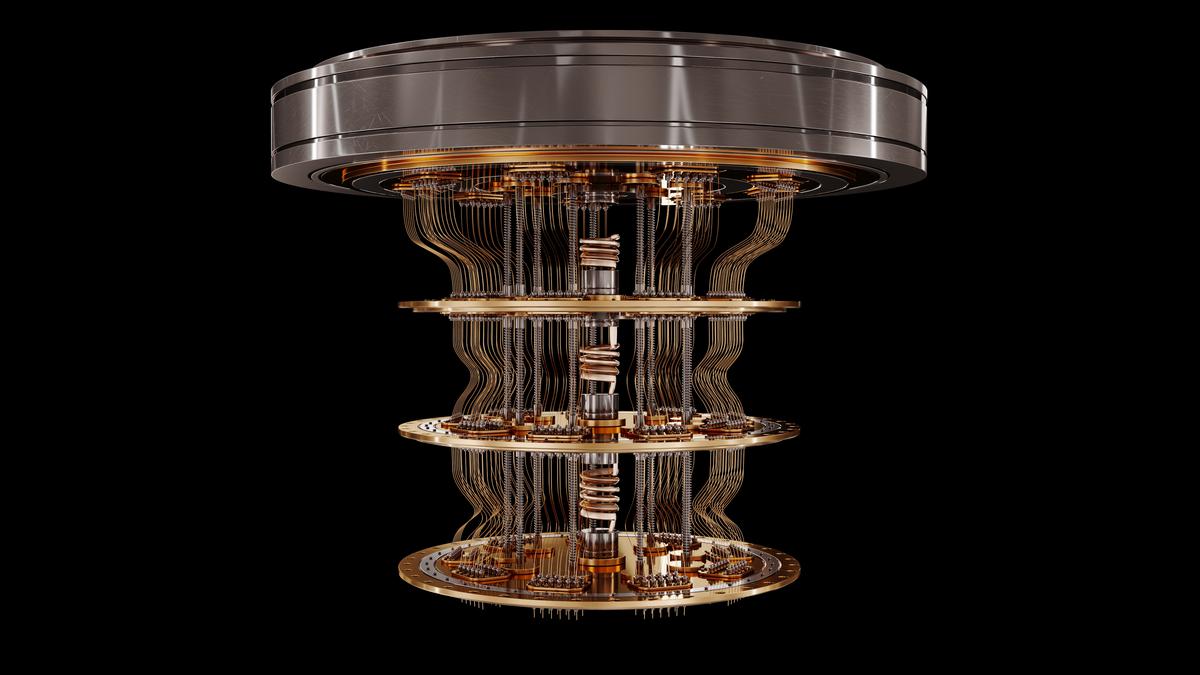
Quantum gates: Devices that translate quantum effects to computing awesomeness Premium
The Hindu
Bits are the smallest unit of information storage, and gates are circuits that change the states of bits. Quantum computers use qubits, which can be in a superposition of two states. Quantum gates act on qubits to process information. CNOT gates act on two qubits; together with other gates that act on one qubit at a time, these gates can perform all possible logical operations.
Information technology (IT) has become essential to communication, banking, business, health, education, entertainment, and many other walks of our lives. Its prevalence makes us wonder if society can survive without it. IT relies on gadgets that store and process vast amounts of information at humanly impossible speeds.
A bit is the smallest piece of information storage (it is a portmanteau of binary digit). Often, a large number of bits is required to convey meaningful information. With the advent of modern semiconductor technology, we routinely speak of household computers having a few terabytes (8 trillion bits) of information storage. One terabyte can store 500 hours of high-definition video content.
In a computer, a bit is a physical system with two easily discernible configurations, or states – e.g. high and low voltage. These physical bits are useful to represent and process expressions that involve 0s and 1s: for instance, low voltage can represent 0 and high voltage can represent 1.
A gate is a circuit that changes the states of bits in a predictable way. The speed at which these gates work determines how fast a computer functions.
Modern computers use semiconductor transistors to build circuits that function as bits. A semiconductor chip hosts more than 100 million transistors on 1 sq. mm. Imagine how small an individual transistor is and how close it is to adjacent transistors. As transistors become smaller, they become more susceptible to quantum effects. This is not desirable as the existing technology will then become unreliable for computational tasks. So there is a limit to how many transistors a computer can have.
Moore’s law, announced in 1965, states that computing power increases tenfold every five years. This law no longer holds as we have already slowed to a two-fold increase every five years. But this doesn’t have to mean we are nearing the end of computing development: the quantum revolution is coming.
The most basic unit of a quantum computer is a quantum bit, or qubit. Like in a conventional computer, it is a physical object that has two states. For example, the spin of a particle can point along two different directions, so the particle can function as a qubit. Or it can be a superconducting circuit that mimics an atom, and its two states can be a ground state, where it has lower energy, and a higher ‘excited’ state.


Contact details of election observers in The Nilgiris released for submitting poll-related complaints during Assembly elections.

Collector directs return of seized cash upon valid document verification amid voter enrollment and election preparations in Erode district.

Telangana Deputy CM Bhatti Vikramarka to present 2026-27 budget on March 20, 2026 , likely to balance welfare, development amid huge fiscal and revenue deficits in the State.

HCLTech named as one of the World’s Most Ethical Companies® by Ethisphere for third consecutive year
HCLTech named as one of the World’s Most Ethical Companies® by Ethisphere for third consecutive year

Rahul Gandhi urges Uttam Nagar residents to maintain peace, blaming BJP for inciting violence and communal tension in Delhi.

West Asia tensions disrupt GCC coconut exports, causing local price drops and surplus for Tamil Nadu farmers.

DMK urges the Election Commission to align Puducherry elections with Tamil Nadu's April 23 polling date for logistical efficiency.

NHAI plans DPR for four-lane Tiruchi-Karur-Coimbatore greenfield highway and northern Tiruchi bypass to improve safety.

Defence Minister Rajnath Singh urges India to achieve self-reliance in drone manufacturing amid global conflict lessons.

Artists learn banana stem paper making at Visakhapatnam workshop

Mumbai will experience mainly clear skies with temperatures around 32°C and possible light rain early Thursday morning.

Thunderstorms with lightning and gusty winds expected in 14 Telangana districts on March 20, 2026

Thoothukudi police arrest suspect in Class 12 girl’s murder after investigation and community protests demanding justice.