Project 560 attempts preservation through art
The Hindu
Art plays an important role in preserving a locality for posterity — a fact Project 560 has tapped into with its schemes
Bengaluru’s vibrant culture and history are being brought to the fore through Project 560, an initiative aimed at engaging the city’s residents and transforming the city into a dynamic canvas for artistic expression.
“We want locals to engage with one another by ensuring Bengaluru remains the protagonist,” says Harshita Bathwal, a Programme Officer for Project 560. The project, under the aegis of the India Foundation for the Arts (IFA), is the first of its kind dedicated to celebrating and preserving Bengaluru’s rich heritage. The name was inspired by Bengaluru’s postal code, with Project 560 spanning the entire city, fostering long-term commitments to its cultural vibrancy.
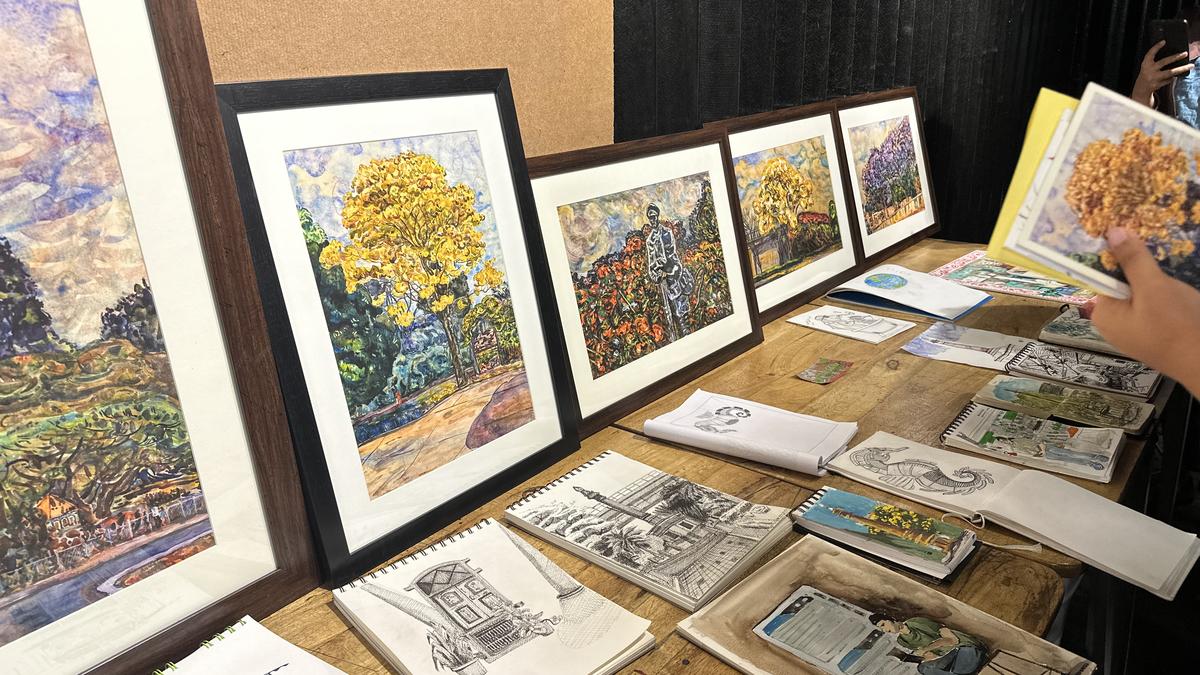
The initiative encompasses various facets, from neighbourhood engagements to curated artistic engagements. One such noteworthy aspect within this project was conducted by art conservationist Roshni M, whose work was recently showcased at the Bangalore Creative Circus. Over the past six months, Roshni delved into the history, art and heritage of Rajajinagar, one of Bengaluru’s oldest industrial hubs, capturing its essence through an art exhibition and documentary. She also conducted a series of ‘sketch meets’ during her research period, where she collaborated with local artists to capture the locality on canvas.
As a native of Rajajinagar, Roshni meticulously gathered archival information and conducted interviews around significant landmarks, including the Navarang Theatre, Sagar Restaurants, and the Rajajinagar Foundation Pillar — a symbol of the locality’s heritage.
Reflecting on her work, Roshni remarked, “The area is quite different from the one inaugurated by Jayachamaraja Wadiyar on July 3, 1949. In the last five years alone, over eight residential complexes have sprung up.”
Due to rapid development, only the historic Ram Kumar Mills continues to stand as testament to Rajajinagar’s legacy. Roshni makes note of the changing landscape and expresses concern about further commercial encroachment. “It is likely that the adjacent areas are going to meet a similar end. Rajajinagar is close to the city centre, making it prime property for commercial and residential complexes to come up,” she explains.
However, Rajajinagar still retains much of its charm and cultural significance, remaining a bustling community hub with residents frequenting popular spots and old haunts for their daily needs. The cultural diaspora of Rajajinagar is evident in its array of temples, including the renowned ISKCON Temple, and other cultural establishments such as the Rumale Art House.


Discover the Minor Planet Centre, the key hub for tracking and verifying observations of small solar system bodies.

Discover the Minor Planet Centre, the key hub for tracking and verifying observations of small solar system bodies.

In this week's Science for All newsletter, XX explains

Test your knowledge with the quiz on Science films at the Oscars through history

Set between the Siwalik hills and the plains, Butwal offers travellers a mix of regional cuisine, pilgrimage trails to Lumbini and the comfort of Hyatt’s new hospitality landmark

Explore 2026's wallpaper trends in India, highlighting botanicals and handmade designs that enhance modern homes with nature-inspired aesthetics.

Mercedes-Benz CLA 250+ with EQ Technology review: design, performance, range and features explained. Discover how the new electric CLA combines advanced AI, long range, fast charging and futuristic styling for the next generation of luxury EVs.

AI tool for sparrow conservation

BTS’s comeback with ‘Arirang’ marks a major global music event. When does the album release, and where can you watch their concert live stream? We have all the details

The 2026 U.S. cholesterol guidelines urge starting screening and treatment at 30 to prevent cardiovascular disease effectively.

Olam Festival 2026 in Thiruvananthapuram returns March 27-29 with 120+ vendors, music, art, and cultural zones.

A few storytellers in Thiruvananthapuram share their journeys, challenges, and evolving methods on World Storytelling Day, inspiring young minds.

76-year-old Kurian Jacob from Kerala triumphs with seven medals, including five golds, at the Open Masters Games in Abu Dhabi.