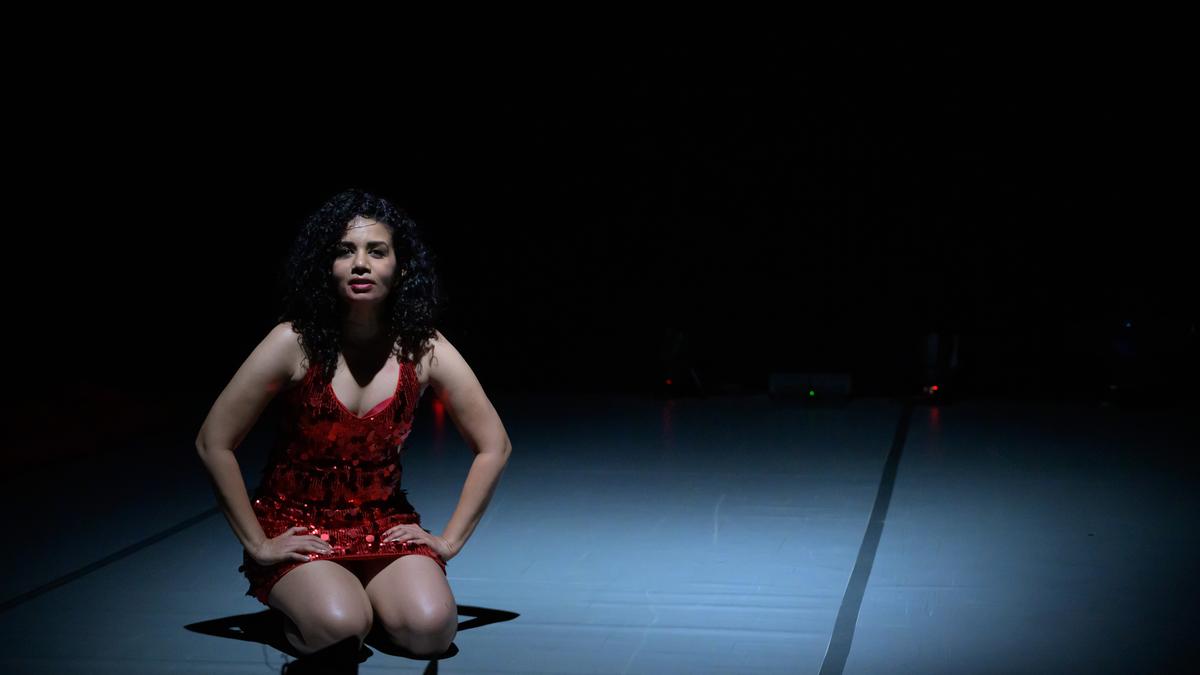
Preethi Athreya’s ‘Rubber Girl’ is a tribute to the cabaret
The Hindu
Experience Rubber Girl at G5A this weekend, a cabaret performance exploring dance, music, and rebellion in a unique setting.
Movement is any dance’s motor. But when it comes to cabaret, a theatrical form that also features music, song, recitation or drama, a dash of oomph is also a requisite.
This weekend at the Black Box, a unique black-chair multi-functional space that seats around 165, G5A presents plenty of all that makes cabaret memorable in Rubber Girl by Preethi Athreya.
G5A produces and co-creates interdisciplinary and multidisciplinary work often seen as experimental, and Preethi has been part of its In Residence programme, a production series that creates space for practitioners to explore their craft and expression and refine their practice. The work, which is grounded in traditional and contemporary performance methods, is then hosted over a period.
Preethi is a contemporary dancer based in Chennai who also trained in Bharatanatyam. After a post-graduate degree in Dance Studies from the Laban Dance Centre, London, she uses dance as an agent of change, constantly trying to free it from the strictures of more traditional dance practices. It is this blue-print that Preethi employs in Rubber Girl, a 57-minute performance where she looks at cabaret through different angles.
“Rubber Girl was the name given to Cuckoo Moray, an Anglo-Indian actress and cabaret dancer, who peppered many Hindi films of the 1940s and 1950s with her graceful moves,” says Pravin Kannanur, a Chennai-based multidisciplinary artiste overseeing the dramaturgy and technical direction of the performance.
“But Cuckoo Moray is not the subject itself. The pretext is the idea of the cabaret. Preethi will explore this idea, what it was in pre-war Europe, Edith Piaf’s torch ballads (laments on unrequited love) and how the German playwright Bertolt Brecht drew from the cabaret, among others. Cabaret allowed for a certain challenging of the status quo, the governing aesthetic of the time. It also challenged the political. The work also references the cabaret sequences in Indian films. Cuckoo’s moniker of the ‘rubber girl’ looks at erasure on the one hand, and the polyvalence of this person on the other,” says Pravin.
Rubber Girl has the structure of a travelogue, but it is not a history lesson or a linear production. “It juxtaposes the dance bars that were taken to court in India and how the cabaret has morphed into the discotheque space and other legitimate spaces. The idea is introduced through well-known songs such as ‘Mera naam chin chin chu’,” adds Pravin.


TGSRTC plans to cut CO2 emissions by 1,200 tons daily through the adoption of electric buses, enhancing sustainable public transport.

Parliamentary panel urges a review of EPF pensions, highlighting ₹1,000 is insufficient amid rising living costs.

ECI reshuffles 19 senior police officers in West Bengal ahead of upcoming Assembly elections, ensuring transparent and fair polls.

Rajasthan’s employment offices report no government job placements in five years, with over 22 lakh registered job seekers.

In a post shared in his X account, the actor also wrote about his emotional attachment to the State

NIA charges six in Puducherry BJP leader Senthil Kumaran's murder case for attempting to sabotage trial by threatening witnesses.

Bollywood star Hrithik Roshan’s HRX Films has teamed up with Prime Video for ‘Mess’ after the thriller series ‘Storm’. The latest series is directed by Rajesh A Krishnan

Bengaluru NGO PfA Wildlife Hospital replenishes water sources in Turahalli forest to protect urban wildlife from dehydration and human-animal conflict.

Bengaluru NGO PfA Wildlife Hospital replenishes water sources in Turahalli forest to protect urban wildlife from dehydration and human-animal conflict.

Andhra Pradesh Upa Lokayukta orders ₹50.24 lakh payment of EPF and ESI dues to KGBV outsourcing staff in Srikakulam.

Former Puducherry Congress MLA V. Vizeaveny joins BJP

Bajaj Electricals acquires Morphy Richards brand rights in India and South Asia, enhancing innovation and market strategy.

CPI(M) insists on contesting more seats in the 2026 Tamil Nadu Assembly elections amid ongoing seat-sharing negotiations with DMK.