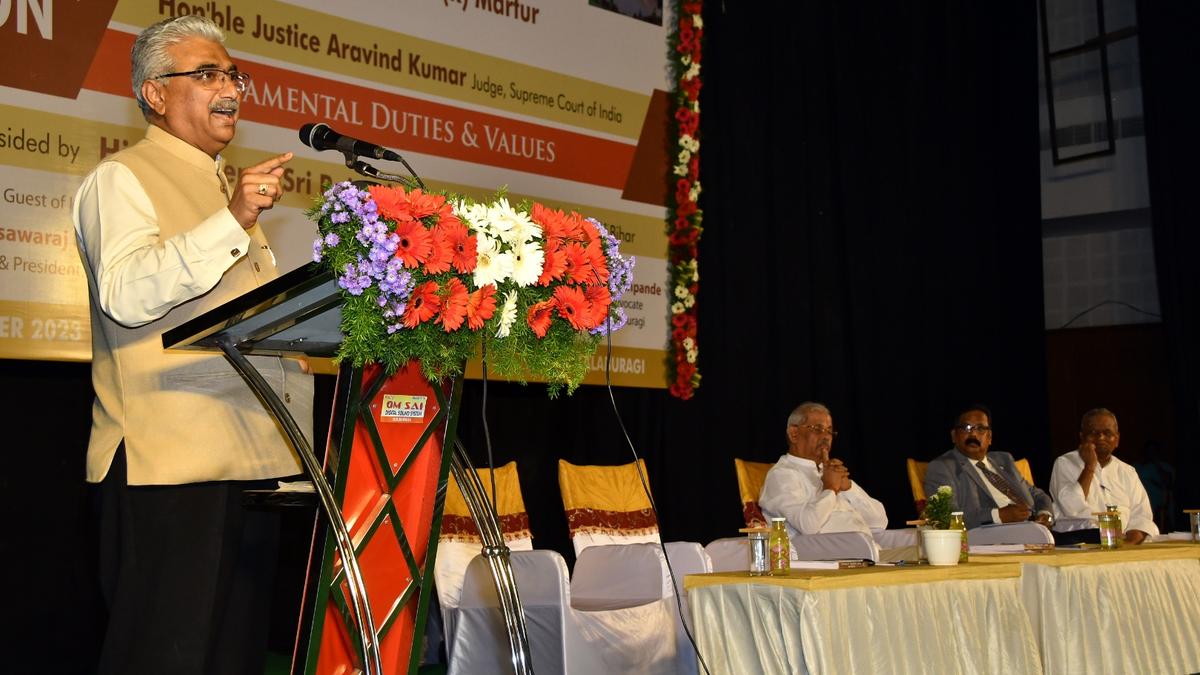
People’s rights do not exist in isolation but they are intrinsically connected to one’s duties, says judge
The Hindu
SC judge Arvind Kumar delivers 3rd Advocate B.B. Deshpande Memorial Oration, stressing on the importance of duties in upholding fundamental rights. He draws parallels between ancient Hindu religious texts and modern Constitution, emphasizing the timeless wisdom of Ramayana and Bhagavad Gita in shaping moral and ethical fabric of India. Principles of Natural Justice, Liberty, Equality and Fraternity are pillars of democracy, protecting individual freedom and forming essence of harmonious society.
“Principles of Natural Justice, Liberty, Equality and Fraternity are the pillars upon which our Democratic Republic stands. These principles are not mere words. They are the guiding stars that illuminate the path towards a just and equitable society. Embedded within the Constitution, we find Part 3 that guarantees the fundamental rights of our citizens. They serve as the bedrock of democracy ensuring that individual freedom is protected and cherished. However, it is crucial to recognise that these rights do not exist in isolation. They are intrinsically connected to the concept of duties. Just as every right carries a responsibility, every freedom bears an obligation to act responsibly and ethically. The symbolic relationship between the rights and the duties forms the essence of a harmonious society,” Supreme Court judge Aravind Kumar has said.
He was delivering a talk at the third Advocate B.B. Deshpande Memorial Oration Series at S.M. Pundit Rangamandir in Kalaburagi on Saturday. The event was organised by Advocate B.B. Deshpande Memorial Oration Series in association with Vijnaneshwara Pratisthan Trust, Martur.
Dwelling deep into the ancient Hindu religious texts such as the Vedas, the Upanishads, the Ramayana and the Mahabharata, Mr. Kumar made an attempt to compare the fundamental rights and duties of the modern times that evolved in the process of the Constituent Assembly debates and found a place in the Constitution with that of ancient Indian jurisprudence.
“In the ancient times, people and their lives were based on noble conduct. There was no written Constitution. They lived on the principle that those who protect Dharma will be protected by Dharma. Tell the truth and follow the Dharma, is the principle that every religion preaches. This is what the Vedas said about 6,000 years ago. They laid down the duties in the form of commands. It was considered that failure to perform individual duties will result in sin for which there was punishment in another world. If you ask me, I would say that our thoughts on religious texts and scriptures, which I believe in, are the rules of our duties which we refer to as Dharma, i.e., structured human behaviour,” Mr. Kumar said.
He termed the ancient texts, particularly the Ramayana and the Bhagavad Gita, as timeless narratives that are not just stories but depositories of wisdom that continue to shape the moral and ethical fabric of the country much like the Constitution does it today.
The former Rajya Sabha member and the head of Vijnaneshwara Pratisthan Trust Basavaraj Patil Sedam, Karnataka State Law University Vice-Chancellor C. Basavaraju and others were present.


Abhishek Banerjee challenges BJP's Suvendu Adhikari in Nandigram, pledging community health initiatives if Trinamool Congress wins.

Rising LPG shortages in Karnataka boost firewood demand, reviving an informal market as households and hotels seek alternatives.

Against the backdrop of intense poll activity, a 400-metre stretch of an arterial road in the outskirts of Chennai (technically in Madurapakkam panchayat under Tambaram assembly constituency) presents a salute to the idea of res publica, which underpins India’s system of governance, where citizens have a say, at least before a government is securely ensconced in the seat of power. A Republic Day initiative shines bright every night

Fadnavis claims zero FIR in Ajit Pawar crash is a defamation attempt by Karnataka against Maharashtra's investigation efforts.

Set to unfold as a one-day pop-up on April 5, the Easter Sadya brings together both vegetarian and non-vegetarian menus, offering a peek into the food traditions of the Syrian Christian (Nasrani) community. While the traditional Sadya is often associated with dishes such as sambar, avial, and rice, this version expands to include community-specific festive dishes.

BJP nominates mother of R.G. Kar victim Abhaya to contest from Panihati in West Bengal Assembly elections.

Veteran Malayalam actor-director E.A. Rajendran passes away at 71, leaving behind a rich legacy in the film industry.

Dakshina Kannada Zilla Panchayat has rolled out digital mode of water bill generation and collection in 23 gram panchayats on a pilot basis for the first time in Karnataka. This is set to be extended to the remaining 200 panchayats shortly, according to the Zilla Panchayat Chief Executive Officer Narwade Vinayak Karbhari.

Bengaluru police questioned a man carrying ₹6 lakh for medical expenses at Vidhana Soudha, later releasing him after verification.

BJP accuses Bengaluru's Congress government of corruption in e-Khata issuance, halting infrastructure projects due to financial mismanagement.

Misinformation in Hyderabad sparks panic buying, causing disruptions as residents react to unfounded rumors of an impending lockdown.

Bengaluru Metro extends services until 2 a.m. on March 28 for IPL match, ensuring convenient travel for spectators.

A bus truck-collision in Andhra Pradesh's Markapuram district, killing several. Catch LIVE updates here!