Patteda Anchu sarees: GI tag brings hope, but weavers need more to sustain the traditional craft
The Hindu
Gurulingappa Gombi, secretary of the Hatagar Nekar Samaj, says that for every one product that has got a GI tag, 10 have been left out. “Products like the cardamom garland from Haveri, Kala Bhat rice from Khanapur, small brinjal from Hukkeri, and Dyamanur Chilli from Kundgol, deserve to be included in the list,” he said. He wants the government to set up exclusive GI shops in districts and taluks, and to issue an order that GI products be given as gifts in government functions, instead of bouquets and shawls.
The Controller General of Patents, Designs, and Trade Marks and Geographical Indications granted the long-awaited ‘GI’ recognition to the Patteda Anchu saree from Gajendragad in Gadag district in north Karnataka in March.
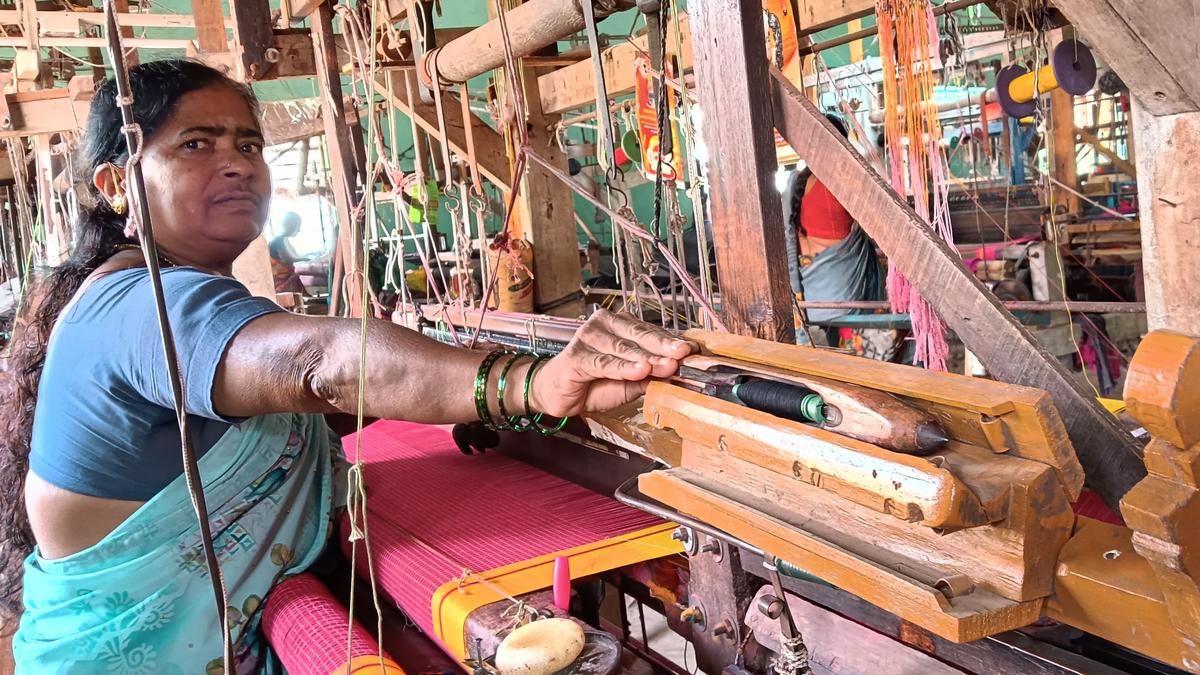
This traditional hand-woven cotton textile with natural colours is known for its bright colours and simple design. It earned its name from its large borders and chequered patterns. It is the daily wear of farm labourers and weavers in the region, known as ‘rough use saree’, made of coarse cotton fibre that can be easily washed and dried at home. Only yellow, blue, pink, green and maroon colours are used for dying. Black and grey are not used as they are considered “inauspicious”.
The sap of plants, like ladies finger, acasia gum and a light coloured mud found along village tanks, is used as the base for preparing the colours of these sarees.
“Patteda Anchu sarees are produced by individuals, and members of cooperative societies and groups in and around Gajendragad. The saree weaving tradition is unique because weavers do it sitting in kuni looms, dug into the earth. It is part of the living tradition in weaving, and is at least 500 years old,” said N. Gopikrishna, a handicrafts promoter.
“We are happy to get the GI certificate as we believe it will protect our craft in future,” Maruti Shabadi, secretary of the Gajendragad Weavers’ Cooperative Producers Society, told The Hindu.
The first application was filed in 2019, as the society wanted to fight against the rising trend of mass produced power loom sarees.
The society, established in 1944, has 1,127 members of which 137 members transact regularly, by buying raw material and selling sarees to the society. It employs around 30 weavers, who are paid around ₹200 per saree. The society sells sarees in the range of ₹700-₹1,000. The society produces around 25 sarees per day.


Nvidia chief Jensen Huang on Monday said the leading artificial intelligence chip maker is heading for space with a goal of powering orbiting data centres.

Meta Platforms shares rose nearly 3% on Monday after a Reuters report that the social media giant plans to lay off 20% or more of its workforce to offset heavy spending

Wholesale price inflation hits 11-month high at 2.13%, driven by rising crude prices and increased costs across various sectors.

Kerala's wellness sector faces uncertainty due to the West Asian crisis, impacting tourism and threatening economic stability.

Experts link Punjab's distress migration to economic stagnation and job mismatches, highlighting systemic failures in political leadership.

India's merchandise exports remain flat in February, with Commerce Secretary warning of a potential dip in March due to trade constraints.

Hard Rock International closes 10 outlets in India, including three cafes in Bengaluru, while Goa hotel remains open.

The booming market for artificial intelligence servers brought Taiwan's Foxconn a 24 percent jump in annual net profit, the company said

In a statement on its website, Adobe said it has in recent years streamlined its sign-up and cancellation processes and made them more transparent.

Stock markets recover as Sensex and Nifty bounce back following a three-day slump, driven by value-buying in blue-chip stocks.

U.S. President Donald Trump’s administration is set to receive a roughly $10 billion fee from investors in the recently completed deal to take control of TikTok’s U.S. business, the Wall Street Journal reported

Meta is planning sweeping layoffs that could affect 20% or more of the company, three sources familiar with the matter told Reuters

Learn how to choose the best personal loan lender by evaluating eligibility, interest rates, and borrowing experience.