Odissi, art and movement converge in Let a Thousand Flowers Bloom exhibition in Chennai
The Hindu
An exhibition at Lalit Kala Akademi traces how the grace, rhythm and philosophy of Odissi move beyond the stage, finding form in painting, drawing and photography
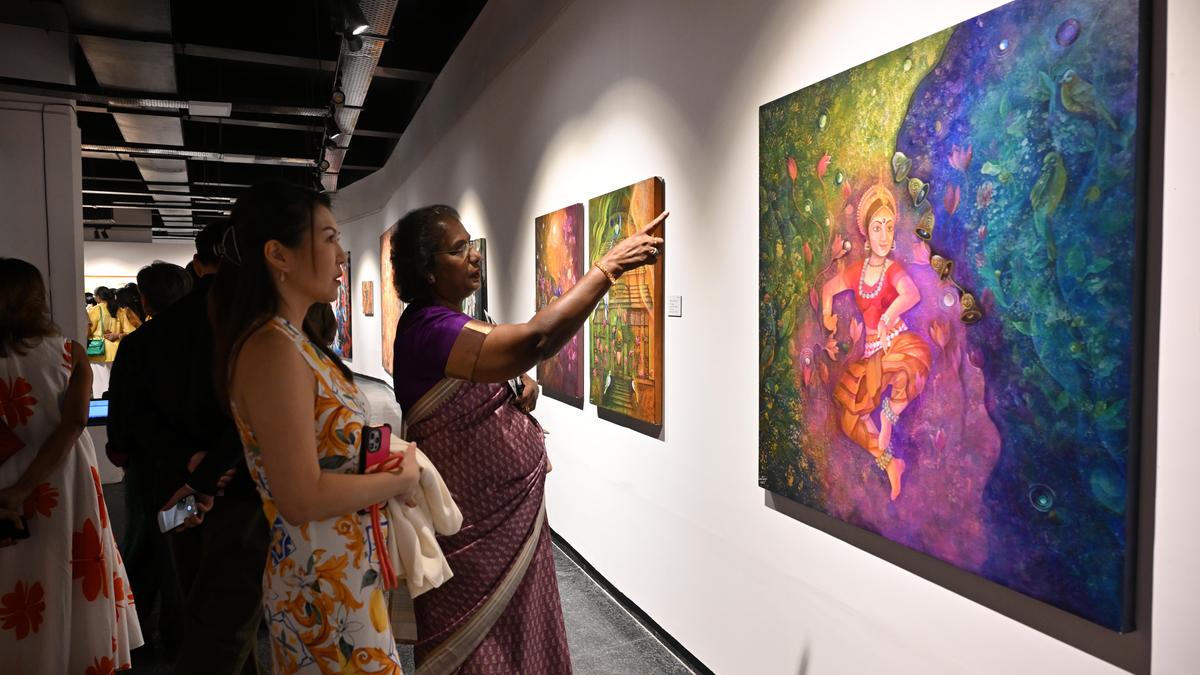
Lalit Kala Akademi will be transformed into a visual tribute to Odisha and its classical dance Odissi, over six days. In Let a Thousand Flowers Bloom, the sensuous curves, silences and rhythms of Odissi step off the stage and onto the canvas, paper and photograph. At the heart of this exhibition is Datuk Ramli Bin Ibrahim — dancer, choreographer and founder of Sutra Foundation (dedicated to promoting and preserving traditional and contemporary performing arts) — whose interpretation of Odissi has inspired artistes for decades. Bringing together drawings, paintings, and photographs by 21 artists from India and Malaysia, many of the works respond directly to Ramli’s body, presence and philosophy, treating him both as a medium and a muse.
The exhibition is also a tribute to the late Dr Dinanath Pathy, artist and scholar who connected dance with visual work, and contributed to Sutra in many ways. Travelling through Chennai, Bhubaneshwar, and Malaysia, the exhibition showcases Odissi as a vibrant art form, one where the essence of its movements lingers well beyond the performance.
From Bhubaneshwar, artist Helen Brahma’s series, Penari Ulung (The Transcendental Dancer), explores her relationship between textile and culture. At the heart of her work is the Sambalpuri textile, draped around Odissi dancers. “The ikat motifs used all over the body of the dancers are intimate to my cultural roots,” says Helen. The portraits embody the divine feminine, but are also inspired by Ramli’s moves that have moved her profoundly. Similarly, another artiste from Chennai AV Ilango , has used acrylic on canvas to bring out the subtle movements and the grace of the dance form. The palette is ripe with the colours of India — mango yellow, marigold, chilli red, royal purple, peacock blue, emerald and parrot green embracing the outfits of the dancers.
Extending the dialogue between movement and image, the exhibition also presented a series of photographic works. For instance, Malaysian photographer Diana Lui’s series of photographic prints presented at the exhibition is a selection of a larger body of work made in the 1990S. The photographs on canvas follow a younger Ramli, and his dancers caught mid-dance form, as their bodies yield to the cadence of music. “I come from a background in dance. For me, everything is linked to movement — the gestures of the body are deeply tied to how we express our inner identity,” says Diana.
Malay artist Shivarajah Natarajan, who also serves as a curator of Malaysian artists, has his canvases unfold as a visual stage where drama, emotion, and rhythm are showcased with evocative clarity. A striking artwork titled The Great Migration embodies the ancient tales of matsya avatar, the fish incarnation of Vishnu. The work reimagines these ancient tales through the rising sea levels all over the world today. Look closer, and the shadow is also telling a story. “People think that shadow has nothing, it’s all black, but in my painting, both shadow and light have their own emotions,” says Shivarajah. The faint silhouette of the Jagannath Temple in Puri emerges in the background, drawing viewers closer to Odisha.
Sacred Moments by Shalini Biswajit | Photo Credit: SPECIAL ARRANGEMENT


The government plans to amend the FCRA, introducing new regulations for NGO asset management and accountability for key functionaries.

The draft policy for “Responsible Digital Use Among Students”, released on Monday by the Department of Health and Family Welfare, has recommended that parents set structured routines with clear screen-time rules and prioritise privacy, safety, and open conversation with children on digital well-being.

Police Observer Sushant Kumar Saxena conducts surprise inspection at Shencottai police station, reviewing warrants and security arrangements ahead of elections.

Andhra Pradesh government to launch key projects in April, focusing on industrial growth and infrastructure development, says Nara Lokesh.

Lok Sabha refers the Corporate Laws (Amendment) Bill to a JPC amid opposition concerns over CSR provisions dilution.

SHG members in Kanniyakumari use snakes and ladders to raise election awareness and boost voter turnout.

Government accelerates consultations for early implementation of the Women’s Reservation Act to ensure women’s representation in 2029 elections.

CM A. Revanth Reddy distributes ₹1 crore insurance cheques to families of deceased Electricity department employees, enhancing financial security for workers.

The Bengaluru Traffic Police (BTP) registered 634 cases of drunk driving during a week-long special enforcement drive conducted across the city between March 16 and March 22.

GHMC intensifies action against property tax defaulters, seizing properties and offering a One Time Settlement scheme for payments.

CCB arrests three drug peddlers in Mangaluru, seizing ₹2.5 lakh worth of MDMA and other valuables.

TVK's 28 candidates in Puducherry include former BJP MLAs, a sitting Independent, and a retired police IG.

BRS submits notice on private member bill to Speaker