No brain, no problem: Tiny jellyfish can learn from experience
The Hindu
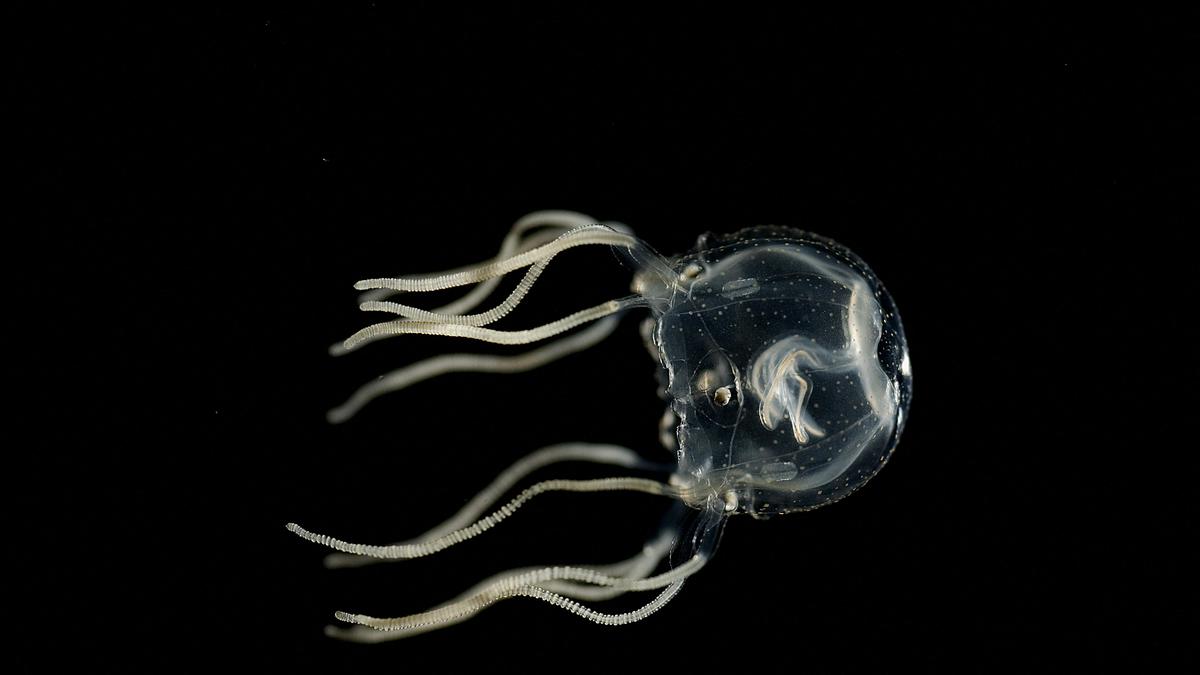
Tiny caribbean box jellyfish are capable of learning from visual cues to avoid swimming into obstacles -- a cognitive ability never before seen in animals with such a primitive nervous system
Caribbean box jellyfish are barely a centimetre long and have no brain.
But these gelatinous, fingernail-sized creatures are capable of learning from visual cues to avoid swimming into obstacles -- a cognitive ability never before seen in animals with such a primitive nervous system, researchers said on Friday.
Their performance of what is called "associative learning" is comparable to far more advanced animals such as fruit flies or mice, which have the notable benefit of having a brain, the researchers said.
The Caribbean box jellyfish, or Tripedalia cystophora, is known to be able to navigate through murky water and a maze of submerged mangrove roots.
These scenarios throw up plenty of dangers that could damage the jellyfish's fragile gelatinous membrane which envelops its bell-shaped body.
Also Read | India adds 664 animal species to its faunal database in 2022, 339 taxa to its flora
But they avoid harm thanks to four visual sensory centres called rhopalia, each of which has lens-shaped eyes and around a thousand neurons.


PM Modi praises Bihar's rich culture and history in a heartfelt letter to CM Nitish Kumar on Bihar Diwas.

Former Minister Semmalai urges parties to limit freebies and prioritize development for Tamil Nadu's future prosperity.

Congress and DMK are set to share 15 seats each for the Puducherry Assembly elections on April 9, 2026.

Four Assam police commandos injured in an extremist attack during a gunfight in Tinsukia district, officials report.

Belagavi ZP CEO emphasizes innovative marketing for farmers and artisans, collaborating with Exim Bank to boost exports and opportunities.

Mizoram's civic body election heats up as parties finalize candidates and campaign strategies ahead of the April 21 polls.

Congress nominates Umesh Meti and Samarth Mallikarjun for Karnataka bypolls, keeping candidacies within influential families.

South Africa wins the toss and opts to bat in the fourth T20 match against New Zealand in Wellington.

High in the Nilgiris, a quiet ecological revival is underway. Once lost to plantations and invasive species, native grasslands and shola forests are slowly returning—bringing back wildlife, improving water security, and strengthening climate resilience. Driven by civil society groups, conservationists, and indigenous communities, this restoration story offers hope at a time when fragile ecosystems across India face growing threats.

Blasts and sirens sounded in Jerusalem as Israel warned of incoming Iranian missile threats amid escalating tensions.

275 former judges and officials criticize USCIRF's report on religious freedom, calling it biased and lacking credible evidence.

Jharkhand Police request Indian Army's help to safely defuse an active WWII-era bomb found near Subarnarekha river.

Tamil Nadu Assembly election: VCK under compulsion to consider local candidates, says Thirumavalavan
VCK leader Thirumavalavan emphasizes the need for local candidates amid concerns over past electoral losses due to outsiders.