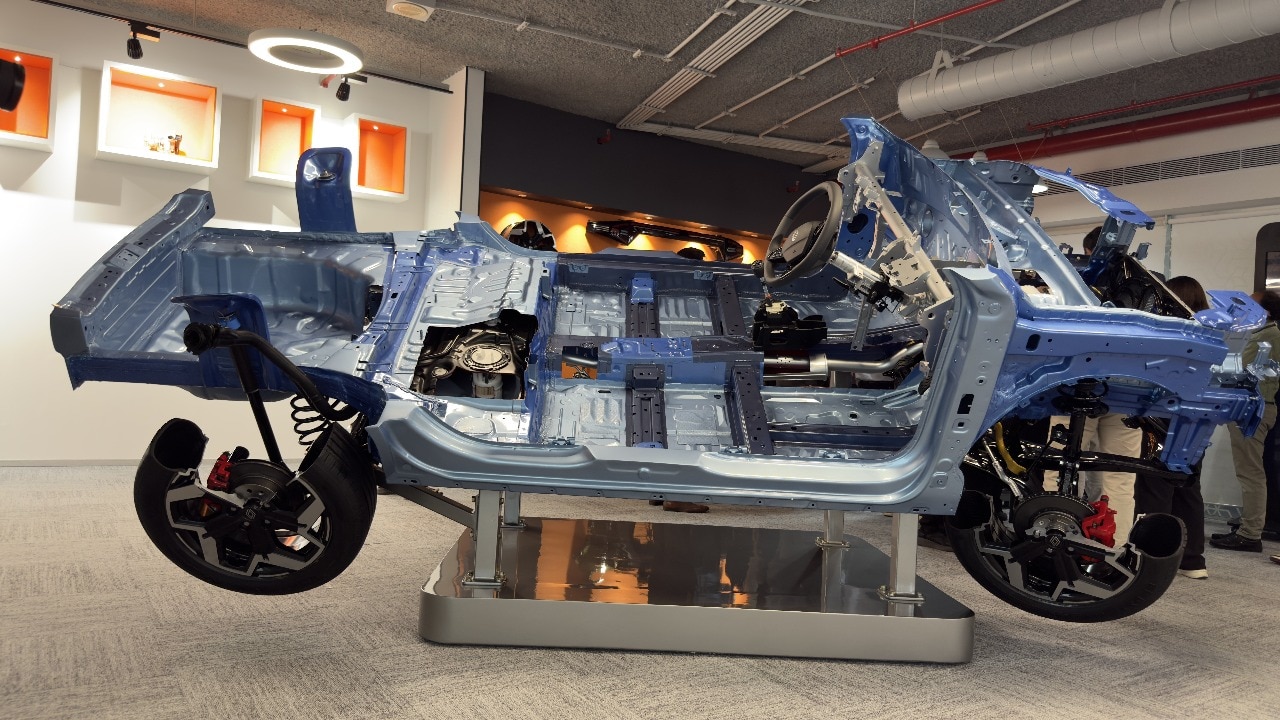
New Renault Duster's RGMP platform explained: What makes it India-ready
India Today
The upcoming Renault Duster for India introduces Renault's RGMP platform, a reworked architecture that differs from the global CMF-B base with upgrades in electronics, modularity and electrification capability.
Renault recently unveiled the India-spec Duster, and one of its biggest changes isn’t something you’ll notice right away. Beneath the design and silhouette lies a new technical foundation that Renault says has been developed specifically with markets like India in mind. India-bound Renault Duster
While the global Duster sold in Europe sits on the CMF-B platform, the India-bound version uses a different architecture called RGMP (Renault Group Modular Platform). At a glance the two platforms appear closely related, and that’s because they share much of their structural DNA. However, Renault has made several important changes that give the RGMP its own identity.
Here’s a closer look at what makes this platform different and why it matters for the Duster’s comeback in India.
One of the most significant upgrades in the RGMP platform is its electrical and electronics backbone.
Renault has introduced a new system called SWEET400 (Software Electric and Electronic Technology), developed in collaboration with Google. Unlike conventional vehicle electronics that operate in isolated modules, this architecture connects multiple vehicle systems through a more integrated software ecosystem.
This means the car’s infotainment, climate control, driver profiles and several other functions can communicate seamlessly. Owners will be able to log in using their Google accounts, enabling the vehicle to automatically load personal settings such as navigation data, music preferences, cabin temperature and even certain driver-assistance configurations.


The iQOO Z11x 5G, which launched on March 12, goes on sale today on Amazon. The device is available in three storage configurations and two colour options. Here is everything you need to know.

Indian-origin developer Aman Gottumukkala, founder of AI coding assistant Firebender, has joined Elon Musk's xAI to build advanced coding AI systems. His move comes as AI companies race to create powerful tools that can help developers write software faster.

Among the fashion standouts at the Oscars 2026 were Nicole Kidman, Teyana Taylor, Priyanka Chopra, Emma Stone, Audrey Nuna, Anne Hathaway and Pedro Pascal.

Thousands of degree certificates and mark sheets have remained unclaimed in several colleges for nearly four decades. Students passed their exams but never returned to collect their documents, leaving institutions struggling to store the growing pile of academic records.

In a small classroom in Aligarh's government school, waste materials are turning into machines. A government school teacher is guiding students to build simple robots and drones using scrap, helping them understand science through hands-on learning.

Elon Musk's satellite internet service, Starlink, is now available in Kuwait. This announcement comes at a time when the country has found itself impacted by the US-Israel war with Iran.

Delhi University has rejected Rahul Gandhi's claim of caste bias in interviews. In a post on X, the university said the Leader of the Opposition should verify facts before making such statements.

Apple is rumoured to be making its debut in the foldable smartphone market this year with the iPhone fold. From the design to the features, and the expected price, here is everything you need to know about the first-ever foldable iPhone.

The Central Board of Secondary Education, CBSE, has cancelled the Class 12 board examinations in several Middle Eastern countries due to the ongoing US-Israel-Iran war. The board also confirmed that the mechanism for announcing results for affected students will be announced at a later stage.

Chinese giant ByteDance has reportedly suspended its plans to release its latest AI video generation model, SeeDance 2.0, after major Hollywood studios raised disputes over copyright violations.

Bidyut Innovation MD Rahul Shah spoke during the India Today Conclave 2026. Shah reckoned that India could soon have its own robots competing those from other countries, perhaps at a fraction of the cost.

Alpha High School, an AI-driven education institute is rolling out a new course with a promise – earn $1 million by the time you graduate or you get a full refund. Here is how it works.

Devendra Singh Chaplot, an IIT Bombay alum has joined xAI to build super intelligence. His arrival was welcomed by xAI chief Elon Musk. Here is everything you need to know about xAI's latest Indian origin member.