Mumbai Climate Week 2026: Bela Gram emerges as Maharashtra’s first net-zero village through panchayat leadership
The Hindu
Bela Gram becomes Maharashtra's first net-zero village, showcasing panchayat leadership's crucial role in local climate action during Mumbai Climate Week 2026.
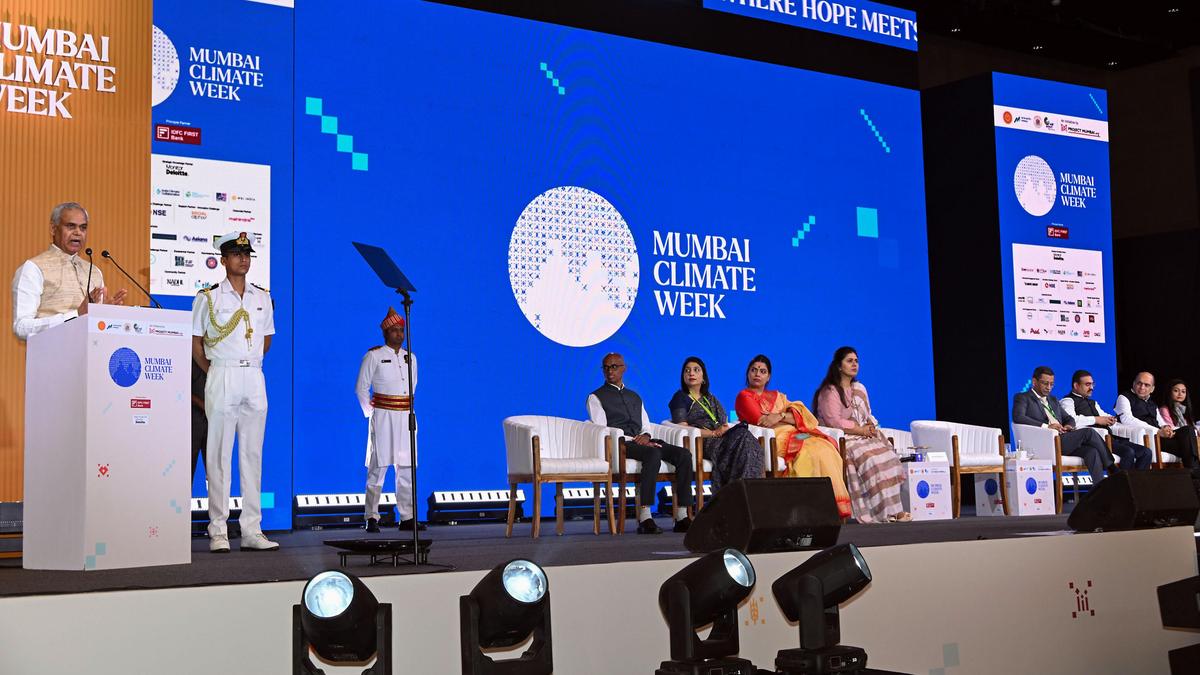
Bela Gram in the Bhandara district of Vidarbha region of Maharashtra, India’s first net-zero panchayat, was highlighted during the Mumbai Climate Week 2026 on Thursday (February 19, 2026), reflecting that panchayat leadership plays a vital role in shaping localised climate action and combating climate change.
“Climate change is first felt by common people in daily routines; in the food you grow, water you fetch. The impacts are visible when it affects health. So, for us, climate action begins at home, when the Panchayat guides, people participate, and change starts,” said Sharada Gaydhane, the Sarpanch of Bela Gram, who led the initiatives to make her village a net-zero panchayat.
Bela Gram panchayat planted more than 90.000 trees during weddings and festivals. It also advocated for a smooth energy transition from smoky chulhas to LPG, installed solar panels at homes, anganwadis, and Panchayat offices. “We also promoted waste segregation at doorsteps and achieved the vanishing of single-use plastics,” said Ms. Sharada Gaydhane, who was twice-elected Sarpanch and a recipient of the Vasundhara awardee.
Bela became Maharashtra’s first net-zero village, receiving the 2024 Rashtriya Panchayat Puraskar. Ms. Sharada Gaydhane, in her blue saree and fixing her glasses, says, “Waste can be converted into wealth if thought properly.”
Ms. Sharada Gaydhane’s story reflects that the panchayat leadership could be a driving force to implement climate action plans, which also became the focus of the panel discussion “From the frontline: Panchayats leading India’s climate change” at Mumbai Climate Week 2026, bringing in voices of panchayat-level leadership, who has brought change in their villages from six States including Karnataka, Kerala, Bihar, Jharkhand and Odisha.
“Bringing out this stories to put light on local and evidence-based solutions to implement long-term climate action plans considering the socio-economic and climate realities,” said Arindam Banerjee, co-founder and partner, Policy & Development Advisory Group (PDAG), hoping that Conference of the Parties (CoP) will help drive a uniform nationwide local climate action platform by 2028 with the proposed global CoP33 to be held in India.


‘The Gallery Of Upside Down Women’, a poetry book by Arundhathi Subramaniam chronicles complex women through history

Kerala's final voters list reveals 2.69 crore voters, with publication set for February 21, 2026.

Fire at Aditya Enclave in Hyderabad's Ameerpet causes panic, but no casualties reported; investigation underway.

Supreme Court dismisses plea to ban naming mosques after Babur, affirming their right to use historical nomenclature.

Ramesh Chennithala claims UDF will win 100 seats in Kerala, criticizing government misuse of resources ahead of elections.

Tension rises in Belagavi village after Sangolli Rayanna statue is desecrated, sparking protests and police investigation.

Sachin Pilot urges a transparent investigation into Ajit Pawar's death, linking it to personal loss and safety concerns.

Unions praise Tamil Nadu's ₹2,446.46 crore allocation for settling terminal benefits for 6,867 retired transport employees.

Karnataka's Guru Spandana adalat will address government teachers' grievances in Mangaluru on February 21.

Rahul Gandhi to appear in Sultanpur court for defamation case linked to remarks against Amit Shah dating back to 2018.

A surgical instrument was discovered in a Kerala woman's abdomen five years post-surgery, prompting an inquiry into medical negligence.

MM Baig was known for directing two films including Naseeruddin Shah’s ‘Massom Gawah’ (1990), which remains unreleased, and ‘Chhoti Bahu’ (1994), starring Shilpa Shirodkar.

Madras HC orders DVAC to register a case in cash-for-jobs complaint against K.N. Nehru’s Municipal Administration Dept.