Minnesota elections office subpoenaed in federal criminal probe over whether non-citizens are on state voter rolls, sources say
CBSN
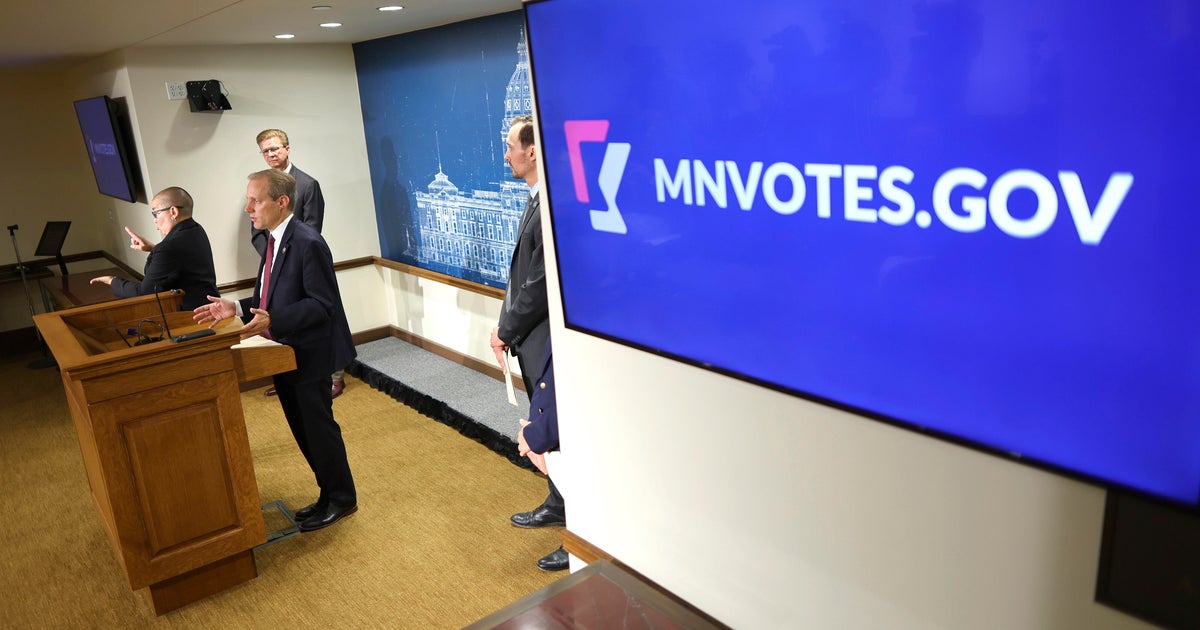
The Minnesota Secretary of State's Office has received a grand jury subpoena ordering it to turn over certain individual voter records, as part of a federal investigation into whether non-citizens are registered or have unlawfully cast ballots, sources with direct knowledge told CBS News. In:
The Minnesota Secretary of State's Office has received a grand jury subpoena ordering it to turn over certain individual voter records, as part of a federal investigation into whether non-citizens are registered or have unlawfully cast ballots, sources with direct knowledge told CBS News.
The investigation, which is being run by the Justice Department and the Department of Homeland Security, appears to represent an escalation in an ongoing dispute between states and the federal government over efforts to review states' voter rolls.
Federal prosecutors and investigators are seeking records pertaining to more than 125 individuals, one of the sources said. To date, no one has been criminally charged.
The criminal investigation is separate from civil litigation that is currently pending against Minnesota by the Justice Department's Civil Rights Division, which is trying to convince a federal judge to force the state to hand over a complete unredacted voter registration list. The DOJ is suing dozens of other states and the District of Columbia over the same issue.
A spokesperson for the Minnesota Secretary of State's Office did not immediately respond to a request for comment.


All but four of the passengers injured in Sunday's deadly collision between an Air Canada plane and a fire truck have been released from the hospital, the airline said Wednesday, as crews began moving the mangled aircraft off the runway at New York's LaGuardia Airport. In:

President Trump will soon nominate a permanent director for the Centers for Disease Control and Prevention, its acting chief, National Institutes of Health Director Jay Bhattacharya, told agency employees at a Wednesday staff meeting. In:

The Federal Emergency Management Agency on Wednesday opened applications for a major resilience grant program that the agency canceled last year, less than three weeks after a federal judge ordered FEMA to make the funding available. In:

From missed doctor's appointments to lost wages, Minneapolis and St. Paul residents faced widespread disruptions to their daily lives when the White House deployed thousands of federal immigration agents to their cities, a University of San Diego survey released this week found. In:

The U.S. Postal Service is temporarily hiking postage prices to account for surging fuel costs caused by the Iran war, the agency announced on Wednesday. Edited by Alain Sherter In:

A panel of appeals court judges handed the Trump administration a major legal victory on Wednesday in its quest to detain large swaths of immigrants living in the country illegally, saying that people who entered the United States without inspection and admission can be detained without bond. Jonah Kaplan and Camilo Montoya-Galvez contributed to this report.

The White House has rejected an offer from billionaire Elon Musk to fund pay TSA workers during a partial government shutdown that has disrupted airport travelers across the country, several sources told CBS News. Kristin Brown and Kathryn Krupnik contributed to this report. In:

Washington — The Justice Department has reached a settlement with former Trump national security official and right-wing activist Michael Flynn after he sued the department, alleging that he was wrongly prosecuted during the first Trump administration. In:

The Trump administration will temporarily lift summer gasoline regulations as prices at the pump near $4 a gallon amid the Iran war. Edited by Aimee Picchi In:

Some of America's wealthiest couples are collecting $100,000 in Social Security benefits — a six-figure payout that a new proposal says should be capped to help the retirement program avoid insolvency in 2032. Edited by Alain Sherter In:

El Paso and Los Angeles were among the most polluted areas in the United States last year, according to a new air quality report that evaluated pollution levels around the world in 2025. In:

Washington — For the first time in history, a robot, not a person, escorted the first lady of the United States Wednesday at the White House.

A jury on Wednesday found that Meta and YouTube are liable for creating products that led to harmful and addictive behavior by young users, a landmark decision that could set a legal precedent for similar allegations brought against social media companies. Edited by Alain Sherter and Aimee Picchi In: