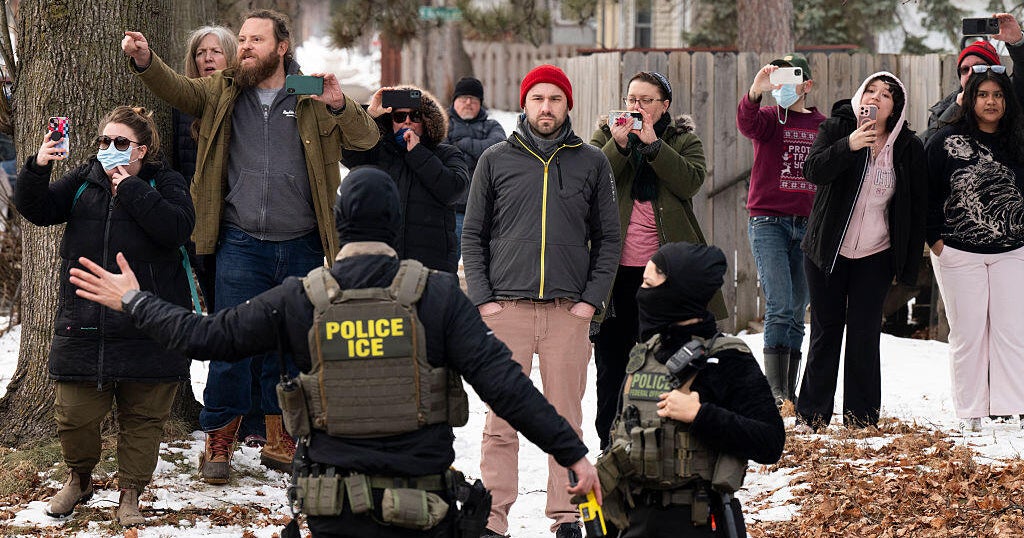
Twin Cities residents missed work, school and lost trust in law enforcement during Operation Metro Surge, survey finds
CBSN
From missed doctor's appointments to lost wages, Minneapolis and St. Paul residents faced widespread disruptions to their daily lives when the White House deployed thousands of federal immigration agents to their cities, a University of San Diego survey released this week found. In:
From missed doctor's appointments to lost wages, Minneapolis and St. Paul residents faced widespread disruptions to their daily lives when the White House deployed thousands of federal immigration agents to their cities, a University of San Diego survey released this week found.
Survey respondents reported missing work and skipping scheduled medical appointments during the immigration crackdown, also known as Operation Metro Surge, in which more than 4,000 federal agents were deployed to the Twin Cities between December and mid-February. Some also said they kept children home from school.
Some reported they were physically assaulted by U.S. Immigration and Customs Enforcement agents, and the majority said they now have less trust in law enforcement in general, the survey found.
More than 35% of those surveyed in Minneapolis and about 20% of those surveyed in St. Paul reported missing work during the operation, most often because their workplace closed or they were concerned for their safety.
Those who reported missing work included service workers, physicians and nurses. The study estimated that there was a combined $243.8 million in lost wages in Minneapolis and St. Paul during Metro Surge.


"Today" show co-host Savannah Guthrie said her family is in agony as she made a tearful plea for someone "to do the right thing" nearly two months after her mother Nancy Guthrie disappeared from her Arizona home. In:

Washington — The Supreme Court on Wednesday ruled that internet service provider Cox Communications cannot be held liable for copyright infringement by its subscribers in a closely watched dispute over pirated music.

Joey Amor says his wife, Army Sgt. 1st Class Nicole Amor, was "the rock" and "the glue" for those around her — a role he says defined her life and service before she was killed earlier this month during the war with Iran. In:

An internal watchdog report in the Department of Homeland Security identified serious vulnerabilities in TSA's screenings at airports nationwide — and the agency has yet to respond five months later, according to internal communications provided to House Homeland Security Committee staff and reviewed by CBS News.

Two orphaned bear cubs are settling in at a California animal welfare center after their mother was euthanized for attacking people, the San Diego Humane Society said Tuesday. In:

Travelers at a Houston airport voiced shock and disbelief over seemingly endless TSA security lines caused by a severe staffing shortage. In:

Paul Kovacich, a K-9 commander serving life for his wife's 1982 murder, has a mixed message for the California parole board ahead of his first chance of freedom: He doesn't want an early release — and he didn't kill his beloved German shepherd. In:

A California court denied the state attorney general's appeal to halt the Riverside County Sheriff's election fraud investigation on Tuesday. In:

The Justice Department's investigation of a $2.5 billion renovation project at the Federal Reserve didn't find any evidence of a crime, a federal prosecutor privately conceded under questioning by a skeptical judge earlier this month, according to a transcript of the sealed hearing. In:

Early this week, Senate Republicans and the president appeared to be edging closer to a framework to ending the Department of Homeland Security shutdown, which is now in its second month — but a breakthrough has remained out of reach.

Democrat Emily Gregory won a special election for a Florida state House seat on Tuesday, The Associated Press has projected, flipping a district that is home to President Trump's estate, Mar-a-Lago. In:

The two Canadian pilots who died in Sunday's runway collision at LaGuardia Airport in New York were young, ambitious men at the start of their careers who each had pursued their yearslong dream of flying. In:

A judge sharply questioned a lawyer for the federal government on Tuesday over the Pentagon's efforts to cut Anthropic out of its classified systems — the latest development in a dispute between the company and the Trump administration over AI guardrails. In: