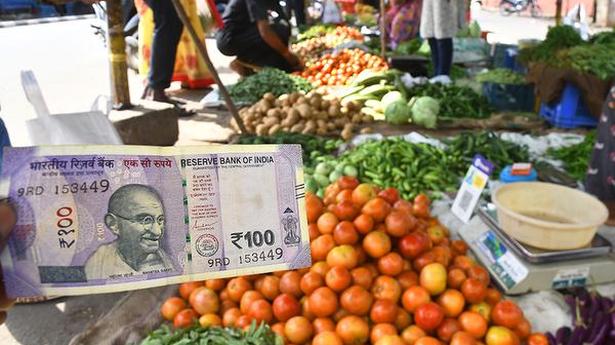
Measures to cool food inflation will deliver in coming weeks, says Finance Ministry
The Hindu
Core inflation below 6% for 4th successive month, says Finance Ministry
The Finance Ministry late Monday termed the increase in retail inflation from 6.71% in July to 7% in August as ‘moderate’, and attributed it to an adverse base effect and an increase in food and fuel prices, which it called “the transient components” of Consumer Price inflation.
Core inflation, which excludes these ‘transient components’ of food and beverages as well as fuel and light inflation, was recorded at 5.9% in August, remaining below the tolerance limit of 6% for the fourth consecutive month, the Ministry emphasised.
“Despite erratic monsoons and negative seasonality in vegetable prices, food inflation in July still lower than the April peak of the current year. To soften the prices of edible oils & pulses, tariffs on imported items have been rationalised periodically & stock limits on edible oils have been kept, to avoid hoarding,” the Ministry said.
Stressing that inflation in “oils and fats” and “pulses and products” have moderated to 5.62% and 2.52% respectively, the Ministry said the Government “has prohibited exports of food products like wheat flour/atta, rice, maida, etc. to keep domestic supplies steady and curb rise in prices”.
“The impact of these measures is expected to be felt more significantly in the coming weeks and months,” it underlined.
“With global inflation pressures, inflationary expectations remain anchored in India with stable core inflation,” the Ministry said, citing a July survey by IIM-Ahmedabad which said ‘one-year ahead Business Inflation Expectations Survey has declined by 34 basis points to 4.83% from 5.17% in June’. One basis point equals 0.01 percentage points.
“Inflation expectations have fallen below 5% after 17 months,” the Ministry said. “Prices of major inputs like iron ore & steel have sobered in the global markets. This, coupled with the measures taken by the Govt. to rationalise tariff structures of inputs to augment domestic supply, has helped to keep cost push inflation in consumer items under control,” it concluded.


The rupee declines 14 paise to 92.42 against the dollar amid rising crude prices and foreign fund withdrawals.

Dell’s total workforce declined by about 10%, or 11,000 employees, in fiscal 2026, it said on Monday

Nvidia chief Jensen Huang on Monday said the leading artificial intelligence chip maker is heading for space with a goal of powering orbiting data centres.

Meta Platforms shares rose nearly 3% on Monday after a Reuters report that the social media giant plans to lay off 20% or more of its workforce to offset heavy spending

Wholesale price inflation hits 11-month high at 2.13%, driven by rising crude prices and increased costs across various sectors.

Kerala's wellness sector faces uncertainty due to the West Asian crisis, impacting tourism and threatening economic stability.

Experts link Punjab's distress migration to economic stagnation and job mismatches, highlighting systemic failures in political leadership.

India's merchandise exports remain flat in February, with Commerce Secretary warning of a potential dip in March due to trade constraints.

Hard Rock International closes 10 outlets in India, including three cafes in Bengaluru, while Goa hotel remains open.

The booming market for artificial intelligence servers brought Taiwan's Foxconn a 24 percent jump in annual net profit, the company said

In a statement on its website, Adobe said it has in recent years streamlined its sign-up and cancellation processes and made them more transparent.

Stock markets recover as Sensex and Nifty bounce back following a three-day slump, driven by value-buying in blue-chip stocks.

U.S. President Donald Trump’s administration is set to receive a roughly $10 billion fee from investors in the recently completed deal to take control of TikTok’s U.S. business, the Wall Street Journal reported