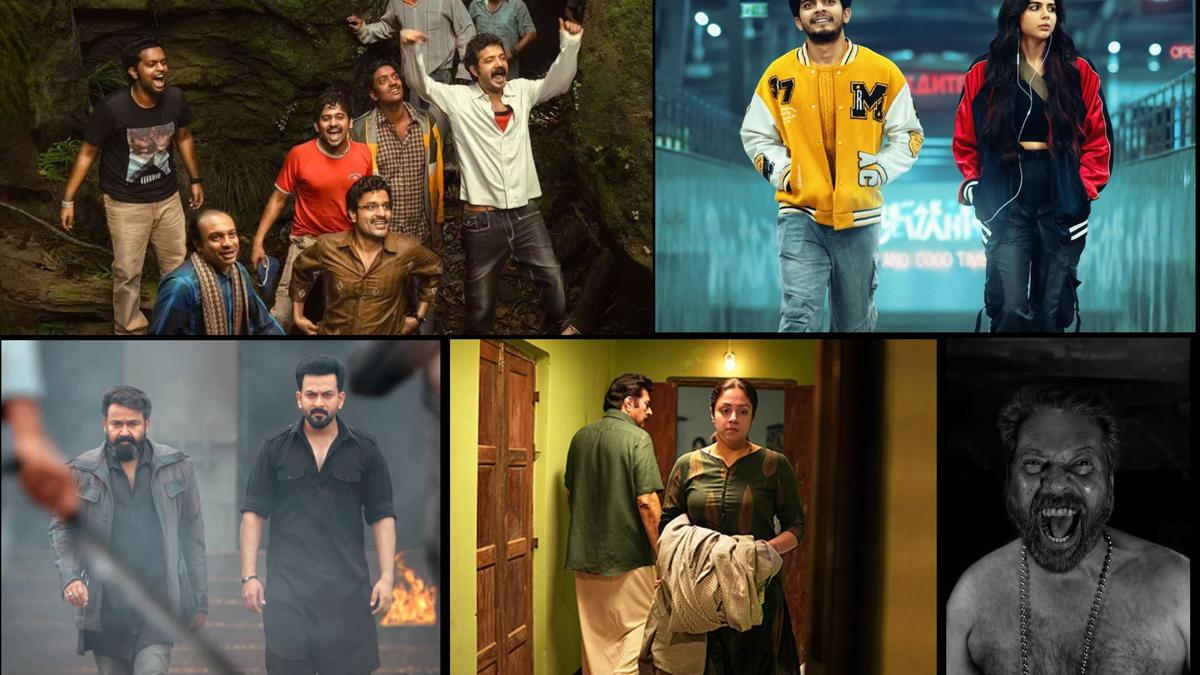
Malayalam film world: breaking conventions, finding new vistas Premium
The Hindu
The stories one associates with the Malayalam film industry these days are joyous. But almost a century ago, its beginnings were steeped in tragedy
The stories one associates with the Malayalam film industry these days are joyous — of it making yet another movie that defies conventional box office logic, of it telling a familiar story in unexpected ways, or of it conquering some uncharted territory. But almost a century ago, its beginnings were steeped in tragedy. J.C. Daniel, who became Malayalam cinema’s first filmmaker with Vigathakumaran (1930), never made another film. P.K. Rosy, the first Malayali heroine, had to flee the State after facing attacks from upper-caste men who couldn’t stand a Dalit woman playing an upper-caste character. Her face was never seen on screen again.
Cinema might have seemed a doomed enterprise back then in these parts — in the yet-to-be-formed Kerala, divided between princely states and the British Raj. The people of this land, fettered by feudal, casteist, and royal oppression, took their own sweet time warming up to one of the youngest art forms. Renaissance movements were only beginning to bring about progressive changes, while the socio-cultural-political churn birthed by Communism was still years away.
Malayalam cinema, now being discovered and garnering praise from the unlikeliest of places, became what it is today through multi-layered churns over the years, both within the industry and in the larger Kerala society. For instance, what is currently being hailed as the new wave in Malayalam mainstream cinema draws a good amount of inspiration from the middle-of-the-road cinema that became popular in the 1980s, taking in the best elements from the mainstream and independent streams of cinema.
Even when the industry was taking its baby steps, it pivoted in a starkly different direction from the rest. Mythological films were the mainstay in some industries back then. In Malayalam cinema, other than a handful of mythological films, relatable family dramas and socially realistic films were made in large numbers right from the early 1950s. It often drew its material from literature, a trend that became visible as early as the second-ever film made in Malayalam, Marthanda Varma (1933), based on C.V. Raman Pillai’s classic novel.
Over the years, some of the major literary figures in Malayalam, including Uroob, Vaikom Muhammad Basheer, Ponkunnam Varkey, P. Kesavadev, Thoppil Bhasi, and M.T. Vasudevan Nair, as well as contemporary writers such as P.F. Mathews, S. Hareesh, and Santhosh Echikkanam, have lent depth to screenwriting in Malayalam. The role that these writers have played in shaping the kind of stories Malayalam cinema told and the particular direction the industry took is immense.
When legendary poet P. Bhaskaran and Ramu Kariat joined hands to make Neelakuyil (1954), one of Malayalam cinema’s landmark films, Uroob was the one who penned the screenplay. The film took casteism by its horns when it was very much visible all around. A progressive outlook was thus coded into a significant stream in Malayalam cinema from its early days. It might not be a coincidence that the three brains behind the film were active in the Indian People’s Theatre Association, the All India Progressive Writers Association, and the Kerala People’s Arts Club.


The stories one associates with the Malayalam film industry these days are joyous. But almost a century ago, its beginnings were steeped in tragedy

Discover the 'Toy Story 5' trailer as Woody and Buzz confront kids' screen obsession in their latest adventure.

India and the U.S. interim trade pact is set for April, with FTAs for the U.K. and Oman also expected then.

Delhi HC orders Jaideep Sengar to surrender in Unnao custodial death case, denying bail extension despite health claims.

A two-and-a-half-year-old boy drowned in a temple pond in Ranipet while his mother prepared food for devotees.

Not sure how to give wishes for the Year of the Horse? Let’s hear from CGs in Guangzhou

R.K. Beach Road turned into a global stage on the evening of February 19 for the International City Parade, a key attraction of the International Fleet Review and Exercise MILAN 2026.

Prosecution asserts no further investigation needed in Kannur ADM Naveen Babu's death, opposing his wife's petition for a fresh probe.

Journalists in Bengaluru protest DPAR's restrictive media access rules at Vidhana Soudha, citing concerns over press freedom.

IIT Madras researchers patent a technique to measure blood clotting time, enhancing implant safety and water purity testing.

Tata Electronics joins Qualcomm Technologies' global network of module manufacturing partners aimed at supporting the growing global demand for modular automotive platforms.

Delhi HC requests Delhi Police's response on Sushil Kumar's bail plea in Chhatrasal Stadium murder case involving wrestler Sagar Dhankar.

Bela Gram becomes Maharashtra's first net-zero village, showcasing panchayat leadership's crucial role in local climate action during Mumbai Climate Week 2026.