‘Malai koothu’ has evolved, but there’s not much in the art form for ‘koothadi’
The Hindu
Experience the cultural richness of 'malai koothu' in the Yelagiri Hills, a traditional temple dance form rooted in mythology.
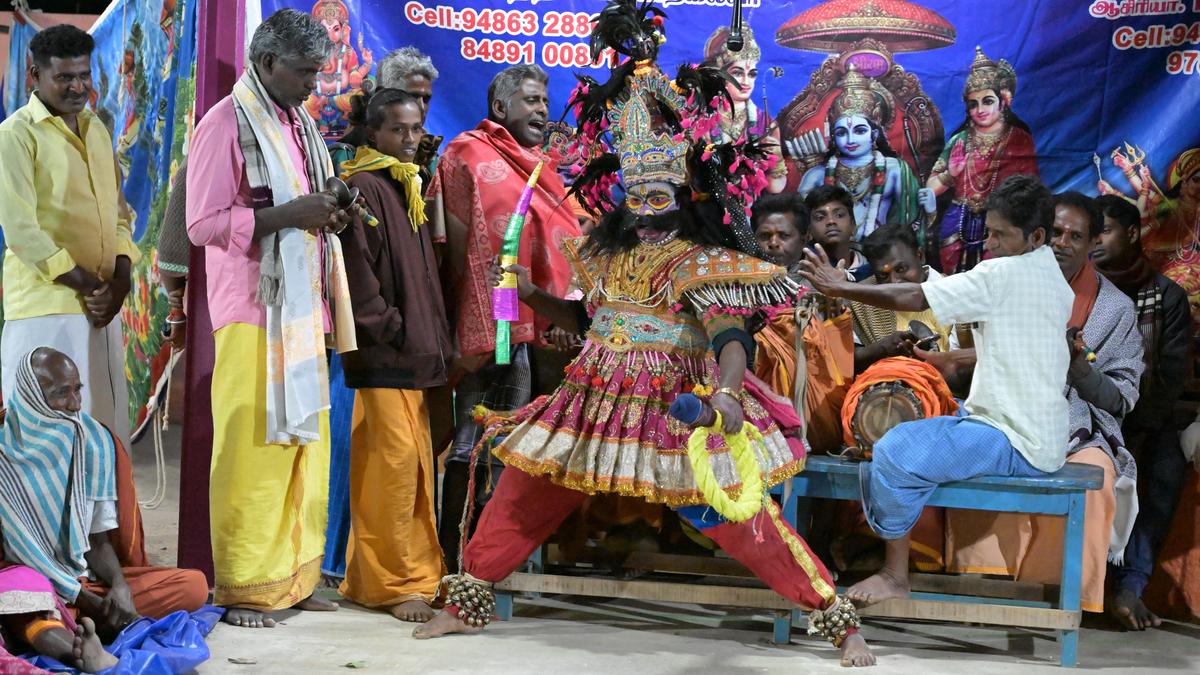
In the sprawling landscaped compound of the Kadavu Nachiamman Temple of Nilavur in the Yelagiri Hills, a ‘malai koothu’ on Haribalan-Sivabalan Sandai was about to open. On that new moon night, the audience had arrived for the temple festival from as far as Jolarpet. They would stay up till dawn. “Here comes ‘Boppan’ for the opening Act.” ‘Boppan’, the buffoon, makes an entry in a jazzy orange outfit, prancing up and down to the blaring but often indiscernible vocals. The buffoon jumps, gets whipped, pretends to scare children seated on the ground, gets whipped again.
As the night advanced, a section of the audience dozes off with banners for blankets, while a few elders keep themselves warm, crouched beneath woollen blankets. An artist hurls profanities at Maradhanda Asuran, causing giggles, and falls on the lap of an old woman in the audience after a pretence-chase by Maradhanda Asuran. A ploy to keep the audience awake on that chilly night.
Haribalan-Sivabalan Sandai opens with Maradhanda Asuran and his daughter Sillingi, and Sillingi’s sons Haribalan and Sivabalan conceived of a boon from Lord Siva, according to mythology. Sillingi, played by an old man draped in a sari and a wig, comes out to narrate her story. Sillingi’s tearful monologue is interrupted when a visibly moved old woman, gets up and pins a currency note to Sillingi’s sari at the shoulder.
This would be the last act for this season from the Tamil month of Thai to Aadi.
‘Malai koothu’, a form of ‘therukoothu’ (street play), a seemingly plebeian art, is culturally moored in the lives of the inhabitants of the hills — the Malaiyali tribes of Dharmapuri and the Javadhu and Yelagiri Hills in Tirupathur. It is also an expression of social cohesion and is primarily performed as a temple dance form in the hills.
“We perform ‘koothu’ for temple festivals, births and deaths, and marriages,” says K. Govindasamy, former president of the Adhanur panchayat comprising 14 villages of the Yelagiri Hills. The 75-year-old is a veteran ‘koothu’ artist. He runs the Kadhavu Nachiamman Koothu Kuzhu that trains artists at Nilavur village. “We did not allow film songs to contaminate the form,” he says.
In the hills, the performers are high pitched so as to reach a larger assembly of audience while performing with no mikes, something that the artists from the plains find hard to emulate, says A. Thirumalaisami, an artist and researcher from the family of ‘therukoothu’ artists in the plains in Krishnagiri.


CM announces Cabinet Sub-Committee on Musi rejuvenation; rehabilitation for all displaced

Ramanathapuram identifies 145 polling stations as sensitive, ensuring security with paramilitary forces ahead of assembly elections, says DEO.

BJP Puducherry president V. P Ramalingam files nomination for Raj Bhavan, joined by Union Minister Mandaviya and Khushbu Sundar.

History-sheeter 'Thoppai' Ganesh shot dead by police in Chennai after attacking officers during attempted escape.

The government plans to amend the FCRA, introducing new regulations for NGO asset management and accountability for key functionaries.

The draft policy for “Responsible Digital Use Among Students”, released on Monday by the Department of Health and Family Welfare, has recommended that parents set structured routines with clear screen-time rules and prioritise privacy, safety, and open conversation with children on digital well-being.

Police Observer Sushant Kumar Saxena conducts surprise inspection at Shencottai police station, reviewing warrants and security arrangements ahead of elections.

Andhra Pradesh government to launch key projects in April, focusing on industrial growth and infrastructure development, says Nara Lokesh.

Lok Sabha refers the Corporate Laws (Amendment) Bill to a JPC amid opposition concerns over CSR provisions dilution.

SHG members in Kanniyakumari use snakes and ladders to raise election awareness and boost voter turnout.

Government accelerates consultations for early implementation of the Women’s Reservation Act to ensure women’s representation in 2029 elections.

CM A. Revanth Reddy distributes ₹1 crore insurance cheques to families of deceased Electricity department employees, enhancing financial security for workers.

The Bengaluru Traffic Police (BTP) registered 634 cases of drunk driving during a week-long special enforcement drive conducted across the city between March 16 and March 22.