Madras as seen in 1942 Premium
The Hindu
Explore Madras as depicted in the 1942 film En Manaivi, showcasing its rich history and transformation into modern Chennai.
One of the best sources for Madras of the early 20th century is cinema. The black-and-white era keeps giving us precious nuggets every once in a while, even though most of those films were shot inside studios. A real gem among these is the 1942 film En Manaivi. A.V. Meiyappan was the man behind it, though his famous AVM studios was, by then, still in the womb of time. Having hired the Admiralty House at Mandaveli from the Maharaja of Vizianagaram, he was producing films there under the banner of Pragati Pictures.
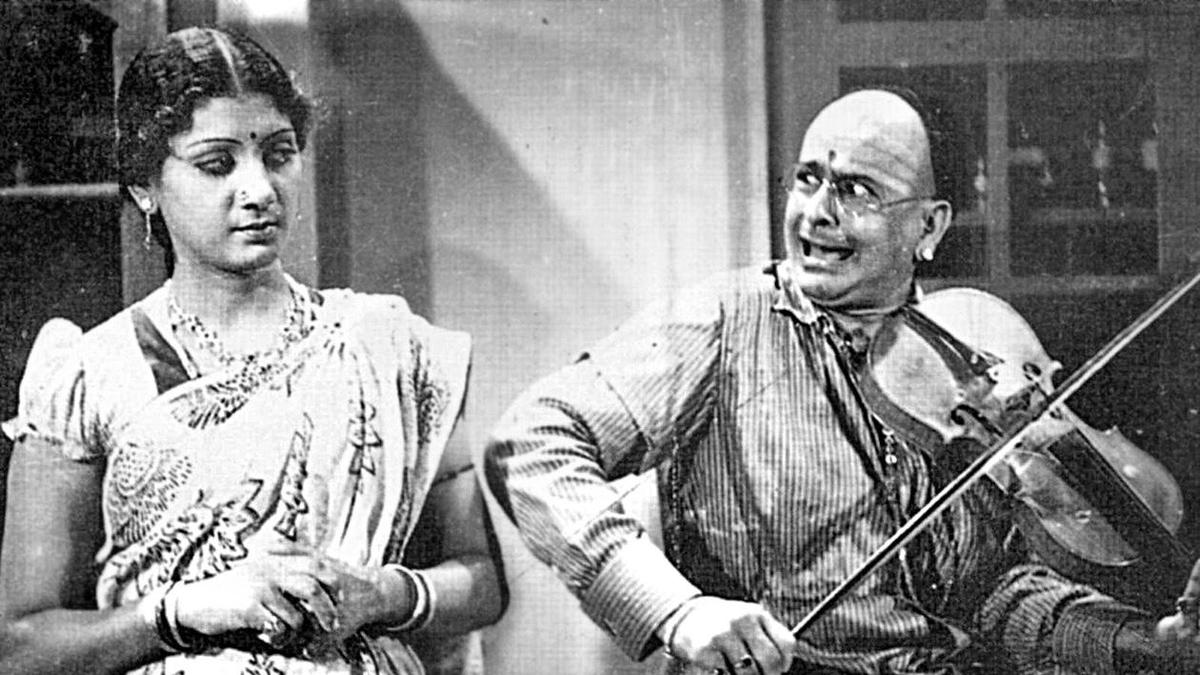
Meiyappan had tried his hand at films several times before and undeterred by early disasters, he kept at it till he found success. En Manaivi was one of his early hits. It was based on Samshay Kallol, a Marathi play by G.B. Deval, which was based on Moliere’s 17th century French one-act verse play Sganarelle or the Self-Deceived Husband. The plot revolves around suspicion between two couples leading to many comic situations. The lead couple was Sarangapani and K.R. Chellam. It is interesting to see that the core of the story – a woman fainting on the street and a portrait landing in the wrong hands – remains unchanged across the original and the Indian versions.
A.V. Meiyappan | Photo Credit: The Hindu Archives
But it is Madras that sparkles throughout the Tamil film. The casting credits feature a quick succession of cinematographic footage of some prominent locations in the city. We have what seems a ghostly Egmore railway station, followed by a busier but still fairly empty Central. The camera then moves onto what is presently the Muthuswami Iyer Bridge, named after the first Indian to become a judge of the High Court of Madras. From here, with a cyclist pedaling furiously, we see the anatomy block of the Madras Medical College, popularly known as the Red Fort. Though the MMC has moved further down the road and this building awaits conversion into a museum, we can see that the view has remained substantially unchanged.
We are next transported to China Bazaar (NSC Bose) Road where the intersection with Broadway (Prakasam Salai) is seen with a tram cutting across. A careful viewing shows one more of the six boundary pillars of the Esplanade standing at the corner. It has vanished along with four of its companions, leaving the one near Dare House as the survivor. We see trams running along the same road, with the old Madras Christian College buildings still standing – Anderson’s Church, College Hall and College House, of which only the first named remains. We also see glimpses of the High Court and the Law College.
The Central railway station in the 1940s | Photo Credit: The Hindu Archives


Jeevan Reddy leads a rally for maize farmers in Jagtial amid speculation of leaving Congress for BRS.

BJP and AINRC likely to maintain 2021 seat-sharing formula for Puducherry's 2026 Assembly elections, confirms party president.

BJP reveals 144 candidates for Bengal Assembly polls, featuring Suvendu Adhikari contesting against Mamata Banerjee in Bhabanipur.

Anna University partners with Ramco Systems to create an advanced ERP lab for enhanced industrial engineering education.

NDA announces candidates for 12 Kozhikode seats in Kerala Assembly polls 2026 as UDF and LDF ramp up campaigning.

As India formulates its next steps in the Israel-U.S.-Iran war, it is necessary to consider not only what it will mean for the whole region but also its own ties with each neighbour

CITU criticizes the Centre's privatization efforts for VSP, alleging employee removal over production increase and financial mismanagement.

Visakhapatnam Customs House's short film "Right Turn" wins Honourable Jury Mention at the 10th Indian World Film Festival.

Economist Arvind Subramanian advises CM Revanth Reddy on strengthening Telangana's finances during a meeting in Hyderabad.

Supreme Court emphasizes stakeholder consultation for legal education reforms, hesitant to change five-year law course duration.

Authorities in Andhra Pradesh are set to tranquillise a roaming tiger near Annavaram temple for safety and conservation.

MEA criticizes USCIRF for bias, urging focus on vandalism of Hindu temples in the U.S. over selective criticism of India.

Bengaluru's Urban Development aims to beautify underutilized flyover spaces, enhancing city aesthetics and improving green cover initiatives.