Machattu Mamangam: when the parched fields come alive with motif horses, drums and uncontainable human spirit
The Hindu
Experience the vibrant energy of Machattu Mamangam, where tradition, community spirit, and breathtaking performances come alive in Thrissur.
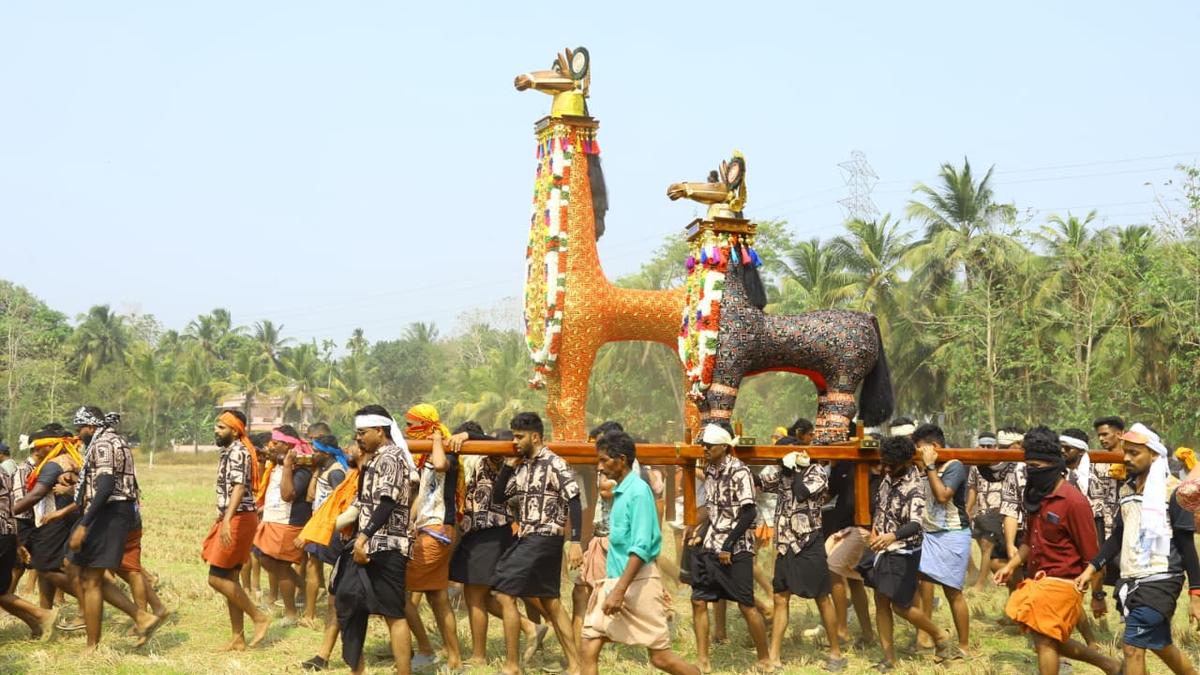
By noon on Tuesday (February 17, 2026), the dry, post-harvest paddy fields around Thiruvanikkavu Bhagavathy Temple near Wadakkanchery in Thrissur, Kerala, seemed to catch fire with an explosive surge of festival energy. From distant villages, groups of men emerged across the sun-dried fields, their shoulders bearing towering, vibrantly adorned poikuthiras — the iconic motif horses of Machattu Mamangam.
One of the most breathtaking sights of the day unfolded as villagers marched towards the temple with massive horses made of bamboo and paddy straw balanced on their shoulders. Their arrival was thunderous. Loud cheers, rhythmic claps, and spirited cries echoed across the open fields as each desam announced its presence with pride and passion.
Procession of motif horses during the Machattu Mamangam, the annual festival of Thiruvanikkavu Bhagavathy Temple near Wadakkanchery, on Tuesday. | Photo Credit: K.K. Najeeb
Soon, the horses lined up on the northern paddy fields of the temple premises. By around 2 p.m., the grand procession moved forward to the powerful rhythms of Panchavadyam. The air vibrated with percussion, each beat heightening the anticipation of the crowd that had thronged Thiruvanikkavu in thousands.
The festival then surged into a crescendo with melam, followed by dazzling fireworks with thunderous sound and ignited even more excitement among the spectators.
But the soul of Machattu Mamangam revealed itself in the much-awaited Kuthirakkali — a breathtaking outburst of collective energy and devotion. Villagers, drenched in sweat and smeared with red mud from the parched fields, lifted the gigantic horses high into the air, tossed them, caught them, and danced around the temple in ecstatic rhythm. With each leap and roar, the crowd’s energy soared. Every group tried to outshine the other, not in rivalry, but in sheer festive spirit and pride in their tradition.


Tamil Nadu's Interim Budget integrates wise sayings and poetry, emphasizing socio-political values and the DMK government's principles.

Mettur Dam's water level is 89.80 feet, with an inflow of 220 cusecs and discharge of 2,500 cusecs.

Experience the vibrant energy of Machattu Mamangam, where tradition, community spirit, and breathtaking performances come alive in Thrissur.

Bill Gates praises Andhra Pradesh's tech-driven governance and RTGS as a model for enhancing public service and citizen empowerment.

Health Matters newsletter: In loss and survival

Tamil Nadu's Agri Budget for 2026-27 allocates ₹47,248 crore to enhance agriculture, reversing cultivable land decline.

Bengaluru police seize drugs worth ₹21.5 crore, arresting 15 individuals, including three foreigners, in a major crackdown on trafficking.

Bengaluru photographer arrested for ₹55 lakh burglary, 348 grams of gold recovered; police warn against leaving keys outside.

Tirupati researcher Lalasa Mukku demonstrates AI's potential to detect cervical cancer and prevent youth suicidal tendencies through innovative image analysis.

TDB forms a task force to address audit report discrepancies regarding Global Ayyappa Sangamam expenses and clarify financial concerns.

Anganwadi workers in Chennai protest for 15 days, demanding regularization and better pay amid overwork and unmet promises.

The annual festival of Ravi Shankar Centre featured an ensemble of — Pt. Shubhendra Rao, sarodist Aayush Mohan, violinist Padma Shankar, flautist Ravichandra Kollur, mridangist B.C. Manjunath, and tabla artiste Anubrata Chatterji

Minister Sivankutty asserts LDF will win a third term in Kerala, citing strong public support and effective governance.