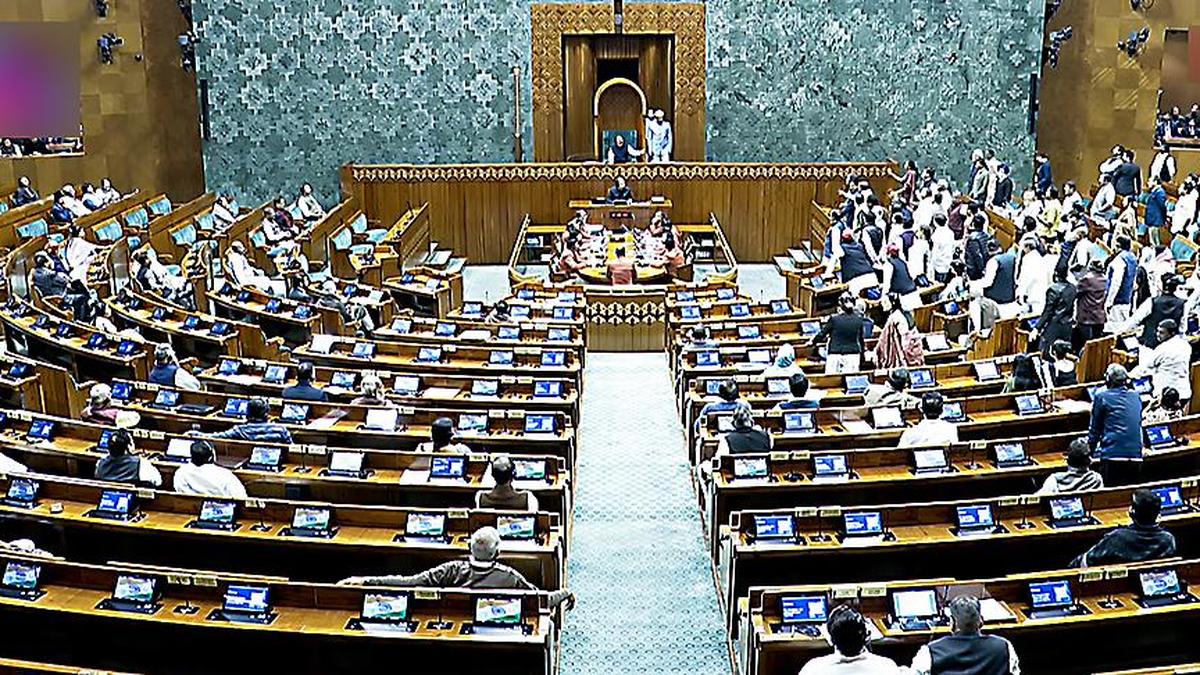
Lok Sabha majorities: Hindi heartland States overrepresented in 11 out of last 15 polls
The Hindu
Explore the regional divide in Indian politics: how the Hindi heartland dominates Lok Sabha majorities while South India faces persistent underrepresentation. An analysis of 15 majorities since 1967 and the future of federalism.
A Lok Sabha (LS) majority is often mentioned as monolithic fact, a number that can be nothing but objective. The objectivity of the number in this case is rather superfluous. An absolute majority in the LS requires 272 members, i.e more than half of its total strength of 543, wherever those come from; but where those members come from within the country has consequences for how representation is managed and governance priorities are set at the national level.
Decisions impacting a particular State or a region can be taken by a majority in Parliament in which the affected State or region has little say. The neutering of Article 370 in 2019 was a remarkable case of this possibility, but examples abound — from setting conditions for central schemes to designing the education policy.
The regional distribution of the LS majority has a qualitative impact on federalism and democracy. This is an analysis of the regional distribution of national majorities in 15 Lok Sabhas, including the current one. We start this analysis with the fourth LS elected in 1967, when the status of the Congress as the single dominant party was broken evidently in the polls. By 1967, several strands of resistance to the national politics, represented then by the Congress, had gained electoral salience. These mobilisations were driven by religion, class, caste, and language. The regional variations in the political dynamics began to influence which party or coalition wins a majority.
The north and the west have weighed more in the ruling benches of the LS, relative to their share in the total strength, while the south, the east, and the northeast have weighed less in the majority than their proportion of the total strength. Of the 15 LS majorities, in 11, the north had proportional or higher share in the majority, while the south had this only in six.
While the north has been underpresented in the majority only four times out of 15, the south has been underrepresented nine times. In 1991, when the Congress was shrunk to the south but still managed a majority, the country also had the first Prime Minister from the south. Non-BJP coalitions tend to have majorities that have a wider spread generally speaking, but the 1999 NDA government led by A.B. Vajpayee is one of the most evenly spread in terms of its members in the LS. The 1977 and 1989 LS elections were exceptional for their complete divergence between the north and the south. In both years, caste and religious conflicts in the Hindi belt shaped the national majority in the LS.
The southern States comprised as low as 2% of seats in the government benches in these two years. The elections of 1977 and 1989 often get portrayed in grand frames — as restoration of democracy after the Emergency and a popular upsurge against corruption after the Bofors kickback allegations. Beyond those claims, and closer to the ground, lies the reality of caste and religious conflicts in the Hindi heartland which fuelled the Jayaprakash Narayan movement and the V. P. Singh movement, respectively. Peninsular India remained solemnly untouched by these battles of the heartland.


The Centre has allocated ₹10,354.15 crore for CMRL's phase II project, with nearly 49% of construction completed.

Explore whether India's cigarette taxes effectively deter consumption, falling short of WHO's recommended benchmark for public health.

Bengaluru's Deputy CM pauses metro fare hike for reassessment, citing operating costs and CPI, amid political disputes.

The Industrial Relations Code must ensure job security while adapting to AI advancements and changing labor market dynamics.

India’s coffee sector is steadily moving from a commodity-led approach to a quality and experience-driven market, said the coffee community here on Monday.

District Magistrate permits KSRTC buses in Mangaluru CBD, enhancing public transport access for women, students, and patients.

TMC celebrates the Supreme Court's intervention in the SIR exercise as a significant victory for democracy in West Bengal.

Experts warn that relying solely on HbA1c for diagnosing type-2 diabetes in India may lead to misleading results.

Manipur CM assures Kuki-Zo people of safe travel to Imphal, aiming to rebuild confidence after years of ethnic conflict.

Congress leaders, including MLA Babasaheb Patil, joined the Hindu Samajotsava rally in Belagavi, showcasing their support for Hindutva associations.

Shivam Mishra, son of a Kanpur pan masala baron, booked after a reckless Lamborghini crash injures six pedestrians.

A 37-year-old Indian-Canadian died after being shot by unidentified men in the parking lot of a busy shopping centre in Toronto, Canada on Saturday (February 7, 2026).

Opposition critiques the Union Budget in Rajya Sabha, highlighting unemployment, farmers' issues, and sluggish economic growth.