Lack of civic amenities irks residents as urbanisation takes toll on constituency
The Hindu
Residents of Thiruporur constituency face civic challenges amid rapid urbanization, impacting resources, infrastructure, and local livelihoods.
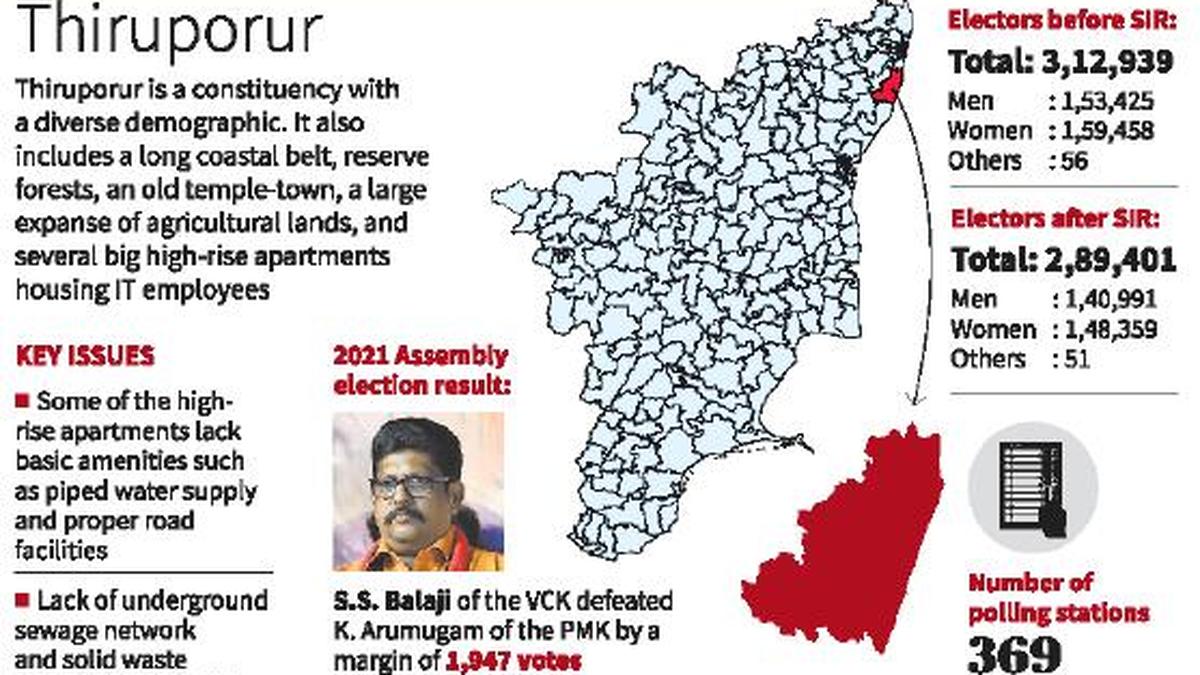
It has a sizeable coastal belt stretching over 30 km, a large expanse of reserved forest areas, a few industrial parks, several well-known higher education institutions, and a substantial stretch of agricultural land spread over two revenue blocks. Yet, nearly half of its electorate reside along a 30-km stretch of highly urbanised ‘vertical villages’. The Thiruporur Assembly constituency — situated south of Chennai on the iconic IT Corridor along the Old Mahabalipuram Road (OMR) — in Chengalpattu district, is indeed a study in dichotomy.
The expansion of Chennai’s IT Corridor over the past couple of decades has resulted in the mushrooming of large multi-storeyed apartments, extending well into the villages on either side of the road.
Nearly 45% of its 2,89,401 voters live in the 100-odd high-rise residential complexes in Navalur, Padur, Siruseri, Pudupakkam, Mambakkam, Kelambakkam, and other adjoining village panchayat areas. As demand for housing grew, these extended areas gradually came to be dotted with ‘sheltered communities’, with IT employees from within Chennai city limits moving there for affordability.
“The rental rates have nearly doubled in the past decade,” said K. Sivaraman, an advocate whose family has been residing in the temple town for generations. The surge in population has resulted in a strain on resources. “These urbanised areas do not have piped water supply. Each family shells out about ₹4,000-₹5,000 a month for maintenance costs, a large part of it going towards procuring tanker water,” he added.
In villages, including Illalur, Thaiyur, and Kolathur, many farmers have leased out their farm wells to private water supply agencies for extraction since returns from agriculture have been on the wane, he said. “The government hasn’t done much to improve the lot of the farmers; most of the government schemes haven’t reached them,” said Mr. Sivaraman, who is also an AIADMK functionary.
The village panchayats also lacked the resources to invest in underground sewage treatment facility for the highly urbanised OMR stretch. The area had plenty of problems related to road infrastructure, streetlighting, and security. In came the Federation of OMR Residents Association (FOMRRA), born about a decade ago much out of necessity to address these day-to-day problems in innovative and sustainable ways, says Harsha Koda, design entrepreneur and co-founder of FOMRRA.


A 32-year-old man is arrested for abusive social media posts and mid-air misconduct involving Bengaluru police and Indigo Airlines.

A tragic bus-truck collision in Markapuram kills 10-12 and injures over 20, prompting a state investigation and condolences from the Chief Minister.

Telangana sets up control rooms after a deadly bus fire in Markapuram, aiding victims' families from Andhra Pradesh.

Microplastics, especially nylon fibres, are present in Chennai’s beach sediments in relatively low abundance, but low overall microplastic abundance does not necessarily imply low ecological risk. Even small particles can cause long-term ecological damage by affecting marine life, moving up the food chain, and eventually impacting human health through contaminated seafood.

Fuel outlets in Hyderabad remain crowded for the third day, as LPG auto drivers face ongoing shortages despite government assurances.

Assembly polls 2026: Follow updates from The Hindu on the upcoming elections in five States on March 26, 2026

40% of West Bengal's voters under adjudication have been deleted, sparking concerns and protests ahead of upcoming elections.

Trump claims Iran is afraid to negotiate a deal amid ongoing conflict, despite Tehran's denial of participation in talks.

Government mandates LPG supply cut-off for households not switching to available piped natural gas (PNG) within three months.

Congress faces eviction from its historic 24 Akbar Road office as it considers legal options against the Centre's final notice.

The Hindu Morning Digest gives a select list of stories to start the day. Read the top news today on March 26, 2026

Chennai's Central, Tiruttani, and Sullurupeta stations will soon feature air-conditioned waiting halls for enhanced commuter comfort.

OPS claims EPS's lost credibility will undermine AIADMK's election manifesto, as DMK promises have proven reliable and effective.