Kerala’s proposed RRTS for high-speed rail travel | Explained Premium
The Hindu
Kerala's new RRTS project aims to enhance high-speed rail connectivity from Thiruvananthapuram to Kasaragod, fostering integration and reducing environmental impact.
The story so far: The high-speed rail proposals in Kerala have once again snowballed into a controversy in the public sphere, with the Kerala government, in its latest move, approving a Regional Rapid Transit System (RRTS) for high-speed rail travel within the State, from Thiruvananthapuram to Kasaragod. The Kerala government, which had earlier submitted a semi-high-speed rail project (SilverLine), has now switched to the new RRTS due to the alleged “indifference” of the Centre towards the State’s demands. In the meantime, technocrat E. Sreedharan has claimed that he has been working on a high-speed rail project for Kerala with the blessing of the Union Railway Ministry, a claim that was confirmed by Union Railway Minister Ashwini Vaishnaw, though the latter has not provided the details of the Central project.
What is the new RRTS project, and will it serve the purpose of high-speed rail travel for Kerala?
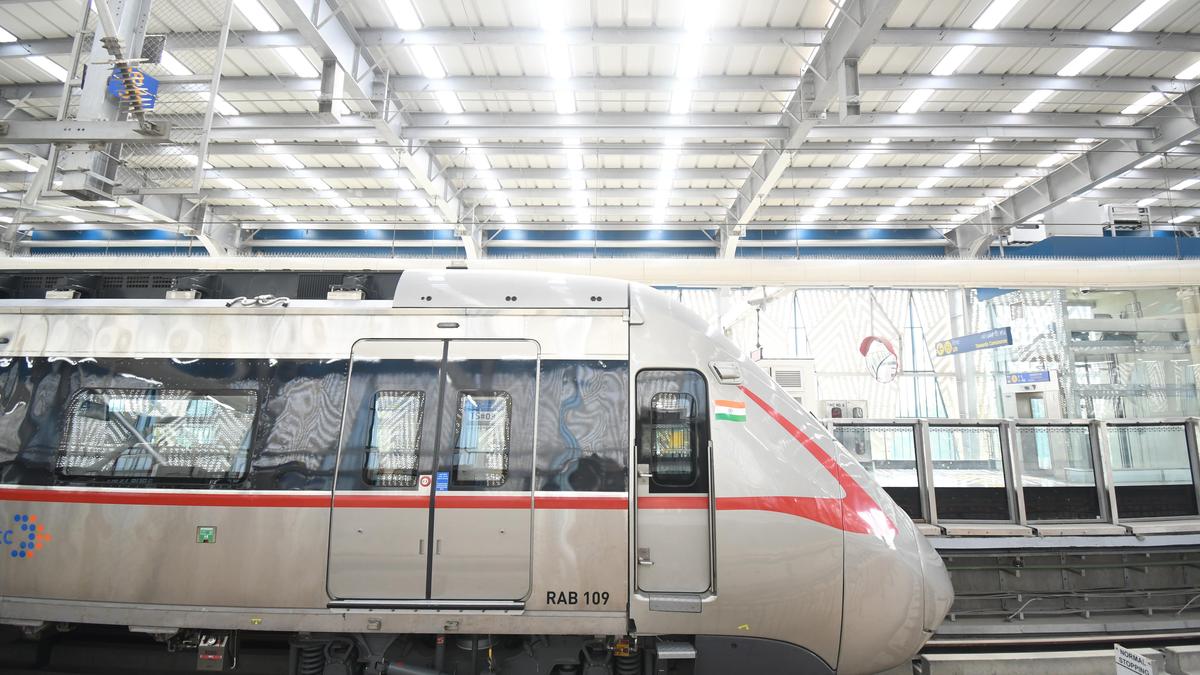
RRTS is a viable and acceptable high-speed rail system, which has been successfully implemented in the Delhi-Meerut corridor, demonstrating its feasibility in India, including its integration with the Meerut Metro. The main highlight of RRTS is that it can be integrated with the existing and proposed metro rail projects in Kerala to improve last-mile connectivity and reduce reliance on private vehicles, along with linking airports. Specially designed train sets can be operated through the corridor at a speed of 160-180 kmph, with short station intervals.
The new project will also reduce environmental impact, as most of it will be built on pillars, with embankments and tunnels used only where necessary. In contrast, the SilverLine project was primarily designed as an embankment model (at ground level), which faced significant public criticism in densely populated areas. The viaduct model of the RRTS will significantly reduce land acquisition, prevent the obstruction of natural water flow, and mitigate public opposition witnessed in certain areas.
Will this serve as a unified multi-modal transit system?
The RRTS is proposed to be integrated with urban metro projects. By enabling integration with the existing Kochi Metro and envisioned metros in Thiruvananthapuram and Kozhikode, last-mile connectivity will be improved. Further, four existing international airports in Kerala will also be linked with the project, creating a unified multi-modal transit system. The project can be extended to Coimbatore via Palakkad, to Kanyakumari from Thiruvananthapuram, and Mangaluru from Kasaragod through interState cooperation.


Anna University partners with Ramco Systems to create an advanced ERP lab for enhanced industrial engineering education.

NDA announces candidates for 12 Kozhikode seats in Kerala Assembly polls 2026 as UDF and LDF ramp up campaigning.

As India formulates its next steps in the Israel-U.S.-Iran war, it is necessary to consider not only what it will mean for the whole region but also its own ties with each neighbour

CITU criticizes the Centre's privatization efforts for VSP, alleging employee removal over production increase and financial mismanagement.

Visakhapatnam Customs House's short film "Right Turn" wins Honourable Jury Mention at the 10th Indian World Film Festival.

Economist Arvind Subramanian advises CM Revanth Reddy on strengthening Telangana's finances during a meeting in Hyderabad.

Supreme Court emphasizes stakeholder consultation for legal education reforms, hesitant to change five-year law course duration.

Authorities in Andhra Pradesh are set to tranquillise a roaming tiger near Annavaram temple for safety and conservation.

MEA criticizes USCIRF for bias, urging focus on vandalism of Hindu temples in the U.S. over selective criticism of India.

Bengaluru's Urban Development aims to beautify underutilized flyover spaces, enhancing city aesthetics and improving green cover initiatives.

Indian Navy warships escort merchant vessels in the Gulf of Oman, ensuring safe passage amid regional tensions under Operation Sankalp.

A rare crab species exhibiting both male and female traits was discovered in Silent Valley, revealing unique biological characteristics.

Gujarat court convicts five in 2016 Una flogging case; punishment announcement scheduled for March 17, 2026.