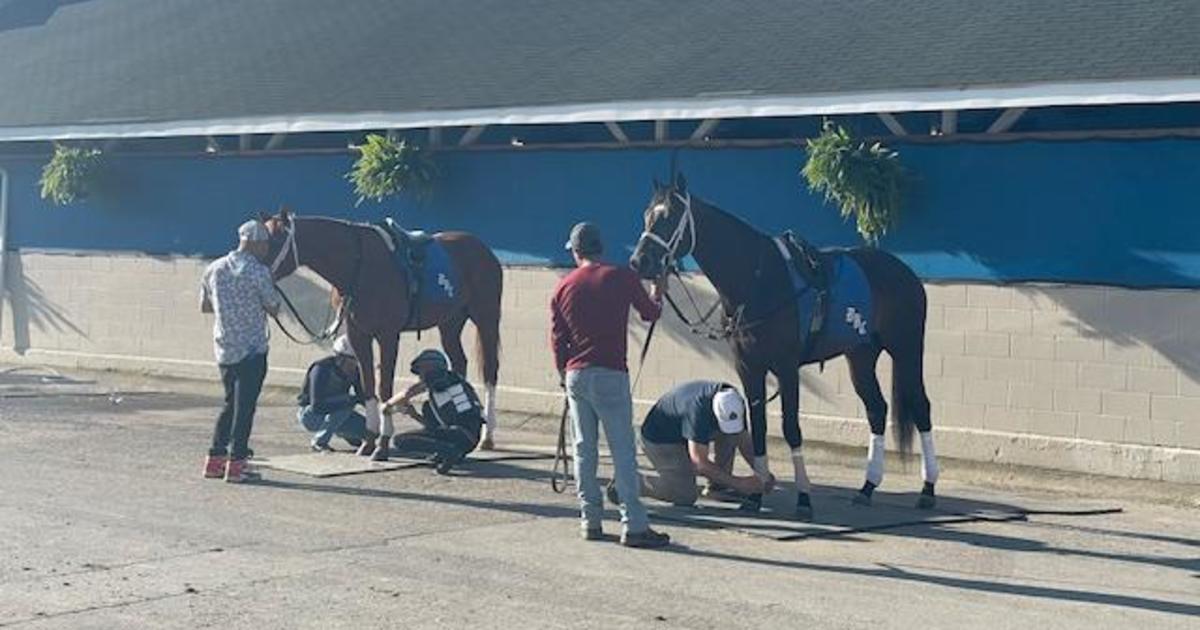
Kentucky's "backside workers" care for million-dollar horses on the racing circuit. This clinic takes care of them.
CBSN
Seventeen years ago, Odilia Castillo, now 37, traveled from her home in Chiapas, Mexico, north to work as a "hot walker" on Kentucky's race tracks. Every morning she wakes up at 3 a.m. and heads to the track by 4 a.m. to walk the horses, who need at least 30 to 45 minutes to cool down after training.
Castillo said she has a "connection with the horses," and that's what kept her caring for the animals — until, in 2021, she couldn't work because of a pain in her stomach. She said she didn't know what the pain was, so she went to the Kentucky Racing Health Services Center. The Louisville clinic was founded in 2005 to meet the needs of those known in the racing world as the "backside," mostly migrant workers who care for the horses who race at tracks such as Churchill Downs.
The mother of two, who is married to another racetrack worker, needed to take days off from work — a dire challenge for these laborers — many of them migrants from Mexico, Guatemala, Venezuela or other Latin American countries — who head to the tracks six days a week to help keep Kentucky's estimated $2.7 billion annual racing economy galloping. They are the hot walkers, exercise riders, grooms and farriers necessary to maintain racing form for the 238,027 horses in the state.


We share our planet with maybe 10 million species of plants, animals, birds, fish, fungi and bugs. And to help identify them, millions of people are using a free phone app. "Currently we have about six million people using the platform every month," said Scott Loarie, the executive director of iNaturalist, a nonprofit.

Washington — As voters gear up for the midterm elections in November that will decide control of the House and Senate, the Supreme Court is set to weigh Monday whether states can count mail ballots that are postmarked by, but arrive after, Election Day.

It was in June 2020 when Linda Dane learned the disturbing circumstances of how her long-lost brother Gary Herbst's skull had been found by a dog in rural Barron County, Wisconsin. In:

A possible meteorite crashed into a Houston area house on Saturday night, tearing through the roof and two stories of the home, officials said. In:

The Senate on Saturday blocked an amendment that would ban transgender athletes from playing in women's sports, rejecting one of President Trump's priorities as he pressures Congress to act on a broad voting bill.

Robert Mueller, a former FBI director who led the investigation into allegations of Russian meddling in the 2016 election, has died, multiple sources told CBS News on Saturday. He was 81. In:

Kendra Duggar was arrested for misdemeanor charges including endangering the welfare of a child and false imprisonment, according to online records. The charges come a day after her husband Joseph Duggar was charged with molestation. In:

At ski resorts across the West this winter, viral images showed chairlifts idling over brown terrain in places normally renowned for their frosty appeal. Iconic mountain towns like Aspen, Colorado, and Park City, Utah, were seen with shockingly bare slopes, as the region endured a historic snow drought that experts warn could bring water shortages and wildfires in the months ahead. In:

The NCAA accused online sportsbook DraftKings of trademark infringement associated with the association's men's and women's basketball tournaments and filed a complaint in federal court seeking an emergency restraining order. In:

Airport delays continue to worsen as a bill to fund the Department of Homeland Security failed to advance in the Senate Friday. In:

Five people who were charged in connection to the Feeding Our Future scheme pleaded guilty to wire fraud this week. In:

Actor Nicholas Brendon, best known for his role as Xander Harris in the popular television series "Buffy the Vampire Slayer," has died, according to his family. He was 54. In:

Washington — The Trump administration has been strategizing methods and options to secure or extract Iran's nuclear materials, according to multiple people briefed on the discussions, as a U.S.-Israel-led military campaign against Tehran enters a more uncertain phase. In: