Supreme Court to consider deadlines for late-arriving mail ballots, as Trump continues attacks
CBSN
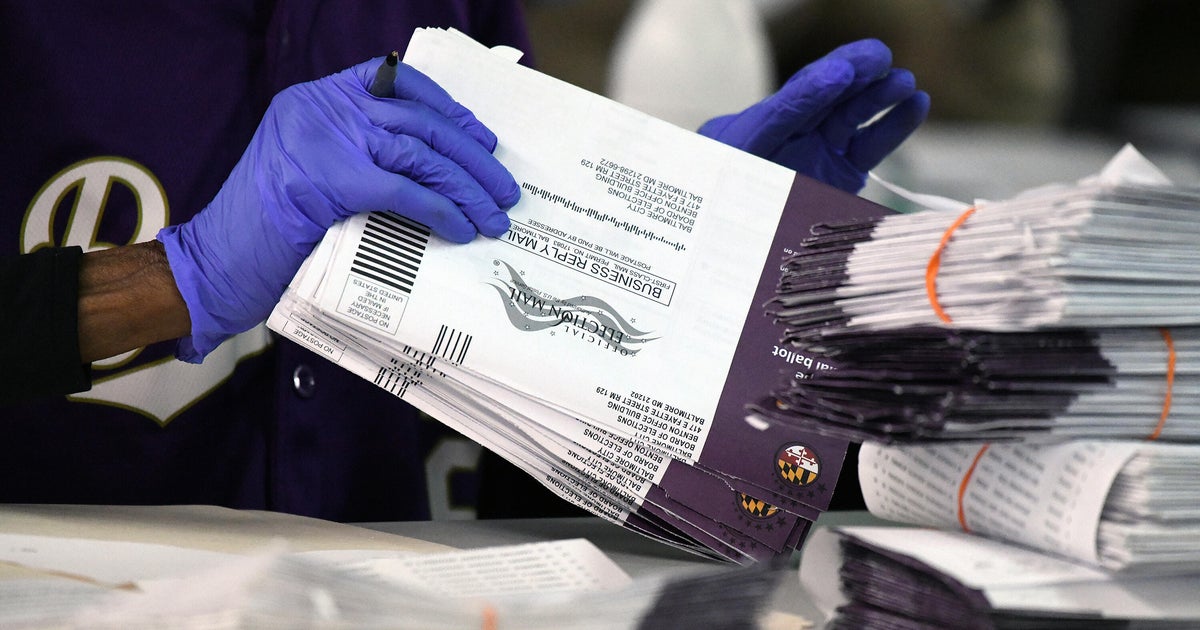
Washington — As voters gear up for the midterm elections in November that will decide control of the House and Senate, the Supreme Court is set to weigh Monday whether states can count mail ballots that are postmarked by, but arrive after, Election Day.
Washington — As voters gear up for the midterm elections in November that will decide control of the House and Senate, the Supreme Court is set to weigh Monday whether states can count mail ballots that are postmarked by, but arrive after, Election Day.
The dispute before the high court, known as Watson v. RNC, involves Mississippi's deadline for late-arriving mail ballots and whether its law — and similar measures in 13 other states — conflicts with federal statutes that set Election Day as the Tuesday after the first Monday in November.
President Trump has continued to target voting by mail, which he claims is "corrupt as hell" and wants to sharply curtail. Since returning to the White House, the president and his administration have tried to gain more control of federal elections. He signed an executive order last March that sought to overhaul U.S. elections, though provisions have been blocked by a federal judge.
All 50 states require ballots to be marked and submitted by Election Day. But 14 states and the District of Columbia have enacted so-called grace periods, in which ballots that are postmarked by Election Day can be counted if they are received by election officials after the specified day. Twenty-nine states and the District of Columbia accept at least some military and overseas ballots that are received after Election Day, according to the National Conference of State Legislatures.
Four states — Kansas, North Dakota, Ohio and Utah — passed laws last year eliminating grace periods. They now require mail ballots to be received by Election Day in order to be counted.


Colombian President Gustavo Petro is the subject of several ongoing narcotics trafficking investigations being overseen by federal prosecutors in New York, sources told CBS News on Friday. Lilia Luciano, Joe Walsh and Margaret Brennan contributed to this report.

The U.S. Treasury has authorized the purchase of Iranian oil that's already at sea, exempting buyers from the tight sanctions that have restricted the country's oil industry for years — a move aimed at stemming soaring prices amid the U.S.'s war with Iran. In:

A federal judge has struck down some of the Defense Department's strict controls on how journalists with access to the Pentagon are allowed to report — ending a policy that caused many news outlets to leave the Pentagon. In:

A jury has found Elon Musk liable for misleading investors by deliberately driving down Twitter's stock price in the tumultuous months leading up to his 2022 acquisition of the social media company for $44 billion. But it absolved him of some fraud allegations, finding that he did not "scheme" to mislead investors. In:

Washington — The Senate on Friday again failed to move forward with legislation to fund the Department of Homeland Security, extending the shutdown that has snarled air travel around the country. Alan He and Caitlin Huey-Burns contributed to this report.

Muddy floodwaters from severe rains inundated streets, swallowed vehicles and prompted evacuation orders for thousands of residents in towns north of Honolulu on Friday as officials warned of the possible failure of a 120-year-old dam. In:

The Justice Department on Friday moved to dismiss its criminal case against two former Louisville police officers who were facing civil rights charges in connection with the shooting death of Breonna Taylor.

Although the Trump administration is pulling multiple levers to tame energy costs amid the widening Iran war, the average price of gasoline in the U.S. on Friday neared $4 a gallon, raising questions about whether those efforts are working. Edited by Alain Sherter In:

The Emmy Award-winning "CBS News Sunday Morning" is broadcast on CBS Sundays beginning at 9:00 a.m. ET. "Sunday Morning" also streams on the CBS News app beginning at 11:00 a.m. ET. (Download it here.)

Washington — Pentagon officials have made detailed preparations for deploying U.S. ground forces into Iran, multiple sources briefed on the discussions told CBS News. In:

Delays at major U.S. airports across the country persist as Transportation Security Administration officers continue to work without pay and call-outs mount as the partial government shutdown drags on. In:

For U.S. consumers, soaring oil prices due to the Iran war don't just mean pain at the pump — the impact is also likely to be felt by shoppers both in stores and online. In:

A second Marine Expeditionary Unit of about 2,200 Marines and three warships is headed toward the Middle East, as the war with Iran continues. In: