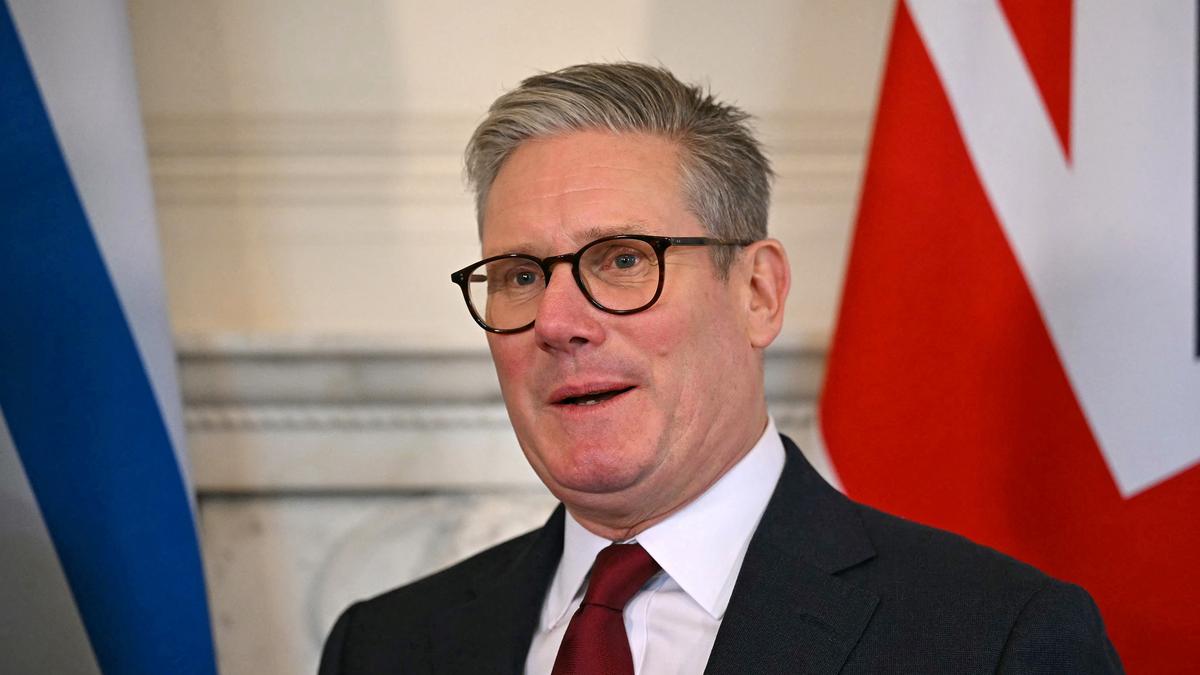
Keir Starmer rejects notion that U.K. has to choose between Europe and America
The Hindu
U.K. PM Starmer rejects U.S. vs. Europe narrative, emphasizes cooperation with both for national interest and security.
U.K. Prime Minister Keir Starmer strongly rejected the idea that Britain had to choose between the U.S. and its allies in Europe.
Mr. Starmer is one of several European leaders navigating Mr. Trump’s imminent return to power. Mr. Trump is expected to meet several Heads of State on Saturday when he visits Paris for the re-opening of the Notre Dame Cathedral. As U.S. President, Mr. Trump had a testy relationship with the European Union (EU), over trade, defence expenditure and positions on Russia and Ukraine
“That somehow we are with either America or Europe is plain wrong. I reject it utterly,” Mr. Starmer said during a foreign policy speech at the Lord Mayor’s Banquet in London on Monday evening.
“The national interest demands that we work with both,” he added.
Mr. Starmer said the U.K. would “never turn away” from its relationship with the U.S., calling the bilateral relationship the “cornerstone” of the U.K.’s security and prosperity for over a century.
The Prime Minister said the two countries being close was not based on sentimentality but “hard-headed realism”, as he highlighted areas of cooperation that were important in current times: tech, AI, security and military cooperation.
At a dinner at the Trump Tower in Manhattan on September 26, Mr. Starmer had told Mr. Trump, then a presidential candidate, that his government “would invest more deeply than ever” in the U.K.-U.S. relationship. This was the first meeting between the two men.


Denmark's recent election results leave Prime Minister Mette Frederiksen's future uncertain amid a fragmented parliamentary landscape.

An explosion at Valero's Port Arthur refinery caused a temporary shutdown but resulted in no reported injuries.

Anduril and Palantir Technologies are working together to develop software for U.S. President Donald Trump’s Golden Dome antimissile shield initiative, a source familiar with the matter said

A federal judge weighing the merits of the Pentagon’s designation of rising Silicon Valley star Anthropic as a security threat repeatedly questioned the government’s reasons for vilifying the company

When the conflict in West Asia, which began with the U.S. and Israel’s attack on Iran on February 28, escalated into a regional war, analysts said that the war would last as long as Iran had missiles or until the Gulf nations ran out of interceptors. However, with “emergency” military sales, piling monetary costs and a strained supply chain, is the U.S. becoming too constrained in its effort to keep the war going — both militarily and monetarily?

U.S.-Israel war on Iran LIVE: Follow The Hindu for updates on the West Asia conflict on March 25, 2026

Jair Bolsonaro to serve his sentence at home due to health issues, monitored by police, with a review in 90 days.

A New Mexico jury finds Meta liable for harming children's mental health, marking a significant shift in accountability for tech companies.

Modi and Dissanayake discuss energy cooperation, West Asia conflict, and global supply chain disruptions in a recent phone call.

Russia launches a massive drone and missile attack on Ukraine, signaling the potential beginning of a spring offensive.

U.S. official Elbridge Colby emphasizes India's vital role in the Indo-Pacific, highlighting mutual benefits despite existing differences.

Philippine President Marcos declares national energy emergency amid Middle East conflict, ensuring fuel and essential goods supply stability.

Mohammad Baqer Zolqadr appointed as Iran's new security chief, succeeding Ali Larijani after his assassination.