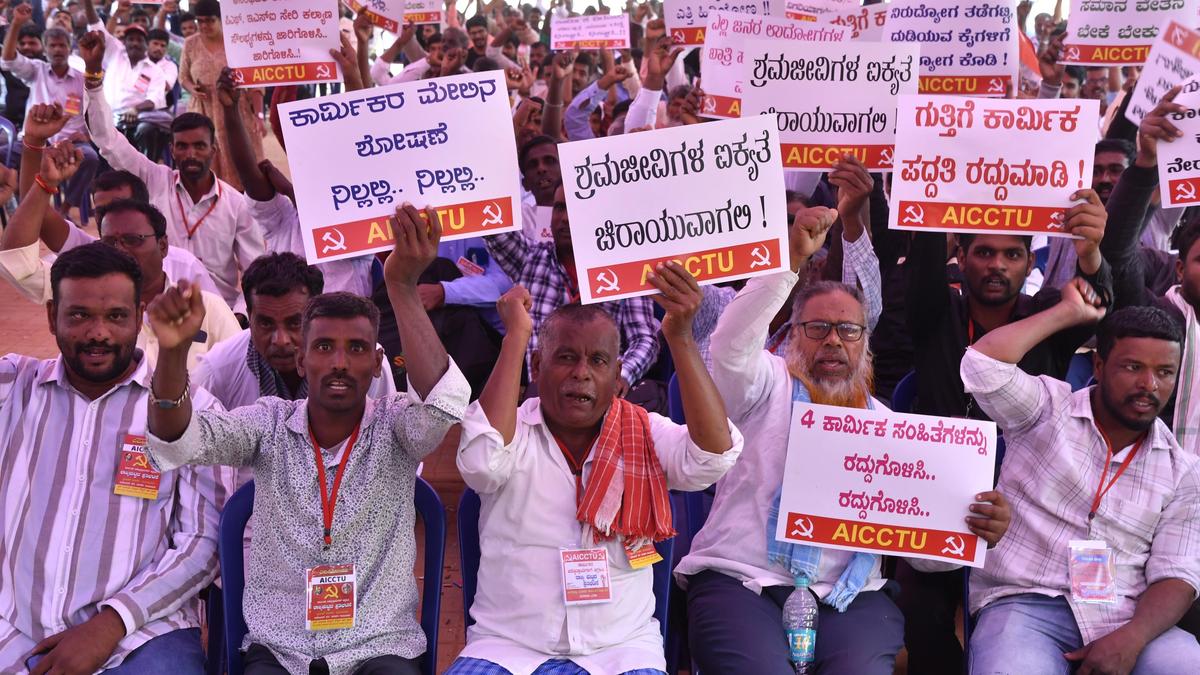
Karnataka’s draft wage rules mirror Centre’s rules, raise concerns on worker coverage
The Hindu
Karnataka's draft wage rules echo central guidelines, raising concerns over worker coverage and potential wage suppression.
Projected as a step towards universal wage protection, the Karnataka’s draft Code on Wages Rules largely mirror the Centre’s framework, one that labour union members argued establishes low wages, weakens enforcement and leaves most workers outside its effective coverage.
The draft, they argued, reflects the limited scope States have to correct structural flaws embedded in a centrally-designed law and may end up depressing wages rather than protecting them.
Released on January 27, the draft Code on Wages (Karnataka) Rules lay down procedures for fixing and enforcing minimum wages in the State. However, unions said they retain key features of the central Code, including discretionary floor wage fixation, a narrowed definition of wages and diluted enforcement mechanisms.
The Code on Wages, 2019, subsumed four labour laws- relating to minimum wages, payment of wages, bonuses and equal remuneration- into a single legislation. The Union government has pitched it as a reform to simplify compliance, ensure uniformity across States and extend wage protection to all workers, with the Karnataka’s draft rules meant to operationalise the law.
However, Satyanand Mukund, State secretary of the All India Trade Union Congress, said the Code effectively excludes over 90% of India’s workforce, particularly informal, women and domestic workers. He argued that digital compliance systems and employer self-reporting disadvantage workers who lack documentation, bargaining power and access to grievance redressal.
The Karnataka draft details the classification of workers by skill level and zones- metropolitan, non-metropolitan and rural- and bases wage calculations on the needs of a standard working-class family, including food, clothing, housing, education and medical expenses. It also mandates annual dearness allowance (DA) revision linked to inflation.


Anna University partners with Ramco Systems to create an advanced ERP lab for enhanced industrial engineering education.

NDA announces candidates for 12 Kozhikode seats in Kerala Assembly polls 2026 as UDF and LDF ramp up campaigning.

As India formulates its next steps in the Israel-U.S.-Iran war, it is necessary to consider not only what it will mean for the whole region but also its own ties with each neighbour

CITU criticizes the Centre's privatization efforts for VSP, alleging employee removal over production increase and financial mismanagement.

Visakhapatnam Customs House's short film "Right Turn" wins Honourable Jury Mention at the 10th Indian World Film Festival.

Economist Arvind Subramanian advises CM Revanth Reddy on strengthening Telangana's finances during a meeting in Hyderabad.

Supreme Court emphasizes stakeholder consultation for legal education reforms, hesitant to change five-year law course duration.

Authorities in Andhra Pradesh are set to tranquillise a roaming tiger near Annavaram temple for safety and conservation.

MEA criticizes USCIRF for bias, urging focus on vandalism of Hindu temples in the U.S. over selective criticism of India.

Bengaluru's Urban Development aims to beautify underutilized flyover spaces, enhancing city aesthetics and improving green cover initiatives.

Indian Navy warships escort merchant vessels in the Gulf of Oman, ensuring safe passage amid regional tensions under Operation Sankalp.

A rare crab species exhibiting both male and female traits was discovered in Silent Valley, revealing unique biological characteristics.

Gujarat court convicts five in 2016 Una flogging case; punishment announcement scheduled for March 17, 2026.