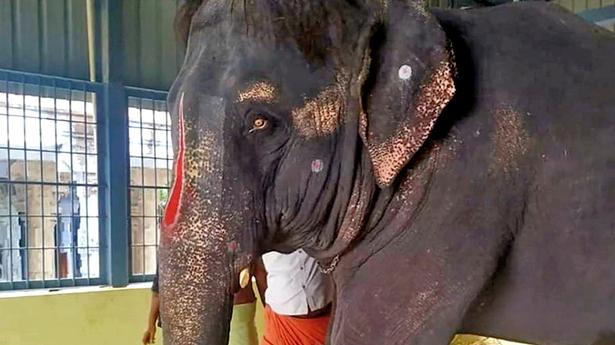
Joymala’s case throws light on trafficking of elephants from Northeast
The Hindu
Kerala, Uttar Pradesh, Karnataka, Assam, Tripura and Madhya Pradesh account for 96% of elephants in captivity without ownership certificates
The ongoing dispute between the Governments of Tamil Nadu and Assam over the alleged mistreatment of a temple elephant named Joymala, has brought into focus the prevailing lacunae over private ownership of elephants in India. Joymala, who was leased by Assam to Tamil Nadu, is in the news after animal rights organisations alleged the elephant was being mistreated. Legal battles are underway at the High Courts of Madras and Gauhati, with both States making contrasting claims.
While Tamil Nadu is one of the States to have strict controls governing the private ownership of elephants, the lack of law enforcement in certain other States has led to a thriving “black market” in which elephants are captured illegally and trafficked to different places, allege activists and conservationists.
A response in 2020 from the Project Elephant Division of the Ministry of Environment, Forests and Climate Change (MoEFCC) to an application filed under the Right to Information (RTI) Act showed that the ownership of at least one out of every four captive elephants held by private individuals was not supported by the relevant documentation. The MoEFCC has clarified that it’s illegal to hold elephants in captivity without ownership certificates.
Also Read | Let Assam team inspect ‘abused’ elephant, Gauhati HC tells Tamil Nadu govt.
While Tamil Nadu reportedly has only one elephant without an ownership certificate, Kerala, Uttar Pradesh, Karnataka, Assam, Tripura and Madhya Pradesh account for 96% of elephants in captivity without ownership certificates. “As per the RTI Act response, 694 out of 723 elephants in India that are privately owned and without documentation are in these States,” Antony Rubin, an animal welfare activist, said.
Activists allege that many elephants without documents have been captured in Assam, Tripura and other northeastern States. They are sold at elephant markets, from where individuals traffic them illegally to other States. Arunachal Pradesh, which has 109 elephants in captivity, has not released any data on whether these elephants have ownership certificates. Data also shows that Assam is home to the highest number of elephants without any ownership certificates, with 335 out of 905 captive elephants not having any documents to prove ownership.
Mr. Rubin said it was illegal to buy or sell elephants in India. Rules only allow for elephants to be exchanged or donated to temples or between private individuals. However, without an ownership certificate, the keeping of any elephant in captivity by a private individual is illegal, as per the new amendments to the Wildlife Prevention Act.


Abhishek Banerjee challenges BJP's Suvendu Adhikari in Nandigram, pledging community health initiatives if Trinamool Congress wins.

Rising LPG shortages in Karnataka boost firewood demand, reviving an informal market as households and hotels seek alternatives.

Against the backdrop of intense poll activity, a 400-metre stretch of an arterial road in the outskirts of Chennai (technically in Madurapakkam panchayat under Tambaram assembly constituency) presents a salute to the idea of res publica, which underpins India’s system of governance, where citizens have a say, at least before a government is securely ensconced in the seat of power. A Republic Day initiative shines bright every night

Fadnavis claims zero FIR in Ajit Pawar crash is a defamation attempt by Karnataka against Maharashtra's investigation efforts.

Set to unfold as a one-day pop-up on April 5, the Easter Sadya brings together both vegetarian and non-vegetarian menus, offering a peek into the food traditions of the Syrian Christian (Nasrani) community. While the traditional Sadya is often associated with dishes such as sambar, avial, and rice, this version expands to include community-specific festive dishes.

BJP nominates mother of R.G. Kar victim Abhaya to contest from Panihati in West Bengal Assembly elections.

Veteran Malayalam actor-director E.A. Rajendran passes away at 71, leaving behind a rich legacy in the film industry.

Dakshina Kannada Zilla Panchayat has rolled out digital mode of water bill generation and collection in 23 gram panchayats on a pilot basis for the first time in Karnataka. This is set to be extended to the remaining 200 panchayats shortly, according to the Zilla Panchayat Chief Executive Officer Narwade Vinayak Karbhari.

Bengaluru police questioned a man carrying ₹6 lakh for medical expenses at Vidhana Soudha, later releasing him after verification.

BJP accuses Bengaluru's Congress government of corruption in e-Khata issuance, halting infrastructure projects due to financial mismanagement.

Misinformation in Hyderabad sparks panic buying, causing disruptions as residents react to unfounded rumors of an impending lockdown.

Bengaluru Metro extends services until 2 a.m. on March 28 for IPL match, ensuring convenient travel for spectators.

A bus truck-collision in Andhra Pradesh's Markapuram district, killing several. Catch LIVE updates here!