Jawaharlal Nehru Tropical Botanic Garden and Research Institute to set up biorepository for Andaman flora
The Hindu
JNTBGRI will conserve 41 Andaman species that are threatened, endemic or valued for their medicinal properties – at the proposed biorepository.
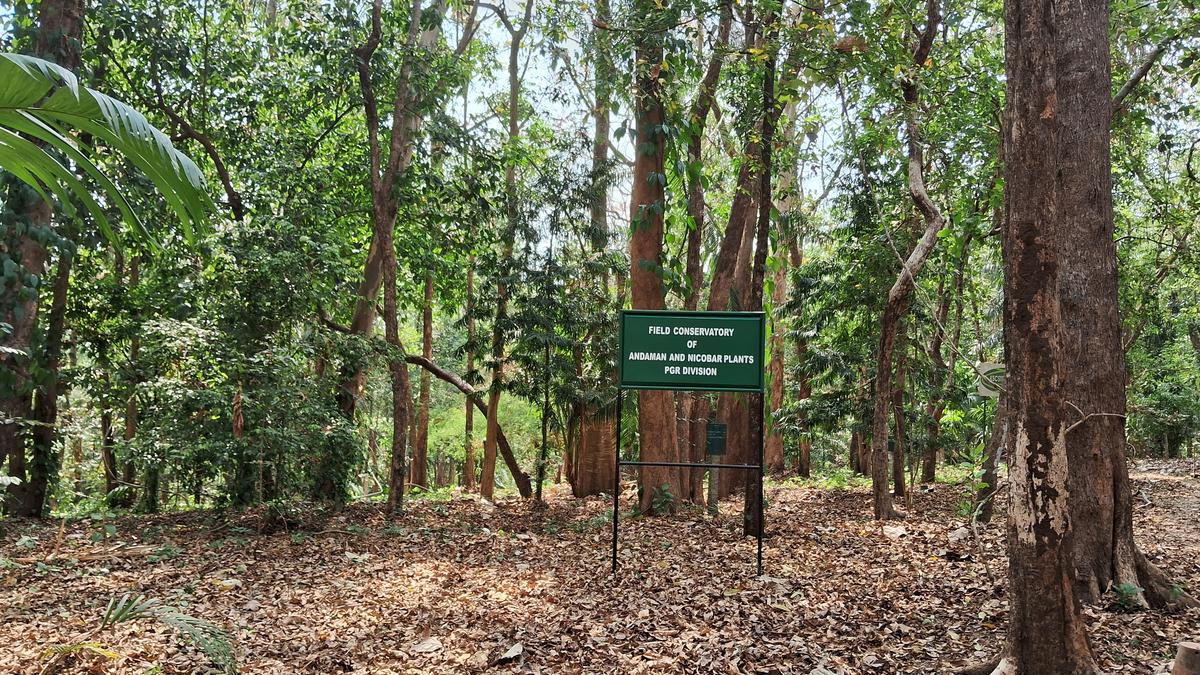
Stately-looking trees tower over the dense undergrowth of bushes and shrubs. Thick-stemmed lianas hang, snake-like, from low branches. For all that, to the casual observer, it could be just another wooded area.
Botanists would be quick to dispel the notion. The plant species in this sylvan location at Palode are, for the most part, extremely rare non-natives.
Nestled in the extensive grounds of the Jawaharlal Nehru Tropical Botanic Garden and Research Institute (JNTBGRI), this 30-acre sprawl has been a second home to Andaman and Nicobar flora since 1994. The sea, perhaps, is the only thing missing here from their original home. The ‘Field Conservatory of Andaman and Nicobar Plants,’ located in the foothills of the Western Ghats, is at the heart of a new JNTBGRI project to develop a biorepository on plant diversity specific to the Andaman Islands.
The JNTBGRI, which won the coveted Global Genome Initiative for Gardens (GGI-Gardens) award for 2024 this month, will use the money to conserve 41 Andaman species (across 40 genera and 27 families) at the proposed biorepository.
Over half of the genera are novel to the Global Genome Biodiversity Network. The primary goal, according to the institute, is to “collect, store, and preserve samples from significant plant families and genera for research and conservation.” The 41 species include several that are threatened, endemic or valued for their medicinal properties. The facility will be established with the help of GGI-Gardens, the Botanic Gardens Conservation International (BGCI) and the United States Botanic Garden (USBG), Anurag Dhyani, a scientist with the institute’s Plant Genetic Resource (PGR) Division, said.
“We will be conserving the plant materials. Leaf samples, for instance, will be preserved at a temperature of (-)80 degrees Celsius. Herbarium specimens will be deposited at the JNTBGRI herbarium,” Dr. Dhyani, who is Project Investigator along with K. K. Sabu, said.
Established in 1994, this ‘Field Conservatory’ has helped conserve scores of species some 1,700 km from their island home, S. Pradeep Kumar, Director (in-charge), JNTBGRI, told The Hindu. On the 30 acres, the JNTBGRI lovingly maintains 170 species under 120 genera belonging to 60 families. Many of them, like the Bentinckia nicobarica and the Pinanga andamanensis, are rare, endangered or endemic to the Union Territory.


Diya Chitale and Manav Thakkar reach semifinals, while Yashaswini Ghorpade upsets top seed Sreeja Akula at National TT Championships.

DYFI criticizes A.P.'s job calendar for failing unemployed youth, demanding a revision to include 1 lakh posts and higher age limits.

‘Lethargic’ officials who left Chambal sanctuary to the mercy of sand miners will be held liable: SC
Supreme Court holds negligent officials accountable for enabling illegal sand mining in Chambal Sanctuary, emphasizing habitat protection laws.

Work on the Srisailam Left Bank Canal tunnel resumes after 13 months, with completion targeted by 2027-end, says Minister Reddy.

Ancient ‘Vanni’ tree at Sri Meenakshi Sundareswarar Temple tilts; steps on to restore it

Bengaluru Metro penalises 14 passengers for disrupting services with loud singing, following a viral clip of their antics.

ASR district plans a 122 km world-class trekking network, enhancing tourism and local employment across Araku, Paderu, and Lambasingi.

Development without impact: Coastal residents of Kanniyakumari and Nagercoil constituencies voice discontent

Environmentalists in Kakinada celebrate World Sparrow Day, urging conservation efforts for sparrows and migratory birds.

T.K. Govindan secures full support from K. Sudhakaran for Kerala Assembly polls 2026 as a UDF-backed Independent candidate.

Karnataka implements weekly reviews and control rooms to combat rural drinking water shortages during the summer months.

BJP leads candidate selection for upcoming bypolls, while Congress faces internal challenges and community pressure in Bagalkot and Davangere.

A man died in a Kolkata hospital lift, prompting accusations of negligence against the West Bengal government and hospital authorities.