'It's a paperweight now': Why the Mounties' ban of popular rifle led to so much pushback
CBC
When it comes to Canada's often tense debate around gun laws, most Canadians likely will not have heard of an RCMP database called the Firearms Reference Table, or FRT.
But to people like Melody Philistin, unexpected updates to this database have a personal impact.
"Yeah. It really sucks," she said.
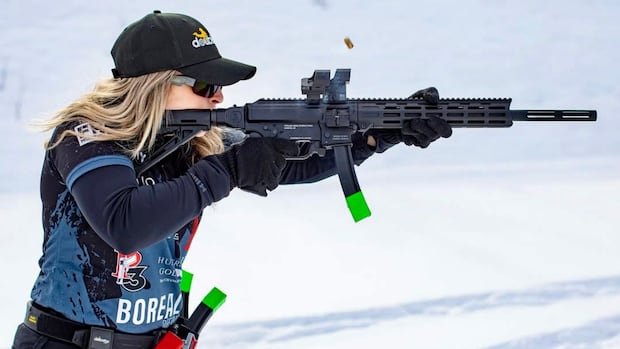
Philistin is a competitive shooter who recently represented Canada at an international event in the Czech Republic.
After one of her firearms was banned last year, she trained for the competition using the Sterling Arms R9 MK1, a semi-automatic nine-millimetre rifle.
"We were using those religiously to practice," she said.
Earlier this month, Philistin learned that the rifle had been classified in the FRT as prohibited. Prohibited firearms cannot be legally used, sold, imported, or transferred to another individual.
"It's just a paperweight now. It just sits there," she said.
"There's nothing we can do. What sucks is that [the R9 MK1] was kind of the last hope for [pistol-calibre carbine shooting] in Canada."
The decision blindsided J.R. Cox, the head of the Calgary-based firearms company Sterling Arms International, forcing his company into what he described as "crisis mode." He had to lay off five of his seven employees and had already shipped R9 MK1 units to dealers when the prohibition hit.
So what is the FRT, and why are both gun manufacturers and gun control advocates pushing for the rules to change?
The FRT is a database used by the RCMP to help classify firearms. That classification determines whether a gun is non-restricted, restricted or prohibited.
Technically, the FRT isn't a legal instrument, but instead just an internal RCMP tool based on definitions set out in the Criminal Code and Firearms Act. But in practice?
"It's both the law and not the law," said A.J. Somerset, the author of Arms: The Culture and Credo of the Gun.


Saskatoon city hall administration is planning to "refresh" the funding strategy for the proposed $1.2-billion downtown arena district amid a lack of commitments from higher levels of government.

A report of fraud tied to a walleye derby is under investigation after Montreal Lake Cree Nation said a participant allegedly violated derby rules and was asked to leave the fishing area.

An Edmonton architectural firm says it is in talks with the provincial government to potentially redevelop the former Royal Alberta Museum.

Does junior football have a future in Prince George?

People are descending upon the city for the dozens of events and live music performances this week as the Juno Awards are set to take place Sunday at Hamilton's TD Coliseum.

For nearly two decades, Amanda Loewen's world ended where the pavement did.

The notion that home ownership guarantees financial security in old age is being challenged by a recent survey.

The family of Nash Prystie has identified him as the man who died in an Ontario Provincial Police (OPP) shooting earlier this month north of Kenora, and is calling for more and quicker help for people with mental health challenges.

Playoff action in the Ontario Hockey League gets underway Thursday night for Guelph and Friday in Kitchener.

UPEI wants its faculty to sign on to an updated version of its sexual assault and discrimination policy, but the union that represents the school's academic staff says it wants the policies to be part of its collective agreement.

In Texas this week for a global energy conference, the federal natural resources minister is proclaiming "Canada is back" and ready to bolster its energy sector and grow exports.

Members of Parliament last year went on the fewest sponsored international trips in the last 15 years, excluding the height of the COVID-19 pandemic.

Ontario is running out of time to beef up rules that would crack down on negligent and misbehaving municipal politicians ahead of the next civic election, some experts and opposition critics warn.