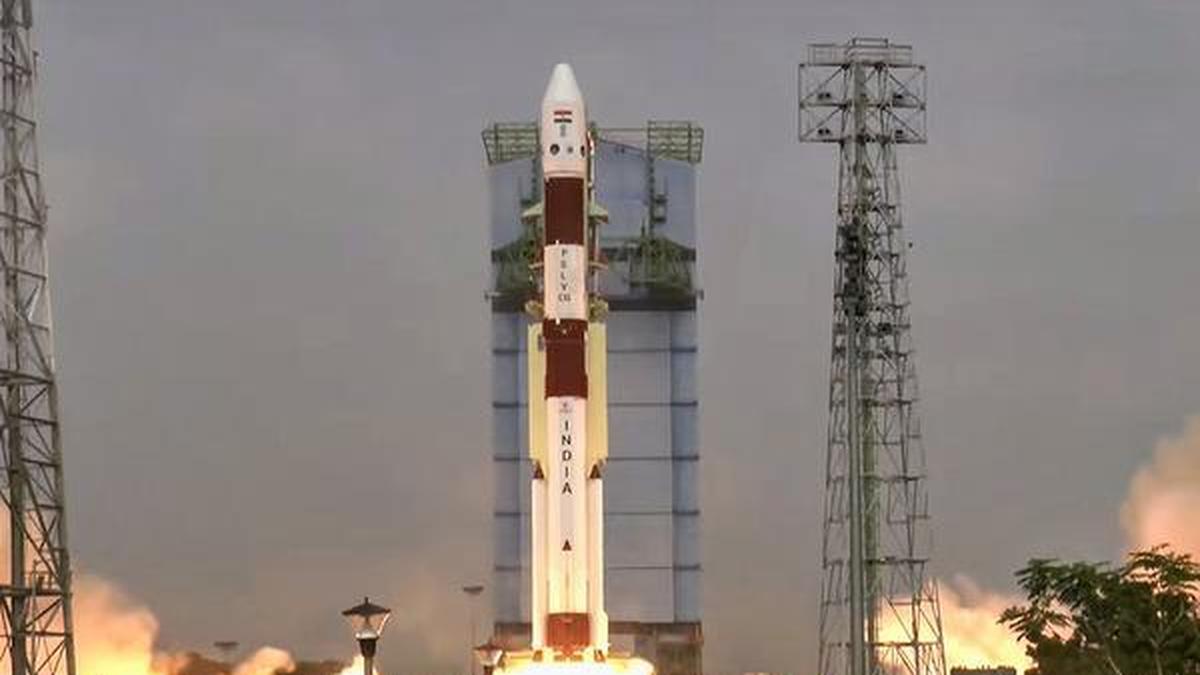
Investigation into PSLV failures ‘ongoing’, next launch date in June: Minister
The Hindu
Investigation into PSLV failures continues, with ISRO targeting a June launch date amid ongoing analysis and external involvement.
The investigation into the causes behind the consecutive failures of the Indian Space Research Organisation’s (ISRO) Polar Satellite Launch Vehicle (PSLV) is ongoing, and an external team is also involved in the probe. But none of the companies that had satellites onboard the doomed rockets have expressed reservations over their reliability. ISRO is considering a fresh launch date in June, the Union Minister of State for Science and Technology, and Space, Jitendra Singh, said at a press briefing on Monday (February 2, 2026).
On January 12, the PSLV C-62 failed its mission to deliver 16 satellites into orbit, and crashed into the sea after the third stage of the rocket failed to ignite. This was similar to the May 18, 2025 failure of the PSLV (C-61), in which, too, the third stage failed to fire, destroying as a result the EOS-09 satellite intended for the government’s strategic needs.
ISRO’s historical response to rocket failures has been to have a Failure Analysis Committee probe the reasons for failure, and publicise its findings. This, however, has not taken place in the case of both of these rockets.
The PSLV is ISRO’s most successful satellite launch vehicle, and since 1993, has had an over 90% success rate, placing nearly 350 satellites into their intended orbits.
Dr. Singh appeared to suggest that the underlying causes of the two mishaps were different. “What happened last time has not happened now. (As an analogy), say, the light has gone off. The last time it happened because a bulb had fused. This time, it tripped,” Dr. Singh said..
“It isn’t that we (ISRO) are so unwise that we could not detect the reason for failures…this time, we are having a third party [appraisal] to create confidence, though we have expertise within ISRO for such analysis. Our probable next [launch] date, which we are ambitiously targeting, is June, after we satisfy ourselves that the problem is rectified. This year, we have 18 launches scheduled, with six of them involving private sector satellites. None have withdrawn their request to launch…this means, trust is intact. Next year, we have three big foreign launches — Japan, the United States, and France, and none have shown apprehension. That means our credibility is intact,” Mr. Singh said.


Witness the blood moon during the lunar eclipse day in India and other countries, through pictures here.

Discover the fascinating world of hydroxyl megamasers, powerful cosmic lasers revealing secrets of distant galaxies and the universe's evolution.

Discover how India's unique resources could lead to groundbreaking advancements in global cancer care and research.

Discover groundbreaking research on Mars lightning, innovative smart materials, and a universal ageing marker in just one minute.

A launch vehicle’s ascent battles gravity to gain orbital velocity, while re-entry is a controlled struggle against the atmosphere to systematically shed that immense kinetic energy through aerobraking, thermal protection and precise guidance within the re-entry corridor. Operating as a semi-ballistic body, the crew module performs a deorbit burn, manages communication blackout, and deploys a three-stage parachute system to ensure a safe splashdown.

The Nissan Gravite is a budget-friendly seven-seater MPV designed for practical family use in India. Sharing its platform with the Renault Triber, it offers flexible 2-to-7 seating, a removable third row, generous boot space, and a fuel-efficient 1.0-litre petrol engine delivering around 19 km/l. With features such as a floating touchscreen, wireless connectivity, digital instrument cluster, and six airbags as standard, the Gravite blends affordability, safety and everyday usability in a compact footprint tailored to urban and small-family needs.

Discover the dedication of Tamil Nadu's teenage cyclists competing at the Track Asia Cup, balancing sport and academics.

Explore how Salar de Pajonales in Chile serves as a vital Mars analogue for studying microbial life and ancient fossils.

NASA revamps its Artemis lunar program to address delays and ensure a Moon landing by 2028.