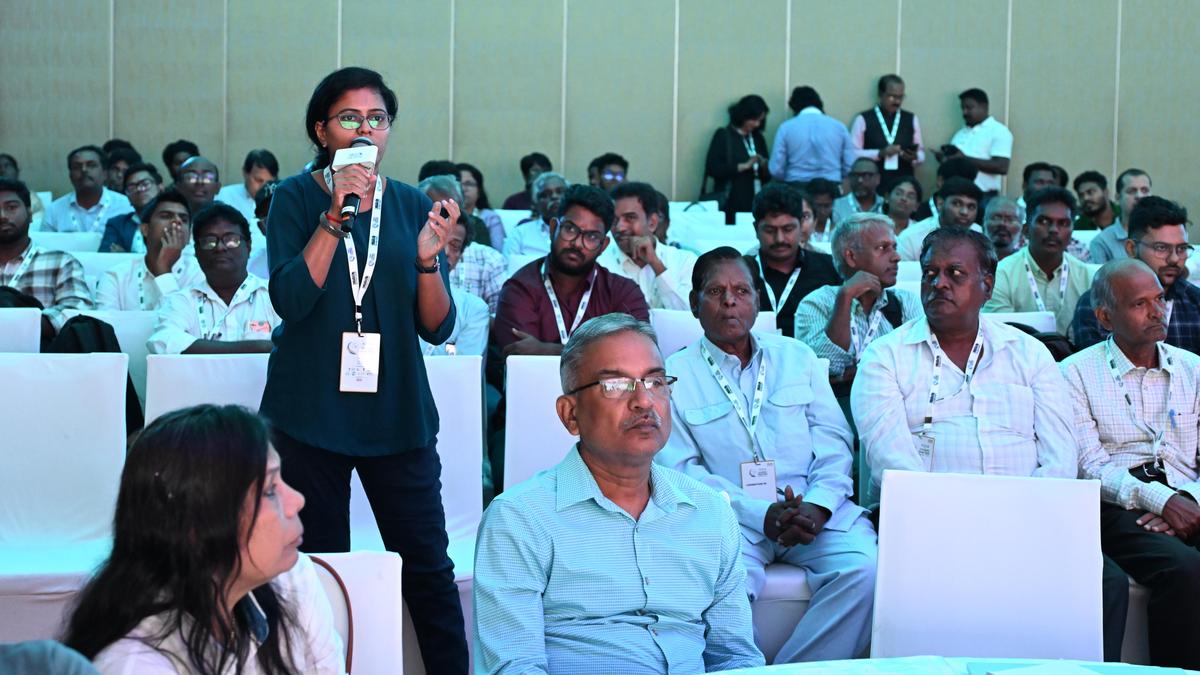
Industrialists push for academia–industry integrators at Deep Tech summit
The Hindu
Industrialists and academia discuss bridging the gap at The Hindu Deep Tech Summit, emphasizing collaboration for industrial agility.
At The Hindu Deep Tech Summit 2026, a candid conversation unfolded around a familiar yet unresolved question: why does the gap between academia and industry persist?
Organised in collaboration with SRM Institute of Science and Technology, the panel titled “The Symbiotic Lab: Re-engineering Academic Research for Industrial Agility” was held on Monday. The session brought together both legacy industry and startups — Gowri Kailasam, Prasad Maganti, T. R. Parasuraman and Dinesh Arjun — for an insightful discussion moderated by John Xavier, tech editor at The Hindu.
For T. R. Parasuraman, GD Naidu Chair Professor at SRMIST and former president and whole-time director of Toyota Industries Engines India Pvt.Ltd, the contradiction is structural. “Industry looks at the short term, academia at the long term,” he said, pointing to a mismatch that often leaves ideas stranded at the proof-of-concept stage. In a country powered by nearly 6.8 crore MSMEs, this disconnect is not just academic; it directly shapes India’s manufacturing ambitions.
Yet, the tone was not pessimistic. Panellists agreed that the past decade has seen a quiet but important shift. Mr. Arjun, CEO of EV motorcycle startup Raptee, talked about how entrepreneurship itself has evolved over the past decade. “Commercialisation was not even part of student thinking earlier,” he noted, adding that students today are building products that have the potential to enter real markets.
Still, friction remains. Ms. Kailasam, CEO of Rane Madras Limited- SLD & LMCD, offered a candid industry view: companies are often racing to solve immediate problems but fail to define them clearly. “We don’t take the time to articulate today’s problems, yet expect answers from academia,” she said. Universities, in contrast, tend to focus on futuristic research that may not translate into immediate applications.
What is needed, several panellists suggested, is a middle ground—one built on co-creation rather than transaction. Mr. Maganti, CEO at Titan, emphasised that research and development can no longer be optional and that industries must actively identify problems across their operations and work with academia to solve them.


Telangana Tourism's A. Vani Prasad emphasises activating underutilised infrastructure to enhance public engagement and visitor experiences.

As the Kerala Assembly polls approach, campaign fervor peaks in Angamaly, highlighting intense competition between UDF and LDF candidates.

Kerala Assembly Elections 2026: LDF aims to maintain dominance in Kozhikode while UDF seeks to revive its political presence.

Naidu prioritizes water conservation in Andhra Pradesh with a 100-day action plan to transfer surplus water to drought-prone Anantapur.

Rehman Patel receives the Kalaa Turuvam Award for his contributions to visual arts at a Chennai ceremony.

100 candidates file nominations for eight Assembly segments in Tiruppur district on final day

Secunderabad Cantonment Board will directly collect property transfer tax at 5% from June 1, amid calls for rate reduction.

UTP Advances Across Key Disciplines in QS World University Rankings By Subject 2026 – Petroleum Engineering Among World’s Top 10

Government ensures continuous monitoring of gas supply systems to maintain adequate stocks and prevent panic buying, officials say.

GBA Chief Commissioner directs Bengaluru Traffic Police to initiate towing of abandoned vehicles and improve road maintenance ahead of monsoon.

When commuters enter Kattankulathur station premises along GST Road, they are greeted by an overpowering stench. As the toilet complex is locked, commuters relieve themselves in the open, filling the air with that stench. Commuters and pedestrians have to cross a stormwater drain network . This path is littered with trash and is also slippery, forcing the public to perform dangerous maneuvers to cross without getting their legs wet. A new FOB would provide safe passage for both rail commuters and the general public. Commuters have asked Southern Railway officials to inspect the station premises.

Pawan Kalyan announces ₹37.25 crore upgrade for Pithapuram railway station under the Amrit Bharat Station Scheme, enhancing passenger amenities.

Governor Gehlot emphasizes education's vital role in life during Haveri University's inaugural convocation, inspiring graduates to dream big.