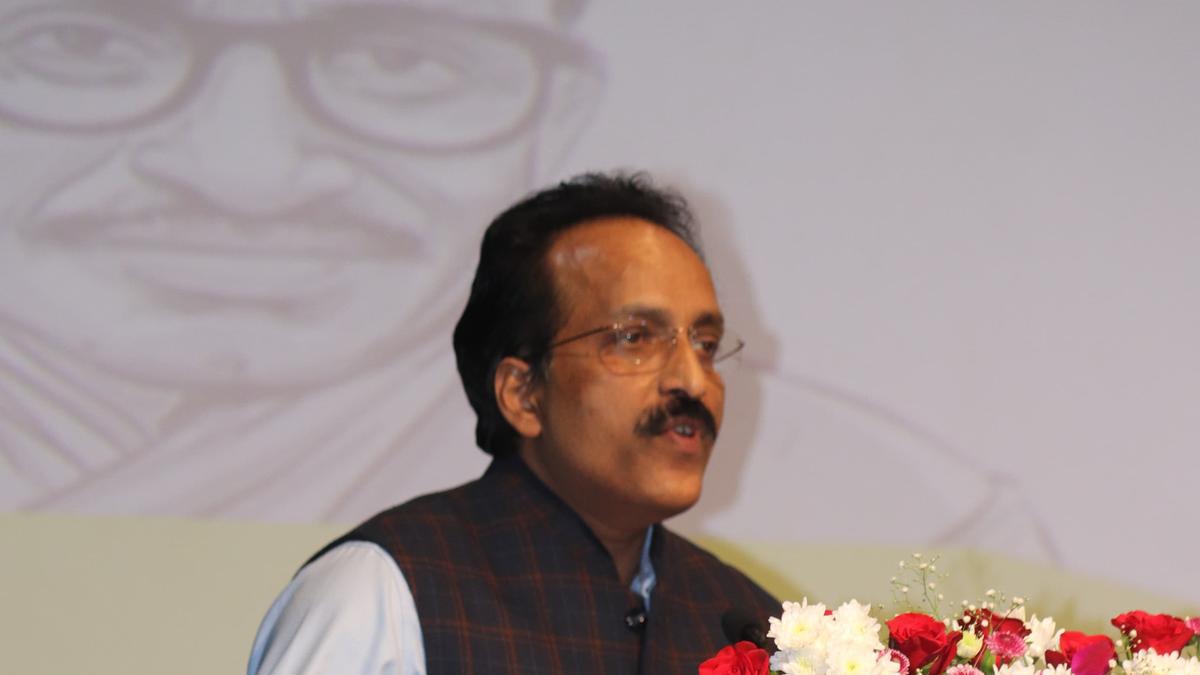
India has had a strong foundation in science over the centuries, says ISRO director
The Hindu
Journalist Praful Ketkar said that Indian thought was rooted in science since the beginning. Long before the 16th century scientists told us that the Earth was not flat, Indians described it was Bhoogola, or a spherical object. Geography was among the subjects taught by rishis in the guru kula system.
The strong foundation of science laid in India over the centuries has led to its growth in the last five decades in science and other areas, according to S. Somanath, Director, Indian Space Research Organisation.
Mr. Somanath spoke at a two-day symposium in Belagavi on January 3 on the theme of ‘Ektamat Manav Darshan’, held at the KLE Centenary Convention Center, in collaboration with Prabuddha Bharat and Rani Channamma University Pandit Deen Dayal chair.
“We have been seeing that India has been able to make many scientific achievements in the last 4-5 decades. This is because of the strong foundation laid since ancient times. India had achieved immense success in metallurgy 2,500 years ago. Our country was the leader in architecture, urbanisation system, administrative decentralisation, and economic situation. Our knowledge heritage of ayurveda, yoga, and architecture has made a unique contribution to the progress of the world,” he said.
“Due to such early advancement, India continues to achieve great things, despite 600 years of slavery. India’s contribution to mathematics is immense. Due to the contribution of the Indian numeral system and zero, mathematics has developed to this level around the globe. The Roman numeral system has many shortcomings. But Indian mathematics is so efficient that we can count up to infinity,” he said.
Journalist Praful Ketkar said that Indian thought was rooted in science since the beginning. Long before the 16th century scientists told us that the Earth was not flat, Indians described it was Bhoogola, or a spherical object. Geography was among the subjects taught by rishis in the guru kula system.
Mr Ketkar, the Editor of Organiser magazine, said while innovation was a means of money making in the West, in India it is aimed at social welfare and universal progress. The two economic ideologies of capitalism and communism are not compatible with India’s economic and social system. “These are advocated and practised by several countries in America, Russia and Europe, which call themselves progressive. India has evolved its own economic system over the centuries,” he said. Despite continued neglect of Indian culture and economic system, the country remains a united progressive global force to reckon with. “Colonial powers tried to divide the country based on language and regional disparities. But India remained one,” he said.
He said that the concepts of secularism and feminism had evolved in Western countries to counter the overarching interference of the church in layman’s affairs. “Priests overruled kings and women had no freedom. However, in India, all such issues were addressed as science was combined with philosophy and spirituality,” he said.


Abhishek Banerjee challenges BJP's Suvendu Adhikari in Nandigram, pledging community health initiatives if Trinamool Congress wins.

Rising LPG shortages in Karnataka boost firewood demand, reviving an informal market as households and hotels seek alternatives.

Against the backdrop of intense poll activity, a 400-metre stretch of an arterial road in the outskirts of Chennai (technically in Madurapakkam panchayat under Tambaram assembly constituency) presents a salute to the idea of res publica, which underpins India’s system of governance, where citizens have a say, at least before a government is securely ensconced in the seat of power. A Republic Day initiative shines bright every night

Fadnavis claims zero FIR in Ajit Pawar crash is a defamation attempt by Karnataka against Maharashtra's investigation efforts.

Set to unfold as a one-day pop-up on April 5, the Easter Sadya brings together both vegetarian and non-vegetarian menus, offering a peek into the food traditions of the Syrian Christian (Nasrani) community. While the traditional Sadya is often associated with dishes such as sambar, avial, and rice, this version expands to include community-specific festive dishes.

BJP nominates mother of R.G. Kar victim Abhaya to contest from Panihati in West Bengal Assembly elections.

Veteran Malayalam actor-director E.A. Rajendran passes away at 71, leaving behind a rich legacy in the film industry.

Dakshina Kannada Zilla Panchayat has rolled out digital mode of water bill generation and collection in 23 gram panchayats on a pilot basis for the first time in Karnataka. This is set to be extended to the remaining 200 panchayats shortly, according to the Zilla Panchayat Chief Executive Officer Narwade Vinayak Karbhari.

Bengaluru police questioned a man carrying ₹6 lakh for medical expenses at Vidhana Soudha, later releasing him after verification.

BJP accuses Bengaluru's Congress government of corruption in e-Khata issuance, halting infrastructure projects due to financial mismanagement.

Misinformation in Hyderabad sparks panic buying, causing disruptions as residents react to unfounded rumors of an impending lockdown.

Bengaluru Metro extends services until 2 a.m. on March 28 for IPL match, ensuring convenient travel for spectators.

A bus truck-collision in Andhra Pradesh's Markapuram district, killing several. Catch LIVE updates here!