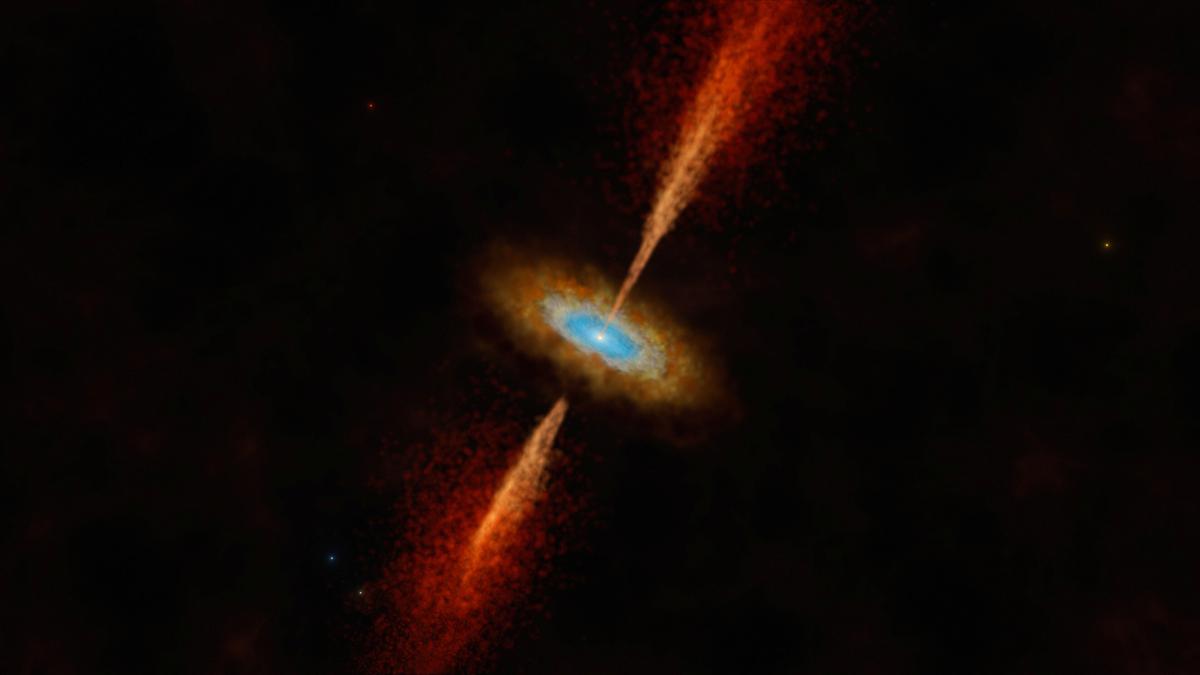
In a first, a newborn star's spinning disk is seen in another galaxy
The Hindu
Researchers said they have spotted such a disk around a star larger and more luminous than the sun residing in one of our nearest neighbouring galaxies, the Large Magellanic Cloud.
Our sun and other stars form when a dense clump of interstellar gas and dust collapses under its own gravitational pull. Once a star is born at the center of such a cloud, leftover material forms a swirling disk around it that feeds stellar growth and often gives rise to planets.
Newborn stars with these circumstellar disks had been observed by astronomers only in our Milky Way galaxy - until now. Researchers said on Wednesday they have spotted such a disk around a star larger and more luminous than the sun residing in one of our nearest neighboring galaxies, the Large Magellanic Cloud.
The star, growing and accreting material from the surrounding disk, is about 10 to 20 times more massive than the sun and perhaps 10,000 times more luminous.
As material is drawn by gravity toward a forming star, it flattens into a spinning disk. The newly observed disk has a diameter of about 12,000 times the distance of the Earth to the sun, or roughly 10 times larger than the one that encircled the sun when it formed approximately 4.5 billion years ago.
The star, which also is unleashing a large jet of material into space, is around 160,000 light years from Earth. A light year is the distance light travels in a year, 5.9 trillion miles (9.5 trillion km).
"This is very exciting," said astronomer Anna McLeod of Durham University in England, lead author of the study published in the journal Nature.
"While we know of many stars like this one being formed in the Large Magellanic Cloud and other galaxies, we have never before observed a circumstellar accretions disk outside of the Milky Way, mainly due to lacking technology. Observing these disks in other galaxies is very important because it tells us about how stars form in environments different from that of the Milky Way," McLeod added.


First randomisation of EVMs and VVPATs for Tiruchi and Perambalur districts completed with political party representatives present.

Puducherry elections see ongoing DMK-Congress rift over seat-sharing, leading to candidate conflicts on nomination day.

Einstein College and Sri Sarada College in Tirunelveli celebrated significant events, honoring academic excellence and cultural heritage.

Priyanka Gandhi criticises PM Modi's West Asia remarks, urging for a comprehensive Parliament discussion on the matter.

Learn who can vote by postal ballot in the upcoming Tamil Nadu Assembly election, including seniors and persons with disabilities.

Decomposed body of a missing 25-year-old man discovered in Dindigul stone quarry, prompting calls for investigation and quarry closure.

SVEEP activities launched in The Nilgiris aim to boost voter turnout at 13 polling booths with low participation rates.

Learn who can vote by postal ballot in the upcoming Tamil Nadu Assembly election, including seniors and persons with disabilities.

Shorts News:Watch: UDF linked to communal forces in Kerala: CPI(M) leader A Vijayaraghavan

Karnataka government postpones Deendayal Upadhyaya event at KSOU Mysuru due to protocol violations and lack of government involvement.

Sameer Wankhede denies bribery allegations involving Shah Rukh Khan’s son in drugs case during Bombay High Court proceedings.

What does it take to design gloves, masks and uniform that factor in the various challenges faced by workers on the waste beat? Indore, Bengaluru and Pune have an answer

Gaurav Gogoi files nomination for Jorhat Assembly seat, marking his electoral debut in the upcoming Assam elections.