IIT Delhi researchers design AC to slash power bills from 1200W to 800W
India Today
IIT Delhi researchers have developed an innovative add-on module for conventional air conditioners that reduces electricity consumption by nearly 33 percent. By separating cooling and dehumidification using a membrane–liquid desiccant system and recycling waste heat, the technology cuts power use from 1200W to 800W while maintaining indoor comfort.
As temperatures soar and power demand reaches seasonal highs across India, a breakthrough from the Indian Institute of Technology, IIT Delhi, could offer major relief to households and the national power grid.
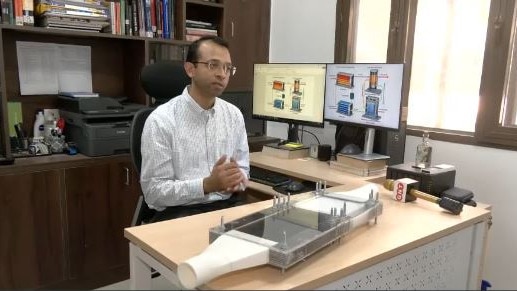
Researchers led by Professor Anurag Goyal from the Department of Mechanical Engineering have developed an innovative add-on module for conventional air conditioners that can cut electricity consumption by nearly one-third, without compromising indoor comfort.
Most air conditioners used today rely on a vapour-compression system that performs two functions at the same time: cooling indoor air and removing humidity (dehumidification). To extract moisture, the system must overcool the air below the desired room temperature so that water vapour condenses into liquid on the cooling coils.
Although this method effectively controls humidity, it is highly energy-intensive because the AC works harder than necessary simply to manage moisture levels. As a result, users often lower thermostat settings to maintain comfort, electricity bills increase, and peak power demand surges during extreme summer months.
On average, a standard room AC consumes about 1200 watts during operation.
Prof. Anurag Goyal's research group has developed a compact add-on module that directly tackles moisture, instead of forcing the AC to overcool the air.


The US and China are in the middle of an AI race. Elon Musk believes that China will win this race, although he says that when it comes to space his own company SpaceX will be the ultimate AI winner.

A video has gone viral on social media that shows a humanoid robot in a restaurant that decides to give up work to dance. The robot creates such chaos that even the restaurant's staff is unable to stop it.

Screen addiction is no longer just a Gen Z problem. According to recent studies and reports, elderly are now spending just as much, if not more, time on smartphones, TVs and social media. Researchers say this rising screen time among boomers and retirees may also have serious effects on their health.


Meta has announced a new programme where it will pay you to post on Facebook. The Mark Zuckerberg-led firm will shell out up to $3,000 (roughly Rs 2,78,000) per month if you have a big following on YouTube, Instagram or TikTok.

Nothing CEO Carl Pei believes that the way we use smartphones is about to change. Users may no longer need apps as AI agents will be able to do everything we need on our phones in the future.


Researchers have found a new spyware targeted at iPhones called DarkSword. DarkSword is said to be able to instantly hack vulnerable iPhones and steal user data, potentially putting hundreds of millions of devices at risk. Here are all the details.

Short kurtas paired with loose pants and dupattas were a big trend in the 2000s Bollywood, and now, they seem to be catching on in the West too.

Meta is scaling back its plans for a metaverse. The Mark Zuckerberg-led firm has announced that the company will be shutting down the Horizons World app from VR by June this year. This announcement comes after the company laid off workers from the Reality Labs division that was responsible for its metaverse projects.

Paul McCartney's last solo album, McCartney III (2020), recorded during the pandemic, topped UK charts, marking his first solo number one since 1989, showcasing his creative freedom and personal musical expression.

ICAI CA Final January 2026 results have been declared today, March 1. Candidates who appeared for Group 1 and Group 2 exams can now check their scorecards, merit list and All India Rank holders on the official website, icai.nic.in. Direct result link is now active.

The OnePlus 15T is set to make its debut in China next week. The compact smartphone boasts a 6.32-inch AMOLED display and will be available in three colour options at launch.