Hundreds of tests planned, working to get crew module from outside India: ISRO’s Somanath on Gaganyaan Premium
The Hindu
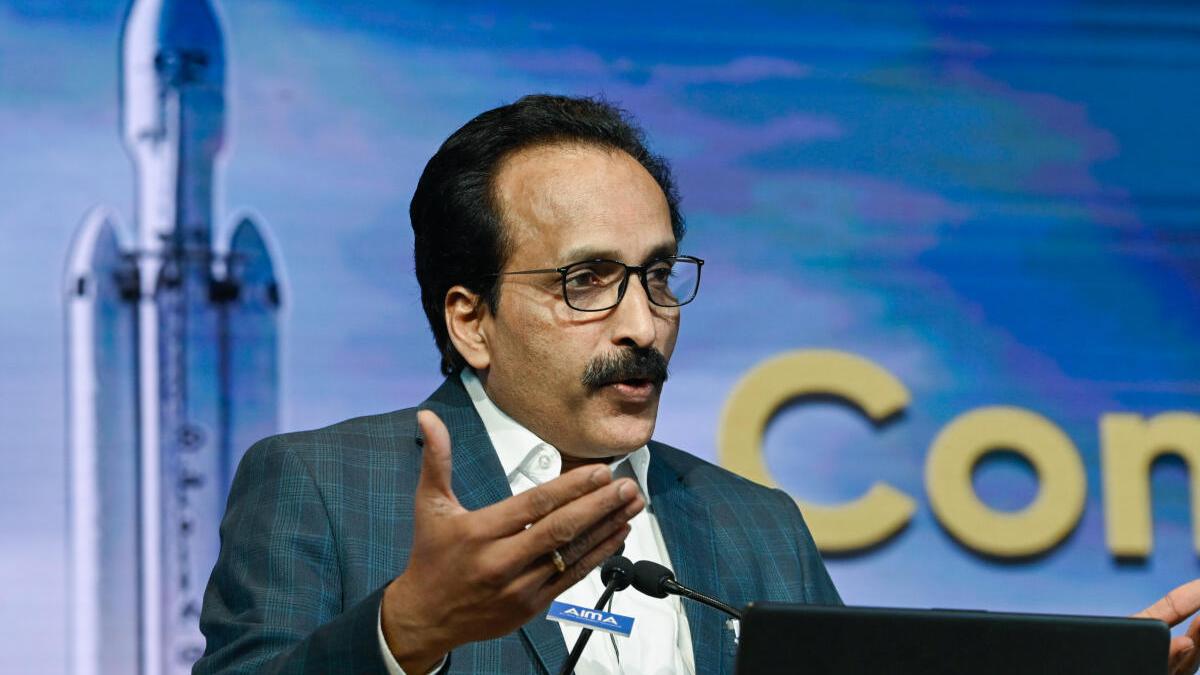
ISRO will test its Crew Escape System (CES) on Oct. 21, 2023, to ensure astronauts' safety in case of a launch vehicle malfunction. The test will use a single-stage rocket powered by liquid propellants, and the mission will be uncrewed. ISRO Chairman S. Somanath spoke of the mission, the crew module, and preparations for the human spaceflight programme. Tests include helicopter-based, test-vehicle-based, rocket-based, abort tests, unmanned, robotic missions, and more. ISRO will decide how many people to send in the first mission, but it will take time to ensure safety.
In a crucial step in India’s ambitious programme to lift its astronauts into space, the Indian Space Research Organisation (ISRO) will test its crew escape system (CES) on October 21, 2023. The flight, from Sriharikota, will test if the CES can protect the astronauts should the launch vehicle malfunction. ISRO has designated this mission TV-D1.
According to an ISRO statement, the test will begin between 7 a.m. and 9 a.m. When the launch vehicle – fit with the crew module and the CES – reaches a velocity of 1.2 Mach and an altitude of 17 km, an abort command will be issued. The module with the CES will separate from the rocket and deploy a series of parachutes, and eventually splash down in the Bay of Bengal, where Navy personnel will recover it. The whole sequence will be uncrewed.
In the ultimate mission that will hoist the astronauts into a low-earth orbit in 2024 or 2025, the rocket will be the Launch Vehicle Mark-3 (LVM-3). But that on October 21 will be a single-stage rocket powered by liquid propellants. It was purpose-built for the TV-D1 mission and wheeled to the launch pad on October 15.
ISRO Chairman S. Somanath spoke to T.S. Subramanian for The Hindu about this test, the crew module, and preparations for the human spaceflight programme, a.k.a. ‘Gaganyaan‘. Excerpts from the interview follow:
You will be soon testing the crew escape system of the Gaganyaan project, which will ultimately take the Indian astronauts into space. Have you made the LVM-3 rocket more powerful to carry the big crew module?
Gaganyaan has many, many elements [and] components. The rocket is one part of it. The rocket LVM-3, which will take the crew to orbit, is being strengthened. The process of strengthening it is already completed. That is called the ‘human rating’ of the vehicle. It is already over. All systems and engines have been tested and confirmed. So our rocket – human-rated – is virtually completed.
There is another element called the crew module and the crew escape system. The new crew module is under development. It is being tested. There is no capability in India to manufacture it. We have to get it from outside. That work is currently going on.


Discover efficient pressure cooking techniques to save up to 50% on fuel. OPOS B Ramakrishnan tells you how

Mercedes-Benz CLA 250+ with EQ Technology review: design, performance, range and features explained. Discover how the new electric CLA combines advanced AI, long range, fast charging and futuristic styling for the next generation of luxury EVs.

Pi Day is celebrated every year on March 14, honouring the significance of the mathematical constant π and its applications in mathematics.

Discover how sculptural interior design transforms modern spaces, blending creativity and functionality to evoke emotion and identity.

A study reveals that certain antibiotics can cause long-lasting changes in gut microbiome diversity for up to eight years.

Indian scientists and international experts are divided over a study questioning the viability of a nuclear reactor fuel called HALEU-thorium; while critics cite safety risks, proponents argue the technology is vital to achieve national energy goals.

ISRO and AIIMS partner to enhance space medicine research, focusing on human health during long-duration space missions.

A practical guide to induction setups for students, families, and home food businesses as India’s LPG supply faces its biggest disruption in years

Explore the electrifying Oscars 2026 race, featuring standout films, baffling nominations, and memorable performances amid a cinematic transition.

Zai and Rom Whitaker’s latest book for young readers, The Book of Indian Snakes, tackles common misconceptions surrounding snakes, highlighting their utility to humans

Discover PC Mahalanobis's pivotal role in India's statistical revolution and his lasting influence on modern statistics in this episode.

Explore why nothing can exceed light speed and the paradoxes that arise if it were possible.

Scientists have engineered bacteria to produce designer proteins by smuggling artificial amino acids, enabling precise drug delivery and multifunctional applications.