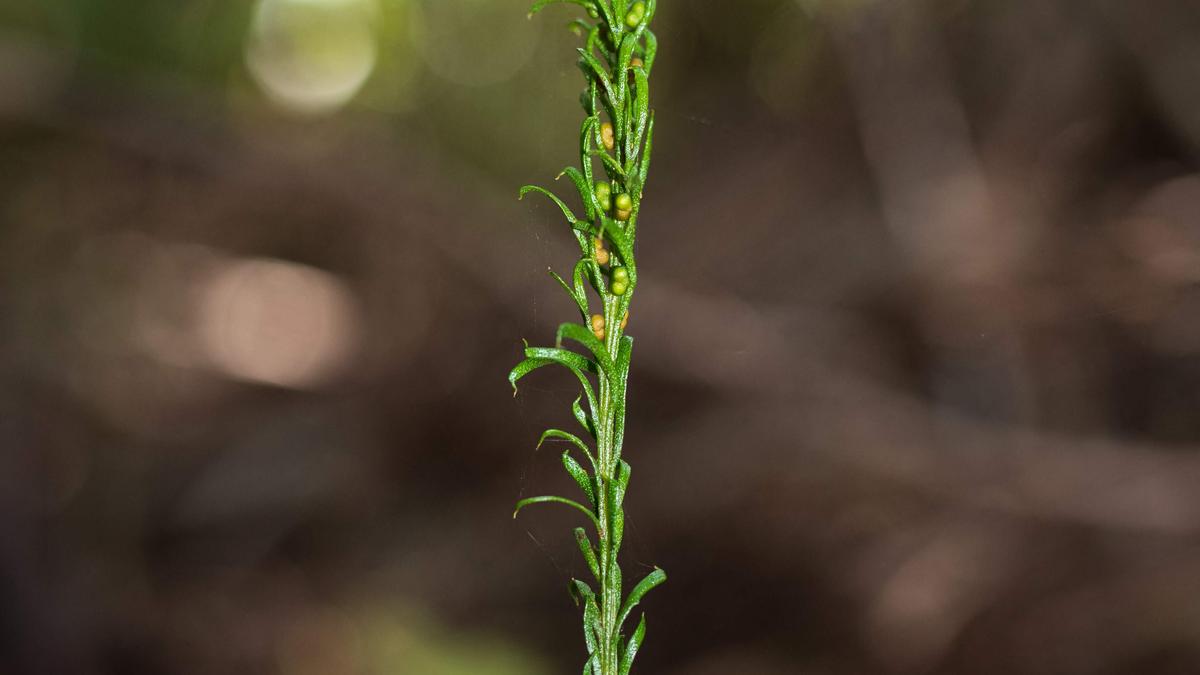
Humble fern from New Caledonia boasts world's largest genome
The Hindu
New research shows that fork fern species, called Tmesipteris oblanceolata, has a genome that is 7% larger than that of the previous record-holder
New research shows that a fork fern species, called Tmesipteris oblanceolata, has a genome — all the genetic information of an organism — that is 7% larger than that of the previous record-holder, the Japanese flowering plant Paris japonica, and more than 50 times the size of the human genome.
The metric for genome size was the number of base pairs, the fundamental units of DNA, in an organism's cellular nuclei. If stretched out like from a ball of yarn, the length of the DNA in each cell of this fern would extend nearly 350 feet (106 meters), taller than New York's Statue of Liberty, the clock tower for London's Big Ben or India's Taj Mahal. The human genome would extend a mere 6-1/2 feet (2 meters).
The fern grows primarily on the ground or atop fallen tree trunks in New Caledonia, about 750 miles (1,200 km) east of Australia, and on neighboring islands such as Vanuatu.
"We can tell you that this species is not very showy. It is a small plant, typically 10-15 centimeters (4-6 inches) in height, which could easily go unnoticed to anyone who's not specifically looking for it," said evolutionary biologist Jaume Pellicer of the Botanical Institute of Barcelona (IBB), co-lead author of the study published on Friday in the journal iScience.
The specimens used in the study were collected last year on New Caledonia's Grande Terre Island. Its leaf-like structures are not true leaves, but rather flattened stems. It belongs to a fern family whose evolutionary lineage split from other ferns around 350 million years ago, approximately 120 million years before dinosaurs appeared.
A large genome is not considered beneficial.
"We think that Tmesipteris oblanceolata has such a large genome not for any evolutionary advantage but simply because, for a reason that we do not know yet, it has failed over time to efficiently remove non-functional or redundant DNA sequences," Pellicer said.


Abhishek Banerjee challenges BJP's Suvendu Adhikari in Nandigram, pledging community health initiatives if Trinamool Congress wins.

Rising LPG shortages in Karnataka boost firewood demand, reviving an informal market as households and hotels seek alternatives.

Against the backdrop of intense poll activity, a 400-metre stretch of an arterial road in the outskirts of Chennai (technically in Madurapakkam panchayat under Tambaram assembly constituency) presents a salute to the idea of res publica, which underpins India’s system of governance, where citizens have a say, at least before a government is securely ensconced in the seat of power. A Republic Day initiative shines bright every night

Fadnavis claims zero FIR in Ajit Pawar crash is a defamation attempt by Karnataka against Maharashtra's investigation efforts.

Set to unfold as a one-day pop-up on April 5, the Easter Sadya brings together both vegetarian and non-vegetarian menus, offering a peek into the food traditions of the Syrian Christian (Nasrani) community. While the traditional Sadya is often associated with dishes such as sambar, avial, and rice, this version expands to include community-specific festive dishes.

BJP nominates mother of R.G. Kar victim Abhaya to contest from Panihati in West Bengal Assembly elections.

Veteran Malayalam actor-director E.A. Rajendran passes away at 71, leaving behind a rich legacy in the film industry.

Dakshina Kannada Zilla Panchayat has rolled out digital mode of water bill generation and collection in 23 gram panchayats on a pilot basis for the first time in Karnataka. This is set to be extended to the remaining 200 panchayats shortly, according to the Zilla Panchayat Chief Executive Officer Narwade Vinayak Karbhari.

Bengaluru police questioned a man carrying ₹6 lakh for medical expenses at Vidhana Soudha, later releasing him after verification.

BJP accuses Bengaluru's Congress government of corruption in e-Khata issuance, halting infrastructure projects due to financial mismanagement.

Misinformation in Hyderabad sparks panic buying, causing disruptions as residents react to unfounded rumors of an impending lockdown.

Bengaluru Metro extends services until 2 a.m. on March 28 for IPL match, ensuring convenient travel for spectators.

A bus truck-collision in Andhra Pradesh's Markapuram district, killing several. Catch LIVE updates here!