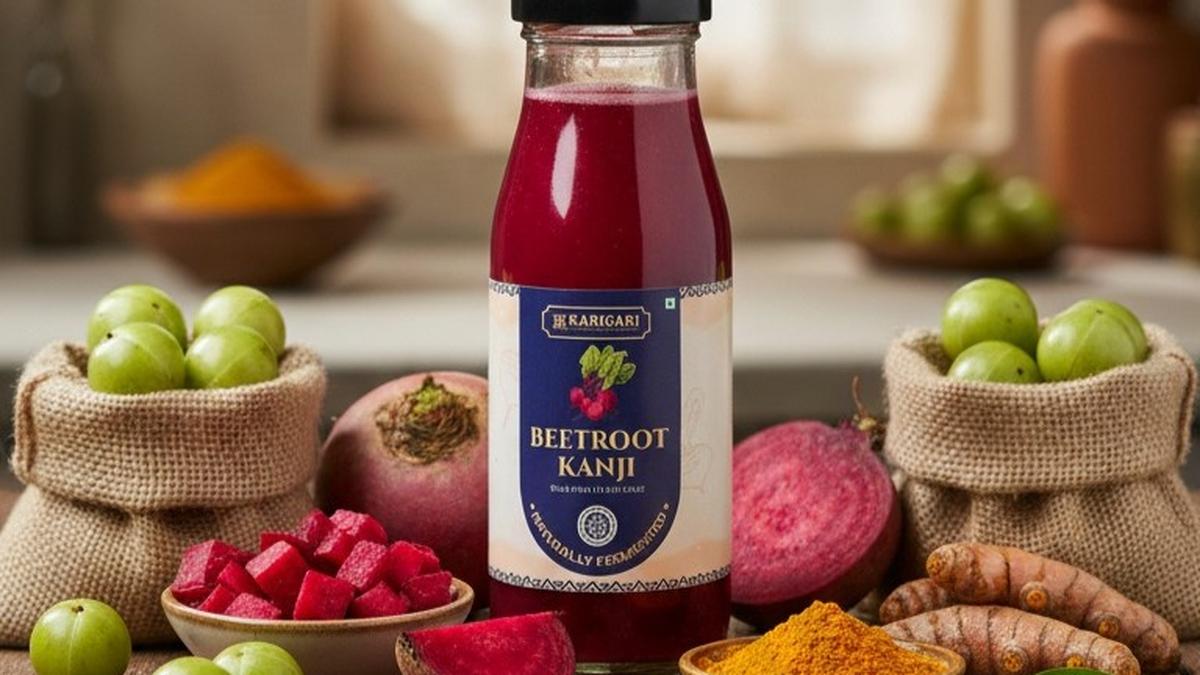
How Harpal Sokhi’s Karigari is letting kanji travel beyond winter
The Hindu
Discover how Chef Harpal Sokhi's Karigari makes traditional kanji accessible year-round with innovative flavors and natural fermentation.
Long before probiotics became part of the global wellness vocabulary, Indian kitchens were fermenting their way to gut health. Kanji, a sharp, mustard-forward winter drink made with black carrots, was a staple across North Indian homes, prepared in large jars and consumed in measured quantities.
At Karigari, chef and restaurateur Harpal Singh Sokhi is extending this familiar winter ritual into a year-round offering. By bottling and retailing kanji across the restaurant’s outlets in Delhi-NCR, he is among the first in the restaurant space to take the traditional fermented drink into a takeaway format.
For Harpal , the idea is deeply personal. “I still remember my mother making kanji in large earthenware and glass jars at home,” he says. “She would keep refilling them through the season. You were never meant to drink large quantities, about 200 ml a day was enough.”
Kanji has appeared on Karigari’s menu for several years now, introduced every winter as a seasonal offering. With the brand’s strong footprint in North India, the drink taps into memories that feel familiar for many diners. “It’s traditional, it’s regional, and it immediately connects with people,” Harpal says. “Many of them have grown up with it.”
From a winter ritual to a restaurant offering
The decision to bottle kanji, however, didn’t begin in winter. The first experiment started in September last year, well before black carrots entered the market. The absence forced a rethink. “Traditionally, kanji is made with black carrots, and that remains the most authentic version,” Harpal explains. “But if we wanted this to exist beyond a short winter window, we had to look at ingredients that are available through the year.”


Anna University partners with Ramco Systems to create an advanced ERP lab for enhanced industrial engineering education.

NDA announces candidates for 12 Kozhikode seats in Kerala Assembly polls 2026 as UDF and LDF ramp up campaigning.

As India formulates its next steps in the Israel-U.S.-Iran war, it is necessary to consider not only what it will mean for the whole region but also its own ties with each neighbour

CITU criticizes the Centre's privatization efforts for VSP, alleging employee removal over production increase and financial mismanagement.

Visakhapatnam Customs House's short film "Right Turn" wins Honourable Jury Mention at the 10th Indian World Film Festival.

Economist Arvind Subramanian advises CM Revanth Reddy on strengthening Telangana's finances during a meeting in Hyderabad.

Supreme Court emphasizes stakeholder consultation for legal education reforms, hesitant to change five-year law course duration.

Authorities in Andhra Pradesh are set to tranquillise a roaming tiger near Annavaram temple for safety and conservation.

MEA criticizes USCIRF for bias, urging focus on vandalism of Hindu temples in the U.S. over selective criticism of India.

Bengaluru's Urban Development aims to beautify underutilized flyover spaces, enhancing city aesthetics and improving green cover initiatives.

Indian Navy warships escort merchant vessels in the Gulf of Oman, ensuring safe passage amid regional tensions under Operation Sankalp.

A rare crab species exhibiting both male and female traits was discovered in Silent Valley, revealing unique biological characteristics.

Gujarat court convicts five in 2016 Una flogging case; punishment announcement scheduled for March 17, 2026.