How Braille calendars are a lesson in accessibility for the visually challenged
The Hindu
On this World Braille Day, let’s see how the Kerala Federation of the Blind produces free Malayalam Braille calendars to improve accessibility for visually challenged community.
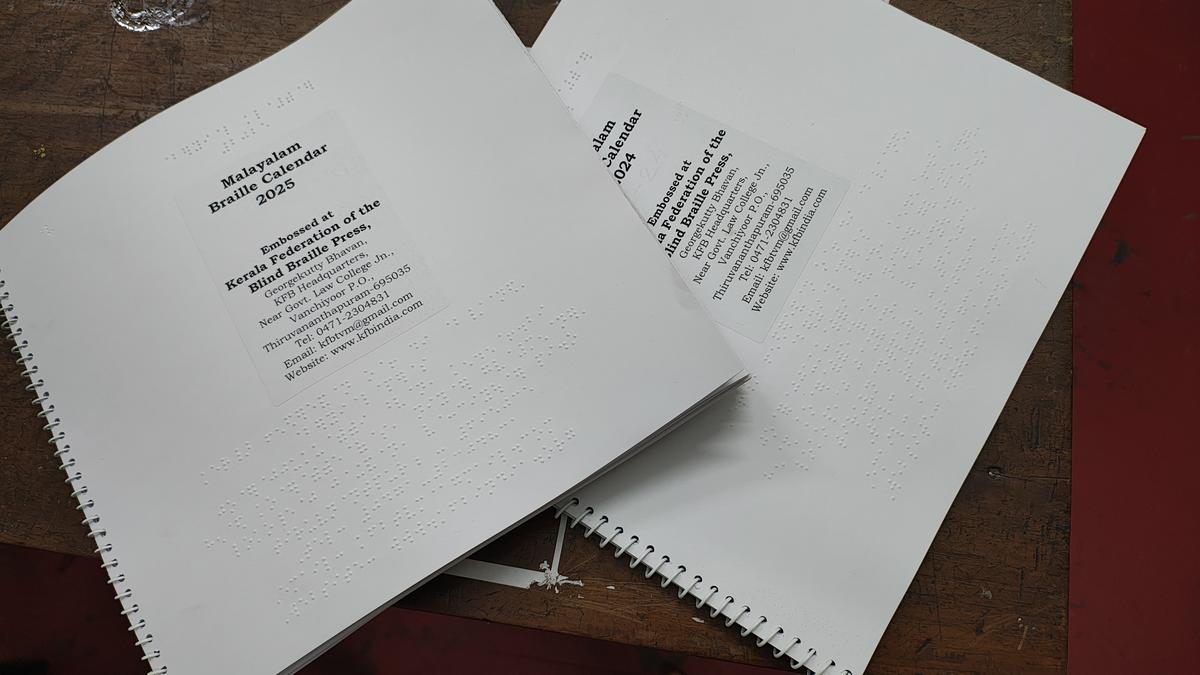
In the basement of the Kerala Federation of the Blind (KFB)‘s office near Law College Junction in Thiruvananthapuram, two large printing press, manufactured in Europe, take up most of the room. A roll of paper weighing nearly 200 kilograms with a thickness of 140 grams per square meter (GSM) is fed into the white press, with metal bars placed in front of it to hold the sheets in place. After the command to print is given from a connected desktop computer, the sheet of paper slides into the machine with a whirring noise. Within a few seconds, sheets of white paper emerge from the other end of the press, with no ink, but embossed with dots of various permutations and combinations, arranged in a grid with 42 characters in each of the 27 lines on a page.
This is how KFB produces its Malayalam Braille calendars using its state-of-the-art press. The calendars are available free of cost to the visually challenged across Kerala, in a move to improve accessibility for the community in the State since last year.
“Calendars are essential to everyone. Even if you have calendars on your phone, you still hang them on the wall or keep them on your table,” says Habeeb C, president of KFB.
Braille is a universally accepted writing system for the visually impaired that uses raised dots to represent letters, numbers and other symbols. The dots are arranged in a specific pattern of six cells invented by Louis Braille in France in 1824. His birthday on January 4 is celebrated as World Braille Day since 2019 by the United Nations General Assembly
“Braille is just a skill for the visually challenged like writing and reading for others. Essentially, we should make use of its possibilities and that’s why we chose something as basic as a calendar,” says Habeeb, also a professor at Farook College, Kozhikode.
Founded on September 11, 1967, the KFB, which currently has 3,980 members, has championed their cause through a range of steps from training programmes to legal negotiations for policy changes. Claiming to be one of the biggest service delivery organisations of the visually impaired in Asia, the Federation has been responsible for printing Braille textbooks used across 12 schools for visually impaired children in Kerala since the 1980s, says Habeeb.
The two machines in Thiruvananthapuram were purchased with the help of the National Institute for the Empowerment of Persons with Visual Disabilities and the Ministry of Social Justice and Empowerment, Government of India. They have another press in Kannur. During the 2024 general elections, the press embossed 1,02,963 ballot papers for the visually impaired in the State.


Abhishek Banerjee challenges BJP's Suvendu Adhikari in Nandigram, pledging community health initiatives if Trinamool Congress wins.

Rising LPG shortages in Karnataka boost firewood demand, reviving an informal market as households and hotels seek alternatives.

Against the backdrop of intense poll activity, a 400-metre stretch of an arterial road in the outskirts of Chennai (technically in Madurapakkam panchayat under Tambaram assembly constituency) presents a salute to the idea of res publica, which underpins India’s system of governance, where citizens have a say, at least before a government is securely ensconced in the seat of power. A Republic Day initiative shines bright every night

Fadnavis claims zero FIR in Ajit Pawar crash is a defamation attempt by Karnataka against Maharashtra's investigation efforts.

Set to unfold as a one-day pop-up on April 5, the Easter Sadya brings together both vegetarian and non-vegetarian menus, offering a peek into the food traditions of the Syrian Christian (Nasrani) community. While the traditional Sadya is often associated with dishes such as sambar, avial, and rice, this version expands to include community-specific festive dishes.

BJP nominates mother of R.G. Kar victim Abhaya to contest from Panihati in West Bengal Assembly elections.

Veteran Malayalam actor-director E.A. Rajendran passes away at 71, leaving behind a rich legacy in the film industry.

Dakshina Kannada Zilla Panchayat has rolled out digital mode of water bill generation and collection in 23 gram panchayats on a pilot basis for the first time in Karnataka. This is set to be extended to the remaining 200 panchayats shortly, according to the Zilla Panchayat Chief Executive Officer Narwade Vinayak Karbhari.

Bengaluru police questioned a man carrying ₹6 lakh for medical expenses at Vidhana Soudha, later releasing him after verification.

BJP accuses Bengaluru's Congress government of corruption in e-Khata issuance, halting infrastructure projects due to financial mismanagement.

Misinformation in Hyderabad sparks panic buying, causing disruptions as residents react to unfounded rumors of an impending lockdown.

Bengaluru Metro extends services until 2 a.m. on March 28 for IPL match, ensuring convenient travel for spectators.

A bus truck-collision in Andhra Pradesh's Markapuram district, killing several. Catch LIVE updates here!