Holi war in Delhi Premium
The Hindu
Tensions escalate in Delhi's Uttam Nagar after a Holi-related brawl leads to a man's death and communal unrest.
Nyaya (justice) is a word that easily rolls off the tongues of residents of Hastsal colony in Delhi’s Uttam Nagar. Here, even children as young as 10 are in crowds baying for blood in the name of justice. The anger traces back to the night of Holi. On March 4, Tarun Bhutolia, 26, lost his life in a ‘clash’ between two families over a Holi water balloon.
What began as an escalation of violence between two families was soon painted with a communal colour, with Tarun’s death being portrayed as an assault on the Hindu community as a whole. While the police arrested six adults and apprehended a minor the next day, it did not deter an angry mob from vandalising the house of one of the accused men, and burning their vehicles. The same house would later face ‘bulldozer action’ by the Municipal Corporation of Delhi (MCD).
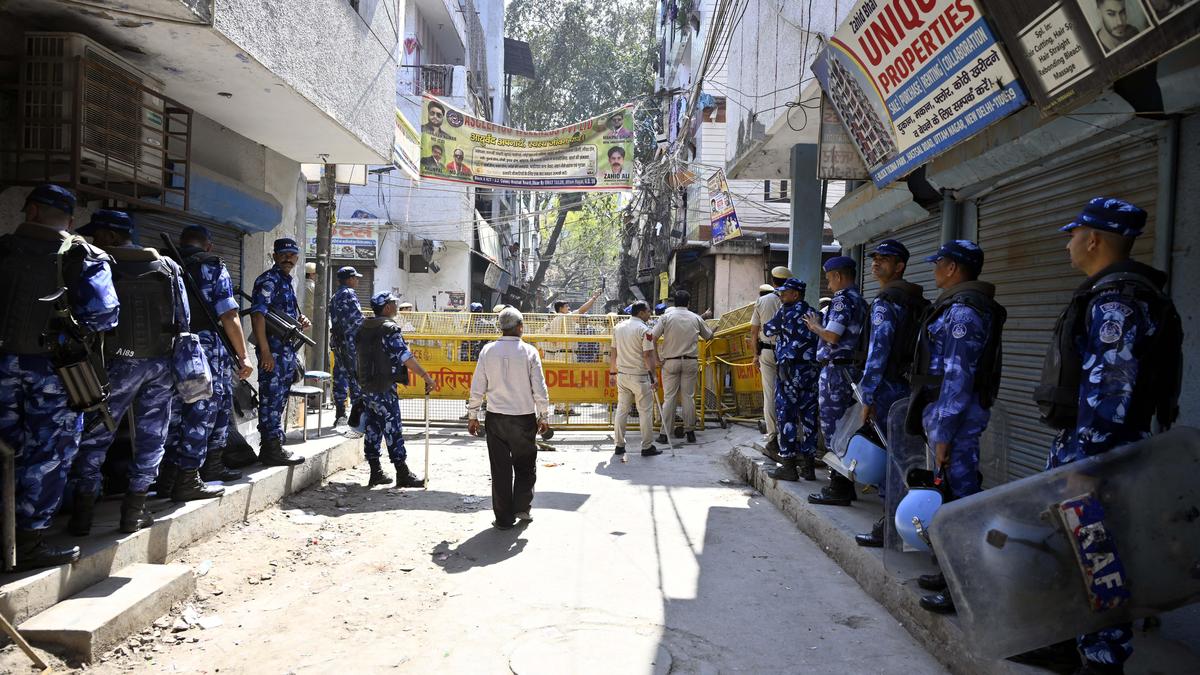
Since the day of the incident, police deployment in the area has remained constant. Even a week later, the 3-foot-wide lane where the houses of both families are located remained heavily barricaded with at least 10–12 Delhi Police personnel, along with members of the Rapid Action Force, keeping constant watch at both ends of the lane. The JJ colony (jhuggi jhopri or hutment) is closed to outsiders.
Residents must now take longer routes to the market; the shops within the colony are closed, and children are escorted to school by parents. Everyone is waiting for the situation to return to ‘normal’. Some residents are relieved: “It is good that the police are present. Anything can happen at any point. We feel safe when the police are there,” says Farzana. She adds that communities have lived in peaceful co-existence in the area for decades.
Tarun’s house in A-Block of the JJ colony saw visitors of all kinds: friends and relatives who came to offer their condolences, neighbours who helped with food and water, curious onlookers, politicians, and members of the Hindu right-wing organisations. Everyone called for ‘justice’; everyone called for blood.
With a heavy blue-black eye, Mamraj Bhutolia speaks softly, recounting the events of the day his son died. “A water balloon fell from the hands of an 11-year-old girl from the balcony on the second floor,” he says, pointing at a house opposite his. This was between 10.30 p.m. and 11 p.m. “A burqa-clad woman, whom we know as Kali or Sairu, was passing by when the balloon fell near her feet. She started making a fuss about it. Despite apologies, she did not stop,” Mamraj says.


Andhra Pradesh's Quantum Valley project aims to establish global leadership in quantum technology, enhancing agriculture, medicine, and more.

Union Minister announces Madurai airport's international status, boosting tourism, job creation, and economic growth in the region.

Experience bold Persian, Greek, and Turkish flavors at Kyra, Holiday Inn's vibrant restaurant offering exquisite dishes and lively ambiance.

Water supply disruptions expected in several Thiruvananthapuram wards due to a major pipeline leak; repairs ongoing.

Organs from a brain-dead youth in Coimbatore have successfully benefited six transplant recipients, highlighting the importance of organ donation.

Minister Dr. P. Narayana announces modernization plans for ASR Nagar slum in Visakhapatnam, ensuring proper housing and improved infrastructure.

A 37-year-old man was arrested near Katpadi for possessing 300 kg of gutka intended for local traders.

Chennai retailers prepare to stock kerosene oil as an alternative amid LPG supply issues, aiding commercial consumers during the crisis.

TNHDA urges Tamil Nadu government to release a white paper on Coldrif syrup linked to child fatalities in Madhya Pradesh.

Chennai police solve a four-year-old murder case, arresting the accused after extensive investigation and tracking.

Deputy CM Udhayanidhi Stalin distributes ₹100.49 crore in welfare aid, emphasizing education and housing initiatives in Tamil Nadu.

Toll rates at 66 Tamil Nadu plazas will rise by 5-7% from April 1, alongside an increase in Fastag pass fees.

Supreme Court requests a status report on Ganga bank encroachments and floodplain demarcation from the Centre and National Mission for Ganga Authority.